
PGA Frisco Fields Ranch: Course Review and Playing Guide
Par: 72 (both courses) | Yardage: 7,025 / 7,198 (tips) | Designers: Gil Hanse (East, 2023), Beau Welling (West, 2023) | Type: Public | Green Fee: $150–$275 | Walking: Permitted
When the PGA of America relocated its headquarters from Palm Beach Gardens, Florida, to a 660-acre parcel of former ranch land in Frisco, Texas, the organization made a statement about where it believed the center of American golf was moving. The campus, which opened in stages through 2023, houses two 18-hole courses, a 10-hole short course called The Swing, the Omni PGA Frisco Resort, a coaching center, and enough retail and dining square footage to suggest the PGA views this property as more than a home office. It is a public-facing declaration that golf can be both accessible and ambitious, built on terrain that would not appear on anyone's shortlist of great natural golf land.
That last detail is worth confronting directly. The fields north of Dallas are flat. Not rolling-but-we-call-it-flat. Flat in the way that North Texas is flat: horizon-line visible in every direction, barely a contour to interrupt the prairie. The degree to which each architect succeeded, and the different strategies they employed to do so, is what makes Fields Ranch worth studying.
The challenge facing Gil Hanse and Beau Welling was to build two courses that feel like genuine golf architecture rather than manufactured difficulty imposed on reluctant ground.
Where to stay in PGA Frisco
Planning the trip? Compare live prices across every nearby hotel and rental in one search.
Prices and availability from Booking.com, Expedia and others via Stay22. GolfTrailsHQ may earn a commission at no additional cost to you.
The Design Story
Gil Hanse, who designed the East Course, is known for restraint. His work at Merion (restoration), Streamsong Blue, and the 2016 Olympic Course in Rio de Janeiro reflects a preference for surfaces that present options rather than corridors that dictate play. At Frisco, Hanse moved roughly 1.5 million cubic yards of earth to create the topographic variation the site lacked naturally. That figure sounds excessive until you walk the East Course and register how subtle much of the shaping is. The fairways roll gently. Greens sit on platforms that feel integrated rather than placed. The bunkers are irregular in shape and positioned to create visual uncertainty about distance and angle. The land does not look as though it were pushed into place, which is the highest compliment one can pay earthmoving on a flat site.
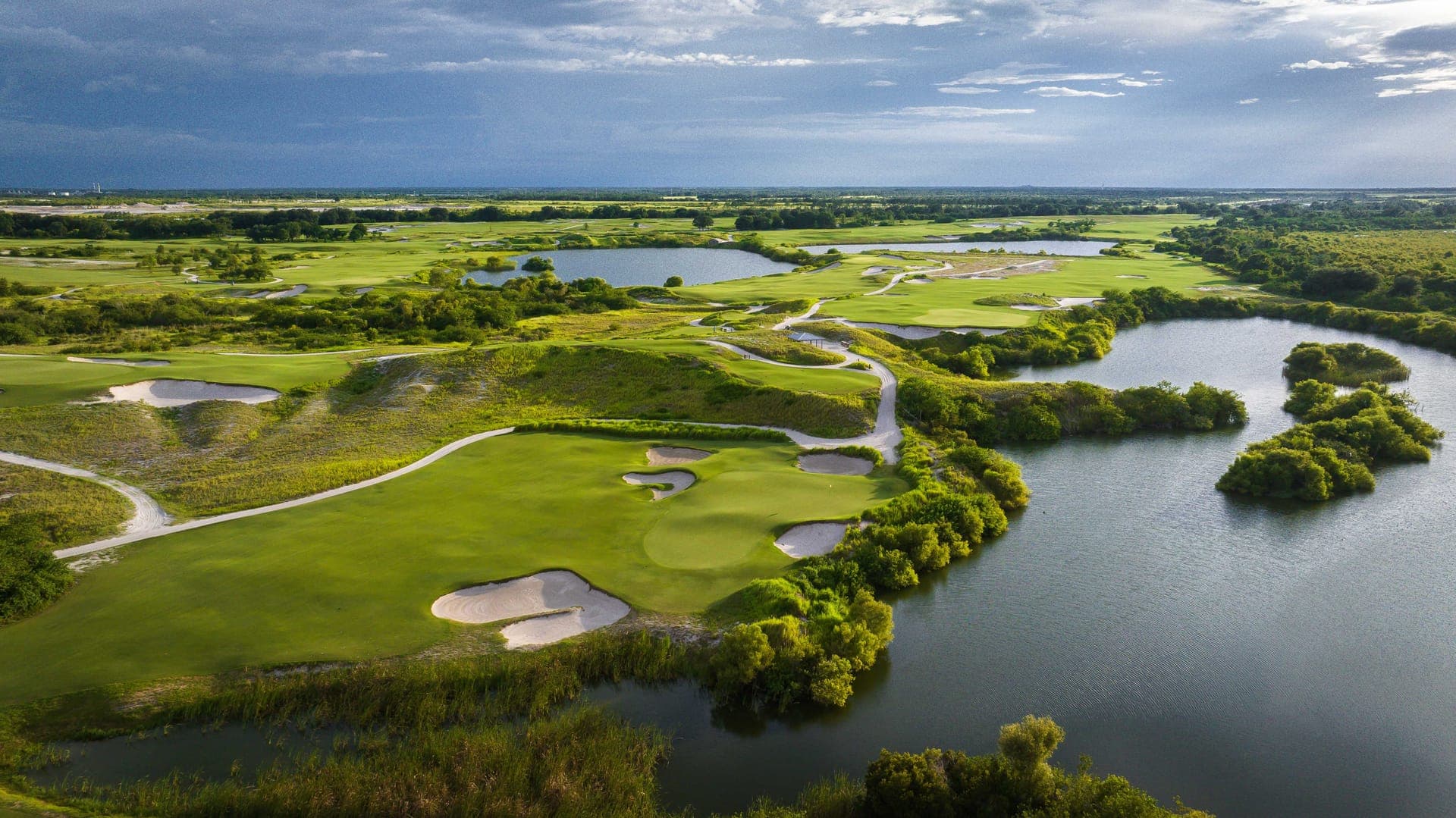
Streamsong Blue
Beau Welling took the West Course in a different direction. Where Hanse favored ground-level subtlety, Welling created more pronounced elevation changes and defined the holes with contouring that is legible from the tee. Water features appear on several holes, and the routing uses the property's creek corridors as strategic elements rather than decorative boundaries. The West Course reads more immediately as designed. Whether that is a virtue or a limitation depends on one's preferences regarding how visible an architect's hand should be.
Both courses use zoysia fairways and Bermuda rough, a combination well-suited to the North Texas climate. The turf quality during the growing season is consistently firm and fast, which rewards the ground game and compensates for the lack of dramatic natural terrain.
How They Play
Fields Ranch East opens with a series of holes that establish the visual language of the course: wide fairways, unpredictable bunker placements, and green complexes that demand attention to pin position. The par 4s are the strength of the routing. Several play at moderate length but use green contours and surrounds to make the approach the defining shot rather than the drive. The 7th, a par 4 that bends left around a cluster of bunkers, offers a risk-reward tee shot where the aggressive line shortens the approach but narrows the margin considerably. The greens on the East Course are Hanse's signature contribution. They are large, with internal slopes that create four or five distinct pin positions per green, each changing the character of the hole. A front-right pin and a back-left pin on the same green can produce two fundamentally different approach shots.
The par 3s on the East are varied in length and orientation. Wind plays a role here that casual visitors underestimate. The DFW corridor generates consistent afternoon winds, and on an exposed site with no tree cover to speak of, club selection on the short holes can shift meaningfully between morning and afternoon rounds.
Fields Ranch West presents a different proposition. The routing is more linear in its early holes, building toward the property's most dramatic terrain along the creek sections in the middle of the round. The par 5s on the West are stronger than those on the East, offering genuine three-shot strategy for mid-handicappers and layup-or-go decisions for longer players. The 13th, a par 5 that plays along water on the left, requires a series of committed shots where each one sets up the next. Bail-out areas exist, but they leave difficult angles to a green that slopes toward the hazard.
The West Course green complexes are somewhat more straightforward than Hanse's on the East, with less internal movement but more severe consequences for missing on the wrong side. The overall experience is more conventionally American in character, which makes the two courses complementary rather than redundant. Playing both in a single day reveals the contrast clearly.
The Swing, the 10-hole short course designed by Hanse, is worth a separate mention. Par 3s and short par 4s on a compact routing, it serves as both a warm-up facility and a standalone experience. The turf and green quality match the championship courses, and the holes are not trivial. For groups with mixed skill levels, or for an afternoon session after 18, it fills a role that more golf destinations should consider.
What the Green Fee Purchases
At $150 to $275 depending on season and day of week, PGA Frisco occupies a tier that invites scrutiny. The infrastructure is extensive. The clubhouse facilities, the practice areas, the on-course conditions, and the overall property maintenance reflect an organization that views this campus as its public identity. GPS-equipped carts are standard.
The practice facility is among the most comprehensive public-access ranges in the country.
The Omni PGA Frisco Resort connects directly to the golf campus, making multi-round stays logistically simple. Walk from the hotel to the first tee without a car. The PGA Frisco complete golf guide covers accommodation options and trip planning in detail.
What the green fee does not purchase is the sense of place that defines the great American golf destinations. There is no ocean, no mountain backdrop, no ancient dunes. The prairie has been shaped into golf land through engineering and design talent, and the result is impressive without being transcendent. That is an honest assessment, not a criticism. The courses play well, the conditions are excellent, and the campus delivers a complete golf experience. But visitors arriving from Bandon or Pinehurst expecting the landscape to carry emotional weight will need to recalibrate.
Practical Considerations
PGA Frisco sits approximately 30 miles north of Dallas, accessible via the Dallas North Tollway. Dallas-Fort Worth International Airport is roughly 40 minutes by car, and Dallas Love Field is closer for Southwest Airlines travelers. The PGA Frisco destination guide provides detailed logistics, including non-golf options in the surrounding area.
The North Texas climate is playable year-round, with the caveat that summer temperatures routinely exceed 100 degrees Fahrenheit. The most comfortable golf months are October through May. Spring and fall offer the best combination of weather and green fee value. Winter rounds are feasible, though dormant Bermuda rough and occasional cold fronts can alter course conditions.
Tip