Links Golf in America: Where to Find It
Links golf, in its purest form, exists on a specific kind of terrain: sandy soil deposited by retreating glaciers or oceans, covered in fescue grasses, exposed to coastal wind, and shaped over centuries by erosion. The linksland between the beach and the arable farmland. Scotland and Ireland have it in abundance. America has very little of it, and what it has tends to sit in places that require significant effort to reach.
That scarcity has not diminished American appetite for links golf. It has, if anything, intensified it. The past three decades have produced a generation of courses that either replicate links conditions on naturally suited terrain or adapt links principles to American landscapes. Some of these courses are genuine links by any reasonable definition. Others are links-inspired designs that borrow the philosophy without the precise geological conditions. Both categories contain exceptional golf.
Bandon Dunes: The American Links Capital
Any discussion of links golf in America begins and ends on the southern Oregon coast. Bandon Dunes Golf Resort sits on a stretch of coastal dunes above the Pacific that is, geologically and atmospherically, as close to Scottish linksland as anything on the American continent. The sandy soil, the fescue turf, the persistent wind, and the absence of trees on the ocean-facing holes create conditions that feel genuinely imported from the British Isles.
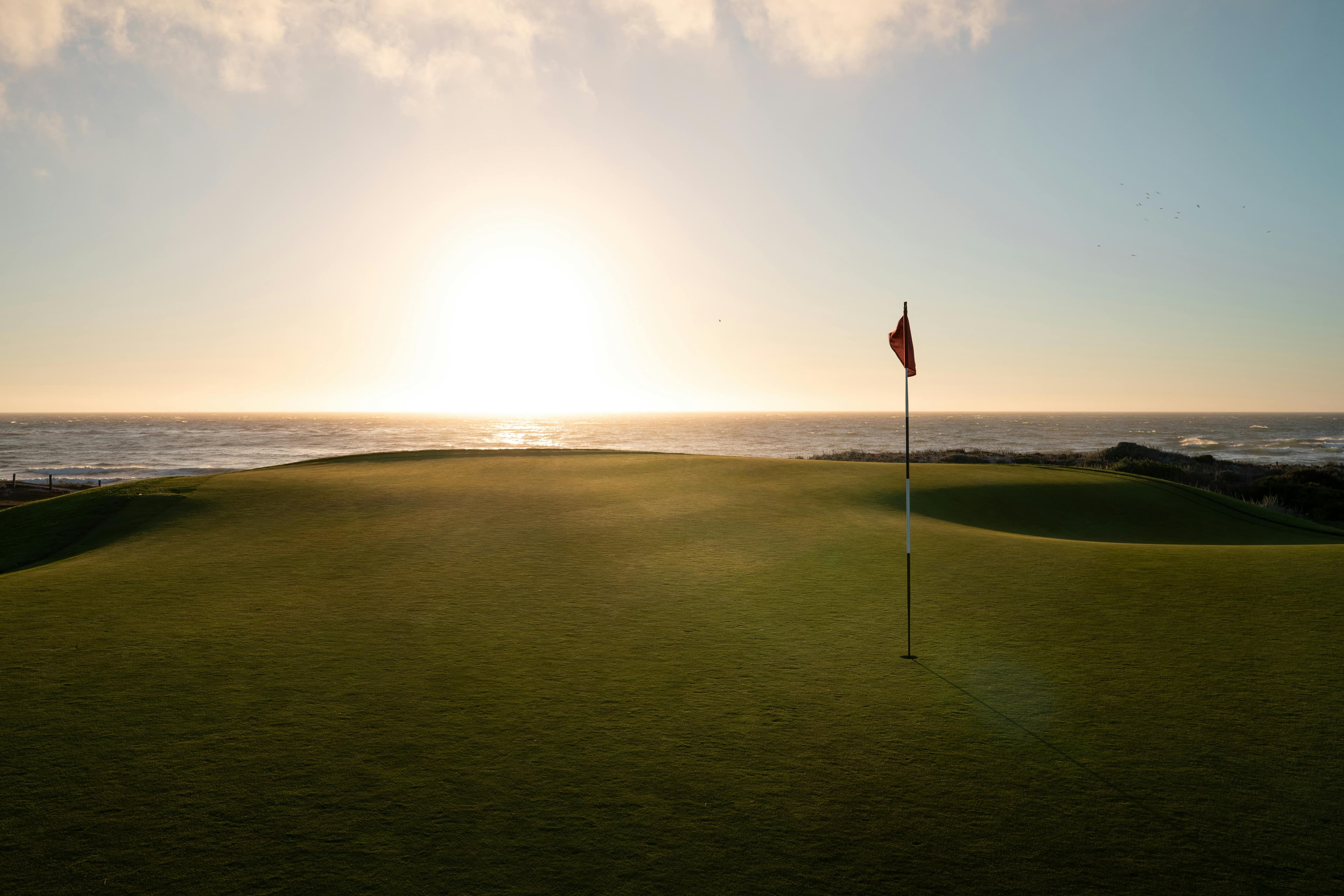
The Links at Spanish Bay
The Lido
Pacific Dunes, Tom Doak's masterwork on the bluffs above the ocean, is the course that most closely approximates links golf as played on the finest Scottish and Irish courses. The turf is firm and fast, the greens accept running approaches, the wind is a constant strategic factor, and the bunkers are deep-faced and placed to catch shots that the wind redirects. There is no irrigation on much of the course. The playing surfaces are maintained by rainfall and ocean mist, as links turf has been maintained for centuries.
Bandon Dunes, David McLay Kidd's original course, introduced the concept of American links golf when it opened in 1999. The routing runs along the cliffs and through the coastal scrub, and while the design is slightly more generous than Pacific Dunes, the conditions are equally authentic. Sheep Ranch, Coore and Crenshaw's open coastal design, adds a third course that plays almost entirely in the wind with minimal bunkering, trusting the ground contours and the elements to provide the defense.
Old Macdonald, Tom Doak and Jim Urbina's tribute to the template holes of C.B. Macdonald and Seth Raynor, completes the links collection. Its greens are enormous, its fairways are wide, and its design references are drawn from specific holes at the National Golf Links of America, North Berwick, and St. Andrews. It is links golf filtered through architectural history.
Getting to Bandon requires effort. The nearest commercial airport with direct flights is Portland, a five-hour drive north. Coos Bay has a small regional airport with limited service. The isolation is part of the experience and part of the reason the golf feels different from everything else in America. There are no condominiums, no real estate developments, no distractions. Just golf on links terrain, played at walking pace, in conditions that change with the weather.
Sand Valley: Links on Inland Dunes
Sand Valley in central Wisconsin occupies terrain that is not coastal but is, in its soil composition and topography, remarkably similar to linksland. The Wisconsin River deposited deep sand over millennia, creating a landscape of low dunes and sandy ridges that supports fescue grasses and drains as naturally as any links course in the world.
The Coore and Crenshaw course at Sand Valley plays firm and fast, with turf that bounces and rolls in the manner of Scottish links. Mammoth Dunes, David McLay Kidd's second major American design after Bandon Dunes, is built on a larger, more dramatic scale, with fairways that are among the widest in American golf. The Lido, Tom Doak's ambitious recreation of C.B. Macdonald's lost Long Island course, opened in 2023 and has been called the most significant new course in America in a decade.
Sand Valley is not links golf in the strict sense. There is no coast, no salt air, no ocean wind. But the playing conditions, the turf, the sandy soil, the ground-game possibilities, replicate the links experience more convincingly than any inland site in the country. The firm, bouncy fairways reward creative shot-making, and the greens accept the kind of running approaches that are standard on links courses and rare everywhere else in American golf.
Erin Hills: Championship Links in Wisconsin
Erin Hills, an hour north of Milwaukee, hosted the 2017 U.S. Open on a course built over glacial terrain that produces fescue-covered drumlin hills, natural drainage, and a wind exposure that mimics coastal conditions. The course is vast, stretching over 650 acres with virtually no trees, and the fescue rough that borders every fairway is the primary defense. When the USGA brought its championship here, Brooks Koepka won at 16-under par, which prompted debate about the course's difficulty. That debate misses the point. The conditions during that week were unusually calm. In wind, Erin Hills is a formidable test that rewards the ground game and punishes the golfer who relies solely on aerial play.
For visiting golfers, Erin Hills offers one of the most immersive links-style experiences in the Midwest. The course is walking-only, the landscape is treeless and expansive, and the round takes on a rhythm that is closer to Scottish golf than to the cart-driven American norm.
Whistling Straits: Manufactured Links
Pete Dye's Whistling Straits along Lake Michigan is links golf through force of will. Dye moved enormous quantities of earth to create a landscape that resembles the coastline of County Clare more than it does eastern Wisconsin. The fescue, the exposed sand, the shaggy dunes: all manufactured. The lake, which provides the wind and the visual drama of a coastline, is real.
Whether Whistling Straits qualifies as links golf is a question that architects and golfers have debated since it opened. The terrain is not natural linksland. The bunkers are constructed, not formed by grazing sheep. Dustin Johnson learned about the hazard definitions the hard way in 2010 when he grounded his club in what he thought was a waste area. It was a bunker. There are over a thousand of them.
But the playing experience, the wind, the firm turf, the visual drama of golf along a vast body of water, captures much of what makes links golf compelling.
Pacific Grove and the California Coast
On the Monterey Peninsula, Pacific Grove Golf Links is a modest municipal course that offers the closest thing to links golf on the California coast at an accessible price point. The back nine, which runs along the rocky shoreline of Point Pinos, plays in wind that comes directly off the Pacific, and the turf is firm enough in summer to reward bump-and-run approaches. It is not a championship course. It is an enjoyable, affordable round on genuine coastal terrain, and it provides a useful complement to the premium courses at Pebble Beach.
The Links at Spanish Bay, also on the Monterey Peninsula, is a more formal attempt at links golf on the California coast. Designed by Robert Trent Jones Jr., Tom Watson, and Sandy Tatum, the course incorporates dune terrain, native ice plant, and exposed sand to create a links atmosphere. The bagpiper who plays at sunset is a theatrical touch. The golf, played on firm fescue in the late-afternoon coastal wind, is the genuine article.
Forest Dunes: The Reversible Links
The Loop at Forest Dunes in Roscommon, Michigan, is Tom Doak's experiment in reversible links design. The course is played clockwise on even-numbered days and counter-clockwise on odd-numbered days, and the two routings produce surprisingly different golf experiences on the same set of fairways and greens. The terrain is sandy and treeless on the links holes, the turf is maintained at links firmness, and the design rewards the creative shot-making that defines links golf at its best.
Why Links Golf Matters
The American fascination with links golf is partly about nostalgia for the game's origins and partly about the quality of the golf itself. The bump-and-run, the low punch into wind, the high cut that uses the breeze to hold a green: these are shots that links conditions demand and that most American courses never ask for.
Links courses, because they are shaped by wind and terrain rather than by irrigation and tree lines, reward a wider variety of shots than the typical American parkland course.
The verdict