The Ocean Course at Kiawah Island: Course Review and Playing Guide
Par: 72 | Yardage: 7,356 (tips) | Designer: Pete Dye (1991) | Type: Resort guests only | Green Fee: $400–$500+ | Walking: Permitted, caddie available and recommended
Pete Dye had eighteen months. The 1991 Ryder Cup needed a venue on Kiawah Island, and the site he was given was ten miles of barrier island coastline where the Atlantic met the South Carolina marsh. What he built in that compressed window remains the most exposed and unrelenting seaside test in American golf. Thirty-five years later, the Ocean Course still forces the same fundamental negotiation: every shot requires a conversation with the wind, and the wind does not compromise.
That 1991 Ryder Cup became known as the "War by the Shore," decided on the final green when Bernhard Langer's six-foot putt slid past the hole. The decades since have confirmed what that week suggested. This is a course that operates at a level of intensity few resort properties can sustain.
The event announced the course to the world in the most dramatic terms possible.
Where to stay in Charleston & Kiawah Island
Planning the trip? Compare live prices across every nearby hotel and rental in one search.
Prices and availability from Booking.com, Expedia and others via Stay22. GolfTrailsHQ may earn a commission at no additional cost to you.
The Design Story
Dye's commission carried unusual constraints. The course needed to be television-ready for the Ryder Cup, which meant elevated tees and greens that gave cameras sightlines to the ocean. That practical decision became an architectural signature. By raising the playing surfaces above the surrounding dunes and marsh, Dye exposed every hole to the coastal wind and opened views of the Atlantic from all eighteen holes.
No other course in the Northern Hemisphere makes that claim.
The routing follows a classical links principle adapted to a barrier island. The front nine runs in one direction along the coast; the back nine returns the opposite way. Wind that assists on the outward half becomes the opponent on the inward half, and the round's character can shift entirely at the turn. Dye understood this dynamic and built flexibility into the design. Multiple tee positions on most holes allow the course to play at lengths ranging from under 5,000 yards to nearly 7,400, and the angles of attack change meaningfully with each set of tees.
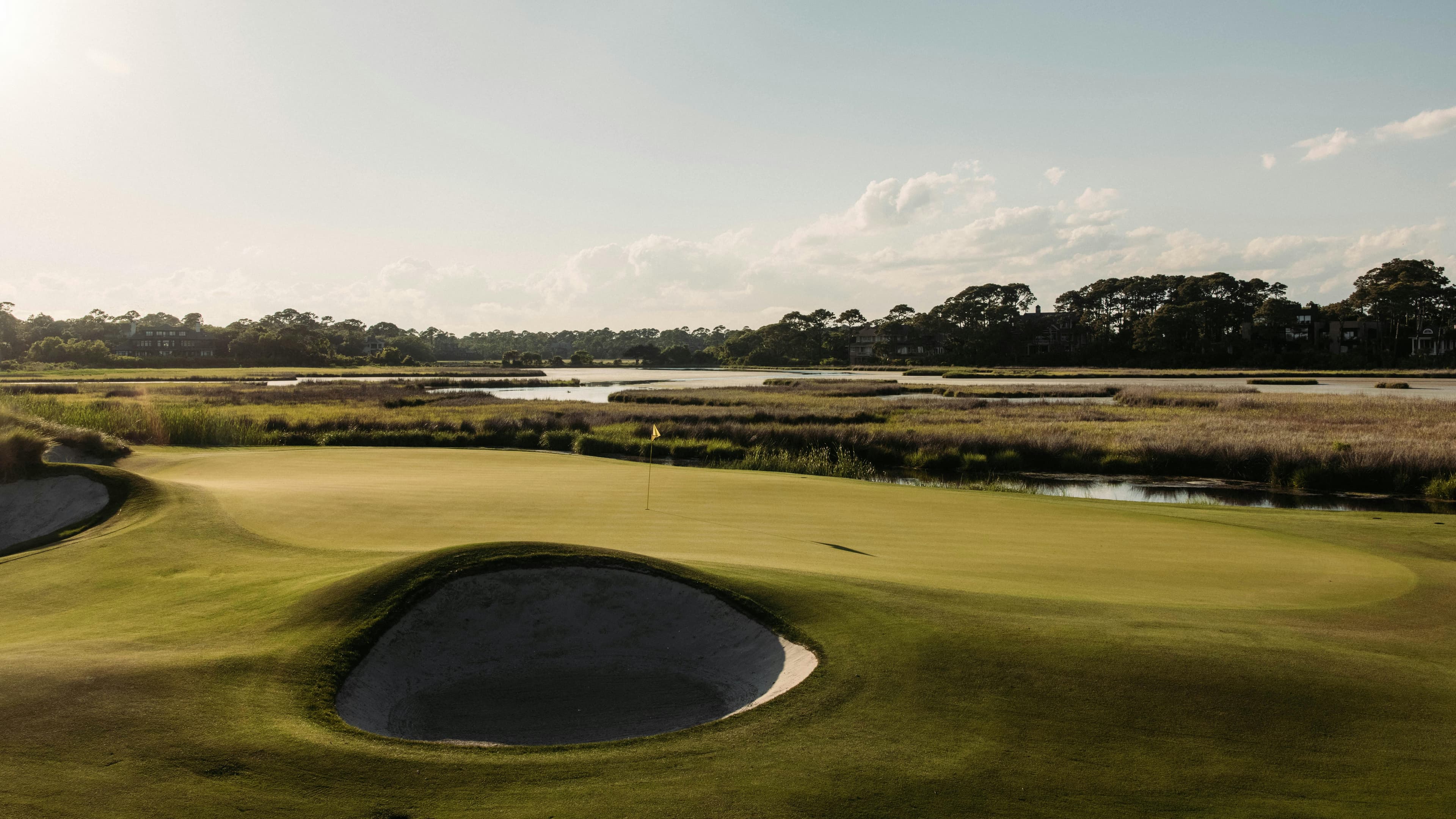
The construction materials are indigenous. Waste areas of crushed shell and sand border the fairways. Marsh, tidal creeks, and lagoons define the boundaries without artificial intervention. The bunkers are deep, irregular, and positioned to collect the shots that wind redirects. The greens are large relative to Dye's usual preferences but carry the contour and false fronts that characterize his most demanding work. Nothing about the course looks manufactured, which is remarkable given how quickly it was built.
How the Course Plays
The Front Nine
The opening holes establish the terms immediately. The 2nd, a long par 5 bending along the oceanfront, introduces the scale and the wind exposure in a single hole. By the time a player reaches the 4th or 5th, the adjustment period is over. Either the wind has been accepted as a constant variable or the scorecard has already slipped away.
The front nine contains several holes where the ocean is not merely visible but architecturally relevant. Marsh crossings on approach shots demand committed swings with the correct club, and the correct club changes with every shift in breeze direction. A mid-iron approach at 8 AM can become a fairway wood by early afternoon. Dye designed for this variability, and the caddies who walk the course daily understand which angles and club selections the conditions require.
The Back Nine Stretch
The return journey into the wind is where the Ocean Course separates itself from courses of similar reputation. The 13th, a par 4 where the approach crosses a marsh inlet toward a green backed by the Atlantic, is among the most visually confrontational shots on the course. The 14th and 15th maintain the pressure without relief.
The 17th, a par 3 over water, carries the weight of history. This is the hole where the 1991 Ryder Cup was effectively decided. In competitive conditions, with wind and consequence layered onto each other, it plays harder than its yardage suggests. The 18th finishes the round with a par 4 that demands precision from tee to green, a closing hole that respects the seriousness of what preceded it. There is no letup, no concession hole, no easy birdie to soften the card on the way in.
What the Green Fee Purchases
Tip
The fee purchases access to a championship venue that has hosted two PGA Championships since the Ryder Cup. Rory McIlroy won the 2012 edition by eight strokes. Phil Mickelson won in 2021 at the age of 50, becoming the oldest major champion in history. The 2031 Ryder Cup will return the event to Kiawah for the first time in forty years. These are not marketing footnotes. They are evidence that the course continues to function at the highest level of competitive examination.
A caddie is available and strongly recommended. The caddie fee and tip add $100 to $150 to the total cost, but the value is proportional to the difficulty. Caddies here read wind, manage expectations, and understand the daily variations in firmness and speed that alter how each hole plays. On a course where club selection is the primary challenge, local knowledge is not a luxury.
Walking without a caddie is permitted and produces the experience the course was designed to deliver. Cart play is available during summer months after 10 AM, a concession to the Lowcountry heat that builds through June, July, and August. Walking is the better choice when conditions allow it.
Practical Considerations
The Ocean Course is restricted to guests of Kiawah Island Golf Resort. Booking is handled directly through the resort, and preferred tee times go to guests staying at The Sanctuary or in resort villas. Advance booking of 30 to 60 days is advisable during peak seasons, particularly spring and fall when the weather is most favorable and the wind most manageable.
The Kiawah Island complete golf guide covers access strategies, multi-course packages, and the full roster of resort and area courses. The Kiawah Island destination guide addresses accommodations, dining, and the broader Charleston region. For most visitors, the smartest itinerary pairs one round at the Ocean Course with two or three rounds at the resort's other courses, distributing the cost while anchoring the trip around its most significant experience.
The verdict