Harbour Town vs Ocean Course: Lowcountry Championship Golf
The South Carolina Lowcountry produces two of the most recognisable courses in American golf. Harbour Town Golf Links on Hilton Head Island is Pete Dye's 1969 collaboration with Jack Nicklaus, a strategic design that rewards precision over power beneath a canopy of live oaks and pines. The Ocean Course at Kiawah Island on Kiawah is Dye's 1991 masterpiece, a 7,937-yard monster built along the Atlantic Ocean for the Ryder Cup. Both are Pete Dye designs. Both host or have hosted PGA Tour events. Both are Lowcountry courses. And they could not be more different.
Where to stay in Charleston & Kiawah Island
Planning the trip? Compare live prices across every nearby hotel and rental in one search.
Prices and availability from Booking.com, Expedia and others via Stay22. GolfTrailsHQ may earn a commission at no additional cost to you.
Harbour Town
Dye designed Harbour Town in 1969 with a 29-year-old Jack Nicklaus as design consultant. The course plays 7,099 yards at par 71 with a slope of 147 from the Heritage tees. It has hosted the PGA Tour's RBC Heritage (formerly the Heritage Classic) every year since opening, making it one of the longest continuously held events on tour.
The course underwent a major restoration in November 2025 led by Love Golf Design. Greens, bunkers, bulkheads, and agronomic systems were rebuilt, bringing the course to its highest standard since the original construction.
Harbour Town's genius is its economy. At 7,099 yards, it is short by modern championship standards. The tight, tree-lined fairways and small, heavily defended greens demand accuracy from the tee and precision from the approach.
The 18th hole, a par-4 along Calibogue Sound finishing at the iconic lighthouse, is one of the most photographed finishing holes in golf.
The course feels intimate. Live oaks, Spanish moss, and tight corridors create a sense of enclosure that contrasts with the exposed links-style courses that dominate the bucket-list tier. Harbour Town does not overwhelm with scale or scenic drama. It engages with subtlety: the green contours, the strategic bunkering, and the angles that reward the golfer who plans two shots ahead.
Green fees run $399 to $518 following the restoration. Sea Pines Resort guests have preferred access. A $9 gate fee applies for non-residents entering Sea Pines.
The Ocean Course
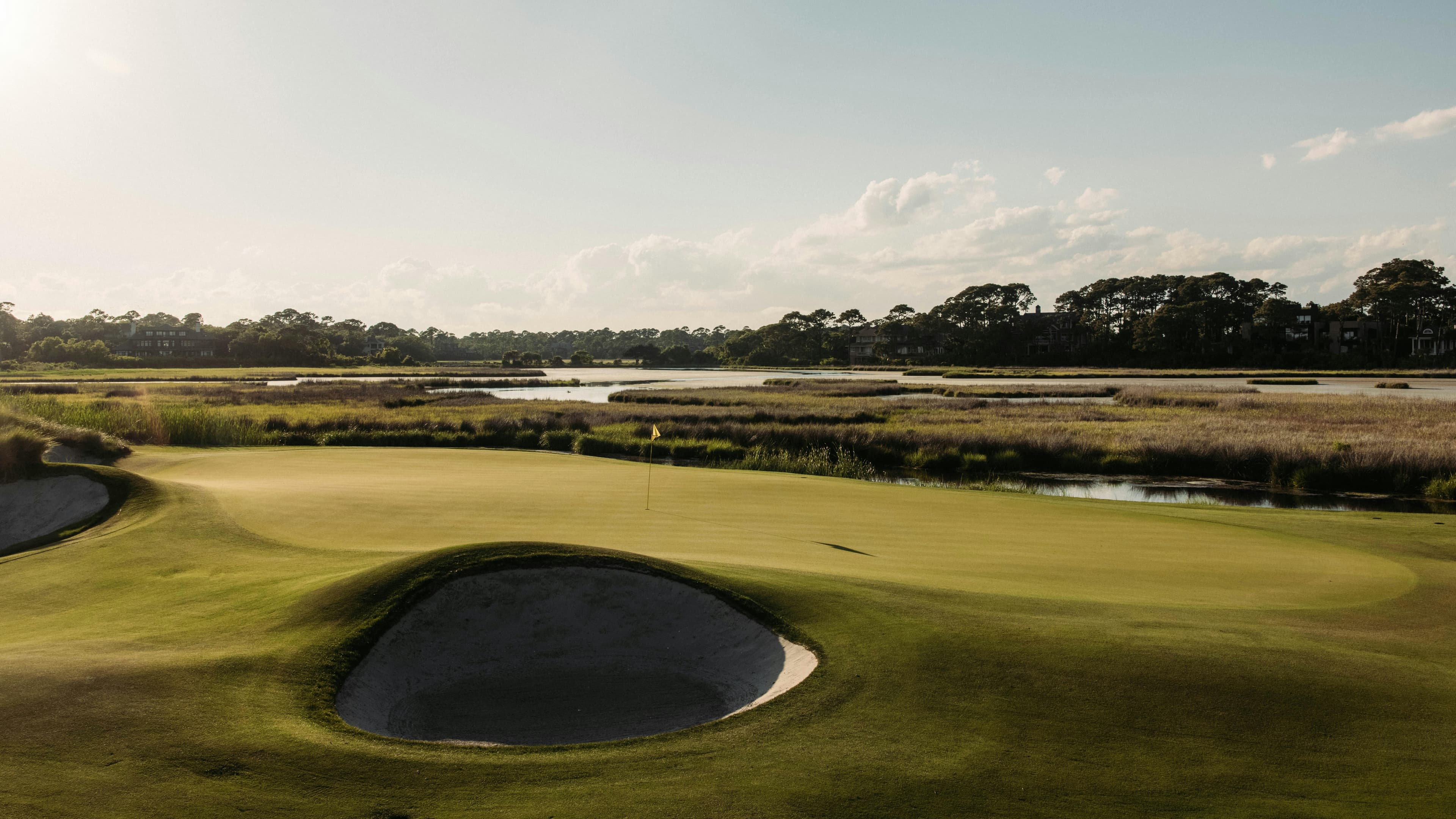
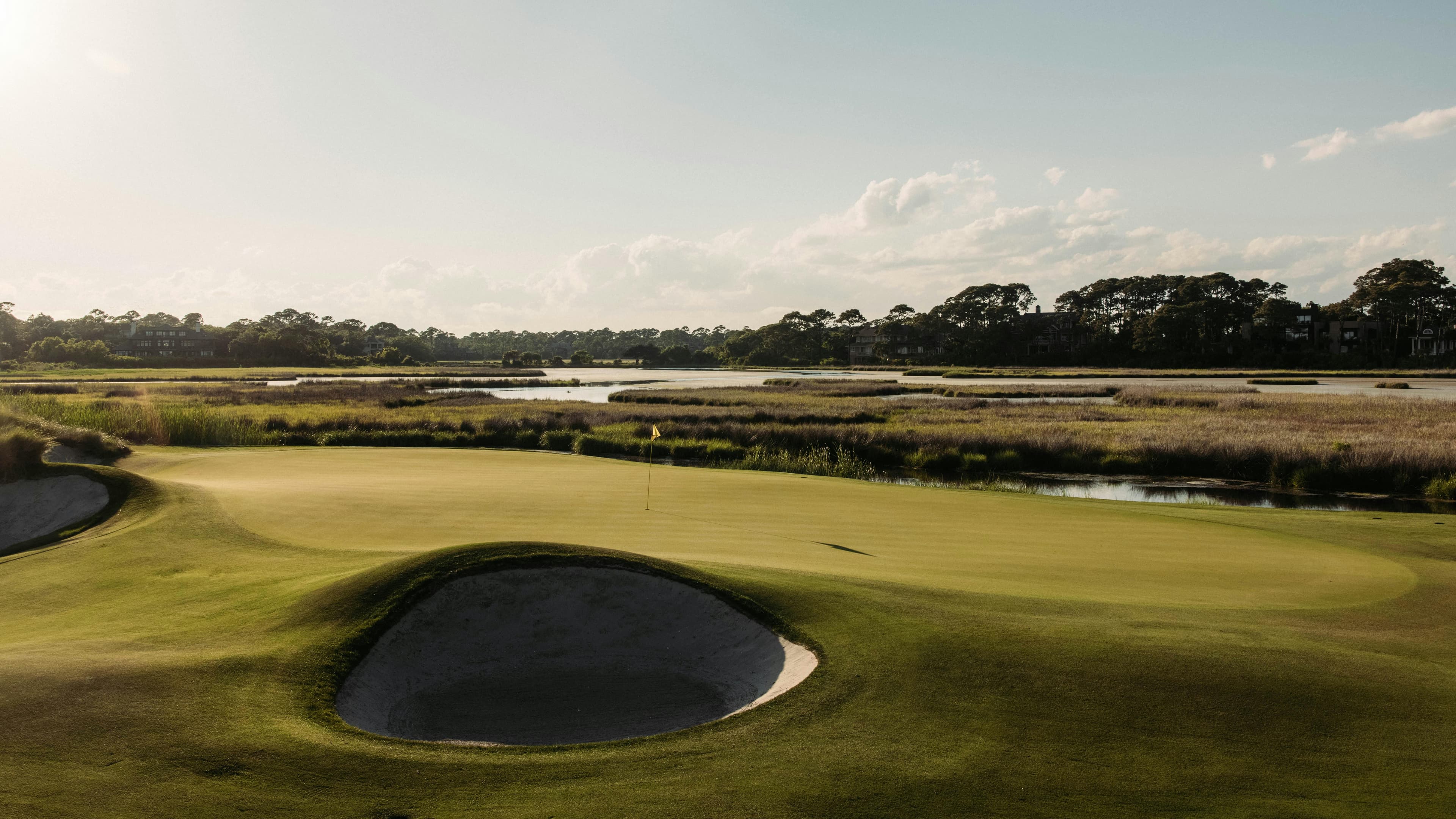
Dye designed the Ocean Course in 1991 specifically to host that year's Ryder Cup. It plays 7,937 yards from the back tees with a course rating of 79.6 and a slope of 155, making it one of the longest and most difficult resort courses in the world. All 18 holes have views of the Atlantic Ocean.
Ten holes run directly along the coastline, the most oceanfront holes of any course in the Northern Hemisphere.
Dye elevated the entire course on dredged sand to ensure ocean views from every fairway, exposing every hole to Atlantic wind. On a calm day, the course is demanding. On a windy day, it is nearly impossible from the back tees. The 2012 PGA Championship (Rory McIlroy) and 2021 PGA Championship (Phil Mickelson, the oldest major champion at 50) confirmed its championship pedigree. The 2031 Ryder Cup will bring the event back to Kiawah for the first time since 1991.
Walking with caddie is the standard format. Carts are permitted in summer after 10 AM. Green fees run $350 to $685 depending on season and resort guest status, with caddie fees additional.
The Dye Contrast
Both courses are Pete Dye, but they represent different periods and different ambitions.
Harbour Town was Dye's breakthrough. Before 1969, the prevailing American course design favoured length and broad fairways. Dye, influenced by Scottish links and the small-scale courses he had studied in Britain, built a course that proved a 6,600-yard layout (as it originally played) could test the best players in the world. Arnold Palmer won the first Heritage in 1969. The course proved that strategy and precision could outweigh raw distance.
The Ocean Course was Dye at his most audacious. Building two decades after Harbour Town, with the Ryder Cup as his canvas, Dye pushed every dimension: length, exposure, hazard placement, and visual intimidation. The course was designed to be seen on television and played in the wind, and it achieves both objectives emphatically.
Harbour Town asks: can you think your way around a golf course? The Ocean Course asks: can you survive one?
Playing Both
The two courses sit 90 minutes apart on the South Carolina coast. A three-day Lowcountry trip playing Harbour Town, the Ocean Course, and one additional course from either island (Atlantic Dunes on Hilton Head or Osprey Point on Kiawah) captures both extremes of Dye's vision.
Play Harbour Town first. The controlled, intimate scale provides a warm-up for the Ocean Course's exposure. After 18 holes beneath live oaks with small greens and precise angles, the first tee at the Ocean Course, with the Atlantic stretching to the horizon and the wind in your face, delivers a contrast that makes both courses more memorable.
Price
A Harbour Town round at $399 to $518 plus caddie tips compares closely to an Ocean Course round at $350 to $685 plus mandatory caddie. The total out-of-pocket per round is similar at both courses' peak pricing: roughly $500 to $700 including gratuities.
Accommodation at Sea Pines (Hilton Head) ranges from $180 to $500 for villas. The Sanctuary at Kiawah runs $328 to $1,200. Hilton Head offers broader mid-range options; Kiawah requires a higher minimum investment.
The Decision
Choose Harbour Town for strategic finesse. The course rewards the thinking golfer, the precision ball striker, and the player who appreciates design that achieves difficulty through angles rather than distance. The restoration has brought it to peak condition. The lighthouse finish is iconic. The intimacy of the setting is unlike any other championship course in the South.
Choose the Ocean Course for the championship experience at full scale. The oceanfront exposure, the length, the wind, and the Ryder Cup history create a round that tests your game at a level few public courses in the world attempt. The difficulty is genuine. So is the satisfaction of completing 18 holes on one of the hardest courses you will ever play.
The verdict
Harbour Town Golf Links