10 Best Golf Courses Built in the Last 25 Years
The period since 2000 has produced a remarkable concentration of excellent new courses in America, driven by two forces: the emergence of resort destinations on previously overlooked land, and a generation of architects who favour minimalism over the heavy earthmoving that defined the 1980s and 1990s. The courses on this list share a common quality: they feel as though they have existed for decades, even when the routing was laid out within living memory. The best modern architecture does not announce itself. It discovers the golf that already existed in the ground.
1. The Lido, Sand Valley, Wisconsin (2023)
Tom Doak and Jim Urbina's recreation of C.B. The original Lido was destroyed in the 1940s, and its recreation on the sandy terrain of central Wisconsin required both archaeological research and architectural intuition. The result is a course that plays like a century-old links: wide fairways, massive greens, and template holes that reward strategic thinking over mechanical repetition.
Macdonald's lost Long Island masterpiece is the most ambitious American golf project of the century.
2. Sheep Ranch, Bandon, Oregon (2020)
No formal bunkers, no trees, no rough in the traditional sense. The course is defined by wind, turf, and the Pacific Ocean. The land dictated the routing; the architects simply found the holes that were already there.
Coore and Crenshaw's design on the most exposed stretch of the Bandon coastline is the purest expression of minimalist architecture in America.
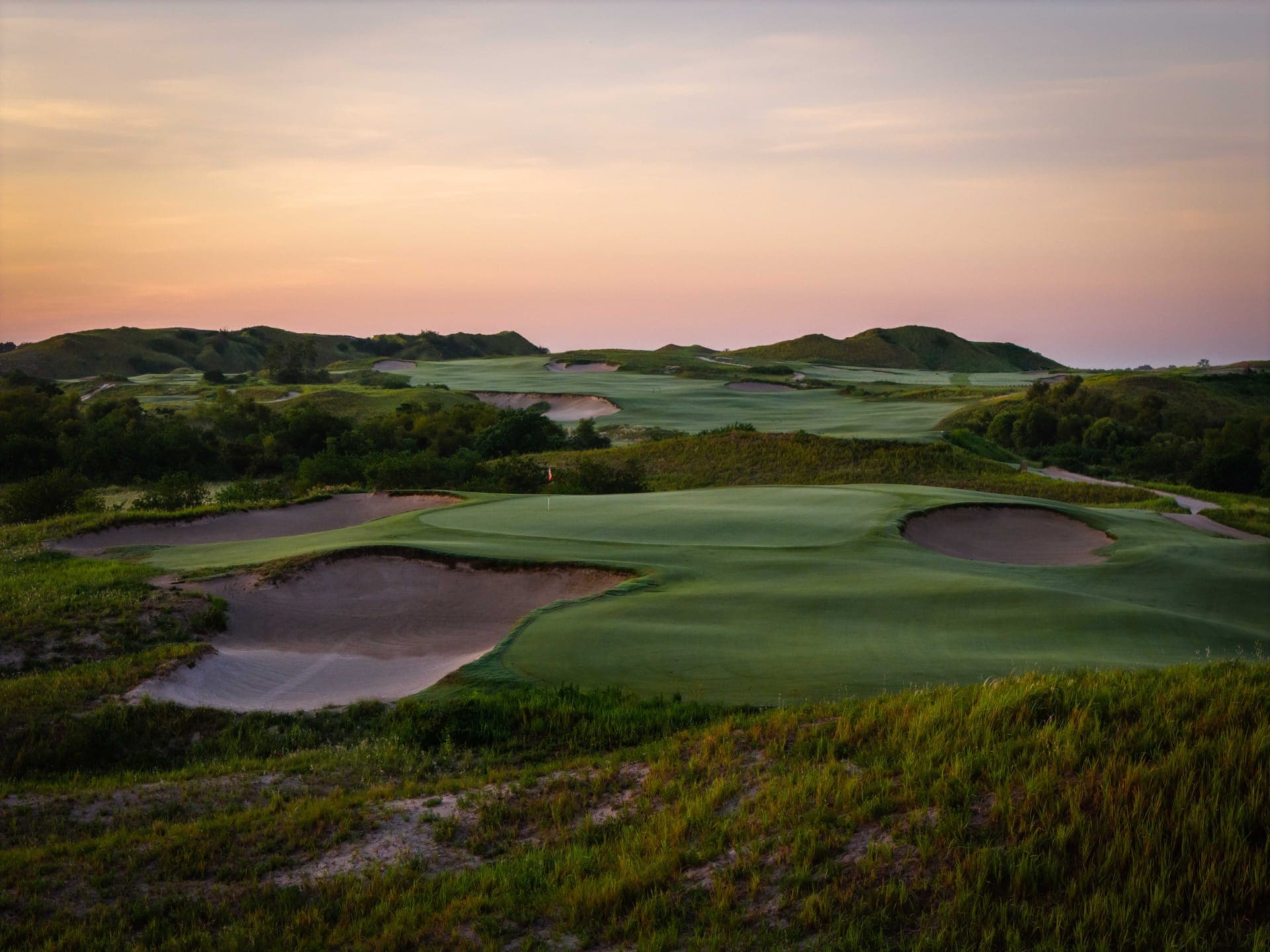
3. Streamsong Red, Streamsong, Florida (2012)
Tom Doak built a links-style course on reclaimed phosphate mining land in central Florida, which is exactly as unlikely as it sounds. The sandy ridges, deep bunkers, and firm playing surfaces create an experience that contradicts every assumption about Florida golf. Streamsong Red proved that great golf architecture requires great land, not great addresses.
4. Streamsong Blue, Streamsong, Florida (2012)
Doak's second course at Streamsong occupies the same former mining land but plays with a different character: wider fairways, gentler contours, and a routing that uses the lake as a strategic feature. Blue is often considered the more approachable of the two Doak courses, but the green complexes are equally demanding. Together, Red and Blue established Streamsong as the most important new golf destination in America.
5. Mammoth Dunes, Sand Valley, Wisconsin (2018)
David McLay Kidd's design features the widest fairways in modern American golf, some exceeding 100 yards. The width is not a concession to lesser players; it is a design philosophy. Every yard of fairway width creates a new strategic option, and the green complexes ensure that the approach angle matters more than the landing zone. Mammoth Dunes is the most democratic great course built in the modern era.
6. Ozarks National, Ridgedale, Missouri (2019)
Coore and Crenshaw's walking-only design at Big Cedar Lodge proved that the minimalist approach translates to the Ozarks as effectively as it does to the coast. The course routes through native grasses, limestone outcrops, and rolling terrain with the kind of effortless quality that only Coore and Crenshaw seem to produce. Ozarks National is the sleeper on this list: underrated nationally because of its location, exceptional in quality.
7. Payne's Valley, Branson, Missouri (2019)
Tiger Woods' first public course design. The course plays through Ozark hollows, around spring-fed creeks, and across limestone terrain with a subtlety that surprised the sceptics. Payne's Valley is playable for high handicappers and challenging for scratch golfers, which is the hardest balance in design to achieve. The par 3 19th, a bonus island green hole, adds a celebratory note that most modern courses lack.
8. Pacific Dunes, Bandon, Oregon (2001)
Tom Doak's coastal masterpiece opened just inside the 25-year window, and its influence on everything that followed is immeasurable. Pacific Dunes demonstrated that American golfers would travel to a remote coastline for links-style golf, that walking-only courses could be commercially successful, and that minimalist architecture could produce experiences that rival the most expensive resort courses. The entire modern minimalist movement in American golf traces back to this course.
9. PGA Frisco Fields Ranch East, Frisco, Texas (2023)
Gil Hanse designed the East Course at PGA Frisco as a championship venue, and the PGA of America's decision to host the 2027 PGA Championship here validates the ambition. The course occupies flat North Texas terrain and uses Hanse's characteristic subtlety to create strategic interest where the land provides none. The shaping is invisible until you play it, which is the hallmark of mature design.
10. Cabot Citrus Farms (Karoo Course), Brooksville, Florida (2024)
Kyle Franz's design at Cabot's Florida property occupies rolling terrain north of Tampa that challenges every assumption about the state's golf landscape. The course is bold, strategic, and visually striking, with green complexes that demand precise approach play. Karoo is the youngest course on this list, and its ranking here is a bet on its continued maturation. The early returns justify the confidence.
The Modern Design Movement
The verdict
Streamsong Red