 Pin it
Ozarks National Golf Course
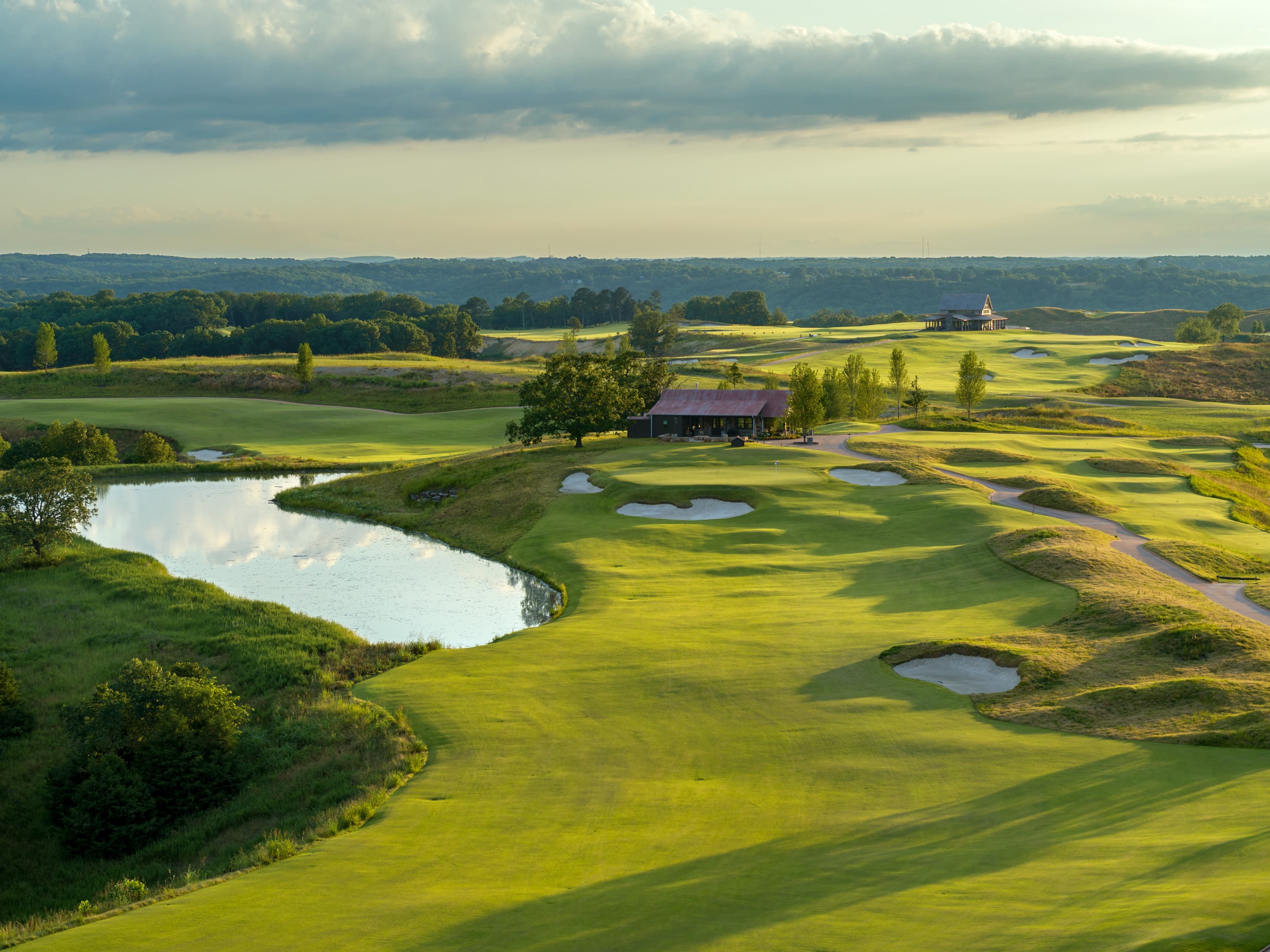
Coore and Crenshaw's ridgeline routing through the Ozarks, featuring panoramic views and a 400-foot wooden bridge on the 13th hole. Golf Digest Best New Public 2019.
Photo courtesy of Big Cedar Lodge · Big Cedar Lodge · Partner
Designed by Bill Coore & Ben Crenshaw (2019)
$225–$525
Book direct via the course website
Ozarks National is the Bill Coore and Ben Crenshaw course at Big Cedar Lodge that won Golf Digest's Best New Public Course in 2019, routed across exposed ridgelines in the Ozarks highlands with views that extend for miles across forested valleys and distant lake horizons. Coore and Crenshaw built their reputation on courses that reveal rather than impose, designs that follow the natural contours of the land. The terrain they were given here is among the most dramatic they have ever worked with.
What to expect
The routing is the achievement. Coore and Crenshaw found a sequence of holes that crosses ridgetops, descends into valleys, and climbs back to elevated tees with a naturalness that conceals the engineering complexity. The 13th provides the most visible evidence of routing ambition: a 400-foot wooden bridge connects two sections of the course across a deep wooded valley. The bridge is functional infrastructure, but it is also a dramatic passage that resets the round's emotional register.
The playing experience rewards the ground game. Fairways are wide by modern standards, and the greens accept running approaches from multiple angles. This is not target golf. The penalty for a missed fairway is rarely severe, but the reward for finding the correct position is significant: a better angle, a simpler approach, a putt that works with the green's natural contour rather than against it. The distinction between good and optimal positioning becomes more apparent with repeated play.
The greens are large and subtly contoured. Several feature significant internal movement that creates pin positions ranging from accessible to genuinely difficult, all on the same green. Putting surfaces are maintained to speeds that reward touch and punish mechanical stroke patterns. That is the Coore and Crenshaw signature: a design that separates skill levels without resorting to forced carries or penal hazards.
Wind is a consistent factor on the exposed ridgeline holes. On calm days, the course plays generously. When the wind arrives, club selection on the par 3s shifts by two or three clubs, giving the course a links-like quality that distinguishes it from the sheltered valley courses in the region.
Ozarks National is walking only, with caddies available. The terrain is substantial and the walk is a genuine workout across the ridgeline holes, but the pace is manageable and the views justify the effort.
By the numbers
- Par
- 71
- Yardage
- 7,036
Is it worth the green fee?
The $225 resort guest peak rate puts it below Payne's Valley in the Big Cedar pricing hierarchy, with the non-guest rate climbing to roughly $525. Shoulder-season discounts apply. Stay at the resort and the math improves substantially.
Booking and trip fit
Book direct through the resort. Pair Ozarks National with Payne's Valley for the marquee two-day Big Cedar experience, and add Buffalo Ridge Springs, Mountain Top, or Top of the Rock to round the trip out.
For golfers who appreciate the Coore and Crenshaw body of work at Sand Valley, Bandon Trails, and Streamsong Blue, Ozarks National belongs in the conversation as one of their strongest designs. The routing uses the Ozarks terrain in ways the flatter landscapes of Wisconsin, Oregon, and Florida cannot replicate.
Where to Stay
Accommodations near Ozarks National Golf Course
Resort
Big Cedar Lodge
Big Cedar Lodge, Missouri, Missouri
The 326-room wilderness resort on Table Rock Lake that anchors the entire Big Cedar golf collection, with on-site courses, eight restaurants, and a full-service spa.
From $200/nightTop of the Rock (on-site); Payne's Valley & Ozarks National within 10 min
ExpediaCheck availability
Lodge
Top of the Rock Cottages
Big Cedar Lodge, Missouri, Missouri
Private cottages at the Top of the Rock complex with full kitchens, stone fireplaces, and views of the Payne's Valley course.
From $250/nightTop of the Rock (adjacent); Payne's Valley within 5 min
Direct websiteVisit website
Compare all stays near Ozarks National Golf Course
Live prices from Booking.com, Expedia and more — every nearby hotel and rental in one search.
Prices and availability from Booking.com, Expedia and others via Stay22. GolfTrailsHQ may earn a commission at no additional cost to you.
Other Courses Nearby
Mid-Range
Buffalo Ridge Springs Golf Course
Big Cedar Lodge, Missouri, Missouri
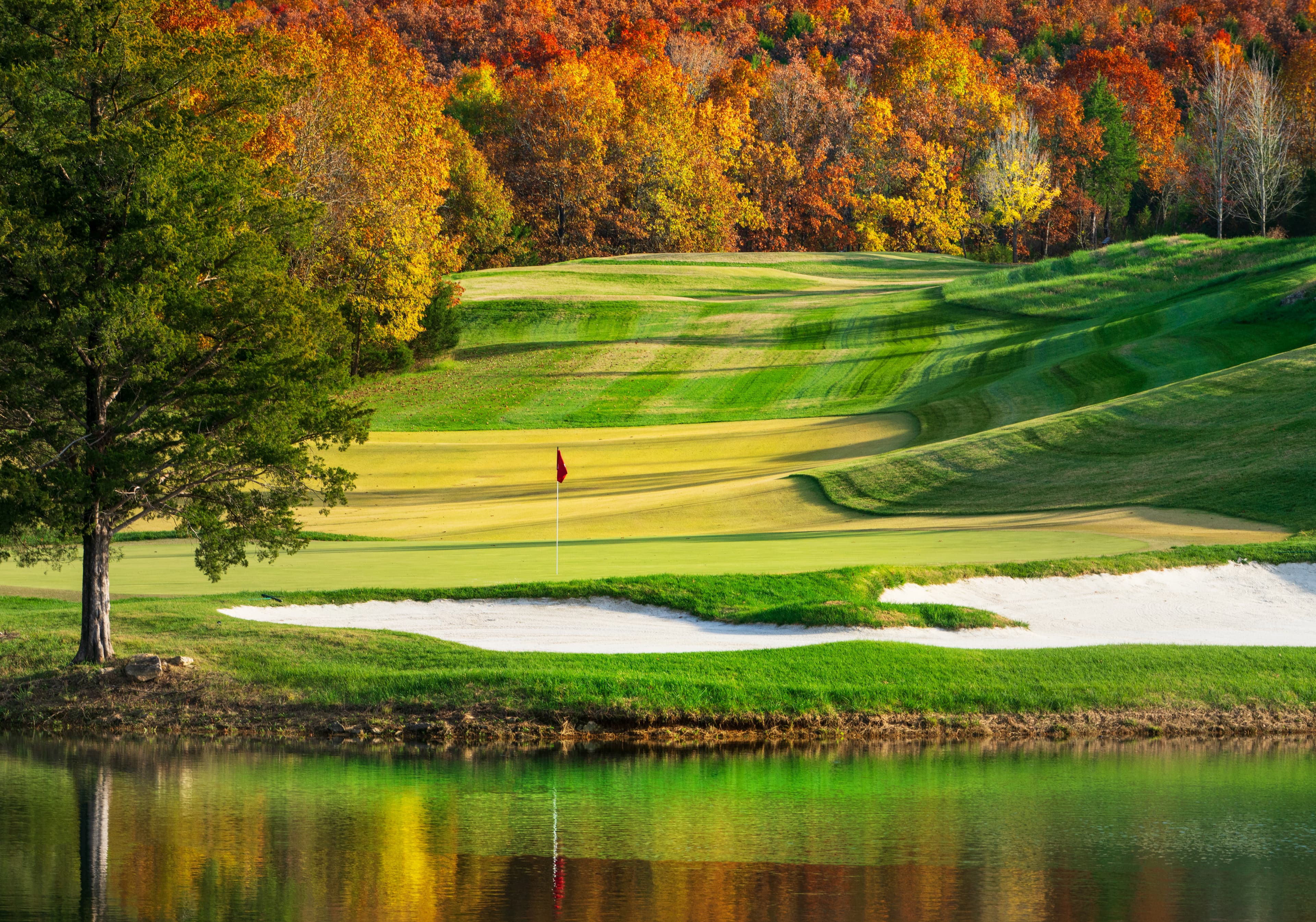
Tom Fazio's 18-hole design through rolling Ozarks grassland, where a resident bison herd grazes alongside the fairways. Ranked among Golf Digest's Top 100 Public.
$225–$275ResortTom Fazio (1999, redesigned 2014)
Direct websiteVisit website

Mid-Range
Mountain Top Golf Course
Big Cedar Lodge, Missouri, Missouri
Gary Player's 13-hole par-3 course routed through Ozarks rock formations at elevation. Walking only, designed to be accessible across all skill levels.
$80–$95ResortGary Player (2017)
Direct websiteVisit website

Bucket List
Payne's Valley Golf Course
Big Cedar Lodge, Missouri, Missouri
Tiger Woods' first public-access course, an 18-hole championship layout with a bonus 19th par-3 carved through Ozarks ridgelines above Table Rock Lake.
From $400ResortTiger Woods / TGR Design (2020)
Direct websiteVisit website

Premium
Top of the Rock Golf Course
Big Cedar Lodge, Missouri, Missouri
The only par-3 course ever used by the PGA Tour, a Jack Nicklaus design through limestone cliffs above Table Rock Lake.
From $135ResortJack Nicklaus (1996)
Direct websiteVisit website
Plan Your Trip
Explore Big Cedar Lodge, Missouri
Full guide: courses, stays, getting there.
Continue →3 Itineraries
Pre-planned trips to Big Cedar Lodge, Missouri.
Continue →Off the Fairway
6 non-golf activities at Big Cedar Lodge, Missouri.
Continue →