Whistling Straits vs Bandon Dunes: Great American Links Courses
These are the two properties most frequently invoked when American golfers discuss links-style play on domestic soil. Both occupy dramatic coastal sites. Both feature courses designed to evoke the ground game, the wind exposure, and the raw terrain associated with the British Isles. And both require meaningful travel to reach, which filters the visitor pool toward committed golfers rather than casual resort guests. But the resemblance, while real, conceals significant differences in philosophy, experience, and the type of trip each property rewards.
Where to stay in Kohler & Sheboygan County
Planning the trip? Compare live prices across every nearby hotel and rental in one search.
Prices and availability from Booking.com, Expedia and others via Stay22. GolfTrailsHQ may earn a commission at no additional cost to you.
Course Quality and Depth
Bandon Dunes holds the advantage in sheer volume of high-quality golf. The resort operates six courses: Bandon Dunes, Pacific Dunes, Bandon Trails, Old Macdonald, Sheep Ranch, and the Preserve (a par-3 course). Pacific Dunes, designed by Tom Doak, consistently ranks among the top five public courses in the United States. Old Macdonald, a Doak and Jim Urbina collaboration modeled on the template holes of C.B. Macdonald, provides an architectural education across eighteen holes. The depth of the roster means a four-day trip can include five or six rounds without repeating a course, and each layout offers a distinct architectural voice.
Sheep Ranch, the newest addition, plays along the cliff edges with the most exposed ocean views on the property.
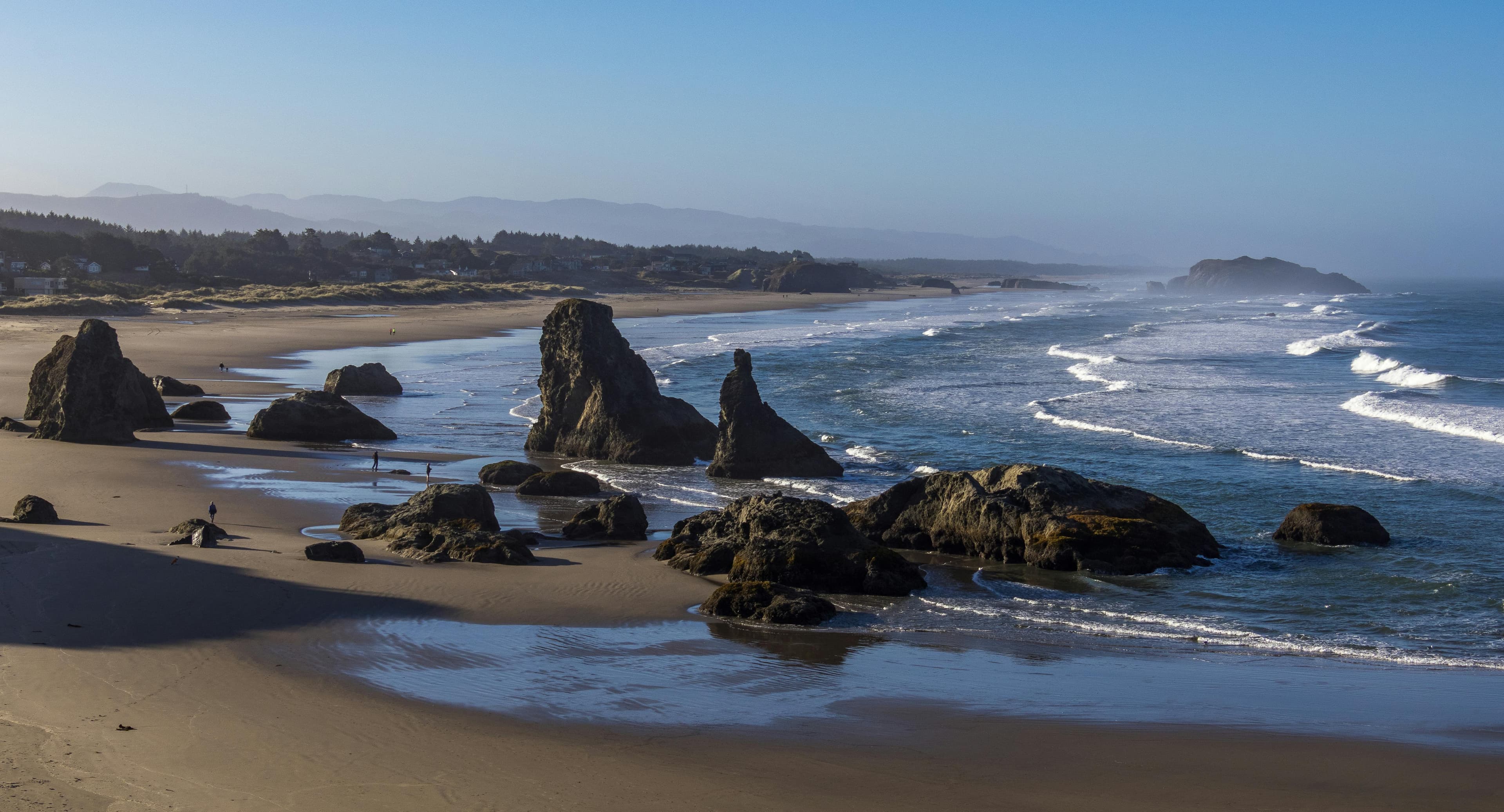
Bandon Trails
Whistling Straits operates within the Kohler golf ecosystem, which includes four courses across two properties: Whistling Straits (Straits and Irish courses) and Blackwolf Run (River and Meadow Valleys courses). The Straits Course, a Pete Dye design built on a Lake Michigan bluff, hosted the 2021 Ryder Cup and three PGA Championships. It is the marquee layout, with faux-links terrain manufactured from a former airfield and over 1,000 bunkers defining the visual identity. The Irish Course provides a more natural companion, and the Blackwolf Run courses, twenty minutes inland, add parkland variety. The quality is genuine at all four, but the architectural range is narrower than Bandon's, and the total volume of golf is lower.
For golfers whose primary objective is playing as many distinct, high-quality courses as possible, Bandon wins this comparison clearly.
Links Authenticity
Bandon Dunes sits on actual coastal sand dunes along the southern Oregon coast, and the courses are built on terrain that is naturally suited to links golf. The turf is fescue, the ground is firm, the ball bounces and rolls, and the wind is a constant factor. Pacific Dunes and Sheep Ranch, in particular, feel as close to Scottish links golf as anything built in the United States.
This is the most debated point between the two properties, and it matters to a specific type of golfer.
Whistling Straits is a manufactured links experience. Pete Dye transformed a flat lakeside site into something visually dramatic through massive earthmoving, and the result is impressive in its ambition. But the turf is bluegrass, not fescue; the ground plays softer, particularly after rain; and the bunkers, while visually striking, function differently than links pot bunkers. The course looks like links golf and plays like a challenging resort course built on terrain shaped to evoke the form. This is not a criticism of the design, which is superb, but it is a distinction that matters to golfers seeking the ground game and the unpredictability that define authentic links play.
Getting There
Neither destination is convenient, and both are better for it. Bandon requires a flight into North Bend (OTH), a small regional airport with limited service, or into Eugene (EUG) or Portland (PDX) followed by a four-to-five-hour drive. The remoteness is part of the identity; once at Bandon, the world narrows to golf, food, and sleep.
Whistling Straits is more accessible. The Kohler property sits roughly an hour north of Milwaukee and two hours north of Chicago, both major hubs. The drive is straightforward, and groups originating from the Upper Midwest can reach the property in a half-day without air travel. For East Coast or West Coast groups, the accessibility advantage is less pronounced, but Kohler is still easier to reach than the southern Oregon coast.
Price and Value
Tip
Kohler's pricing is comparable on a per-round basis, with Straits Course green fees at the top of the range and stay-and-play packages that bundle lodging at the American Club, a Forbes Five-Star property. The accommodations at Kohler are more luxurious than Bandon's, which shifts the experience toward a traditional resort trip with links golf as the centerpiece rather than the sole focus.
Non-Golf Experience
Bandon offers almost nothing beyond golf, and that is by design. The lodge has a pub, the food is good, and the setting is spectacular. But the town of Bandon is small, and the coast is remote. For golfers who want their trip to be entirely about the game, this is an asset.
Kohler provides a fuller resort experience. The American Club offers spa facilities, fine dining, and a level of polish that Bandon does not attempt. The town of Kohler is compact but pleasant, and Milwaukee's dining and cultural scene is within a reasonable drive for an evening.
Best For
Bandon Dunes is the stronger choice for groups that want to play the most golf, experience authentic links conditions, and immerse in a trip where the game is the entire agenda. Consult the Bandon Dunes guide for detailed planning.
Whistling Straits is the better fit for groups that want a Ryder Cup venue, resort-level accommodations, and easier logistics, particularly those driving from the Midwest. The Whistling Straits guide covers the full picture.
The verdict