Coore and Crenshaw: Why Minimalism Wins in Golf Design
Bill Coore and Ben Crenshaw do not build golf courses so much as find them. Their design philosophy, refined over three decades of collaboration, rests on a conviction that the best golf emerges from the ground rather than being imposed on it. In practice, this means less earthmoving, fewer manufactured features, and a willingness to let the natural terrain dictate routing, green sites, and strategic character. The results, consistently, are courses that feel as though they have always existed.
This is not laziness disguised as philosophy. Minimalism in golf architecture requires more time on site, more careful study of topography, and more discipline in resisting the temptation to improve what the land already provides. Coore, who handles the day-to-day design work, often spends months walking a property before committing to a routing. Crenshaw, whose Hall of Fame playing career gives him an elite golfer's understanding of shot values and strategic angles, contributes judgment about how the design will play at every level of ability. The partnership works because each brings something the other cannot.
The Bandon Dunes Connection
The Coore and Crenshaw approach found its ideal setting on the Oregon coast. Bandon Trails, their first course at Mike Keiser's Bandon Dunes resort, routes through coastal forest and meadow terrain that is distinct from the oceanside links of the resort's other courses. Where Pacific Dunes and Bandon Dunes play along exposed bluffs, Bandon Trails moves inland through a landscape of dunes, shore pines, and native grasses. The routing uses the natural rises and falls of the terrain to create views that open and close as the round progresses. It is a quieter course than its neighbors, and its quality has taken time to be fully appreciated.
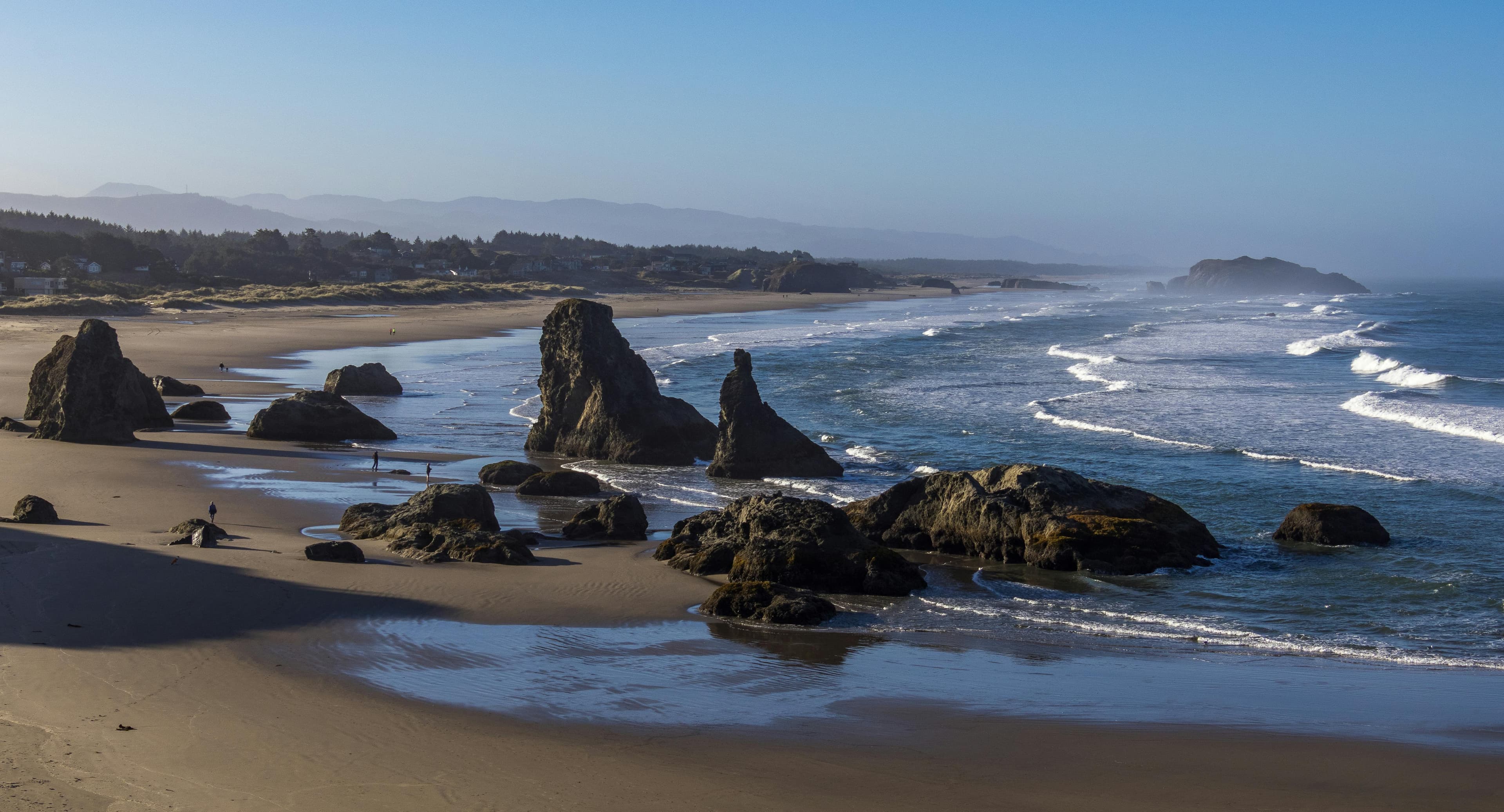
Bandon Trails

Sand Valley
Sheep Ranch, their second Bandon design, is the opposite of quiet. The routing is deliberately simple: out and back along the cliffs, with wide fairways, few bunkers, and green complexes that rely on natural contours rather than manufactured shapes. The wind does the defensive work. On calm days, Sheep Ranch is generous and exhilarating. On windy days, it is a survival exercise conducted against one of the most dramatic backdrops in golf.
Built on open coastal bluffs with the Pacific visible from every hole, Sheep Ranch is among the most exposed courses in America.
Sand Valley and the Wisconsin Sandhills
The firm at Sand Valley in central Wisconsin has produced work that may represent their finest achievement on sandy terrain. The Sand Valley course, completed in 2017, sits on a landscape that recalls the great Sand Belt courses of Melbourne, Australia: gently rolling sandy ground covered in native vegetation, with the kind of natural green sites that architects spend their careers hoping to find.
Coore and Crenshaw's routing moves through this terrain with a lightness that makes the course feel inevitable. The green complexes use the existing undulations of the sand, creating putting surfaces with character that no amount of manufactured contour can replicate. The Sandbox, a 17-hole short course on the same property, distills the firm's philosophy into a format that takes ninety minutes to play and demonstrates, in miniature, what minimalism looks like when the land cooperates fully.
The Desert Work
The Sonoran Desert is not an obvious setting for minimalist golf architecture, and Coore and Crenshaw's work in Scottsdale is all the more impressive for how naturally it sits in that landscape. We-Ko-Pa's Saguaro Course, built on Fort McDowell Yavapai Nation land, is a course that treats the desert as a feature rather than an obstacle. The routing moves through saguaro cactus, mesquite, and ironwood, and the fairways and greens are the only irrigated surfaces on the property. Everything else is native desert.
The result is a stark visual contrast between the maintained playing surfaces and the surrounding landscape, and that contrast gives the course a clarity that more heavily landscaped desert courses lack. Strategic decisions are easier to read because the boundary between golf and desert is crisp. Coore and Crenshaw shaped the fairways to use the natural drainage patterns of the desert floor, creating movement and interest without significant earthwork.
The Talking Stick courses, also in Scottsdale, are earlier Coore and Crenshaw designs that demonstrate a different approach to desert golf. The North Course in particular is remarkably open, with minimal bunkering and wide fairways that play fast and firm. It is one of the most accessible designs in the firm's portfolio and one of the best values in the Scottsdale market.
Barton Creek and Hill Country Golf
At Omni Barton Creek in Austin, Coore and Crenshaw built a course on Hill Country terrain that challenged their minimalist principles. The limestone ravines and cedar-covered slopes of the Texas Hill Country are dramatic, and the temptation to build heroic forced carries and elevated tee shots is considerable. Their response was characteristically restrained. The course uses the ravines for framing and visual drama but does not require carries over them on most holes. The green sites sit on natural shelves and plateaus, and the routing flows with the terrain's contours rather than cutting across them.
The result is a Hill Country course that plays more naturally than its neighbors, including the two Fazio courses on the same property. The contrast is instructive: where Fazio sculpts the land to create his vision, Coore and Crenshaw adapt their vision to the land. Both approaches produce excellent golf. The difference is in how the courses feel under your feet and in how they sit in the landscape when viewed from a distance.
Ozarks National
At Big Cedar Lodge in the Missouri Ozarks, Ozarks National opened in 2019 on a property adjacent to Tiger Woods' Payne's Valley. The course sits on high ground with views across the Ozark ridgelines, and Coore and Crenshaw used the sloping terrain to create a course that plays through meadows and along ridgetops with a sense of space and openness that is unusual for the region.
The greens at Ozarks National are among the firm's most interesting, with contours that create distinct quadrants and pin positions that change the character of each hole significantly. The course is walkable, which matters to Coore and Crenshaw and should matter to visiting golfers. Their courses are designed to be experienced at walking pace, and the routing at Ozarks National, which moves naturally from green to tee without long transitions, makes that experience pleasurable rather than arduous.
Why the Philosophy Works
The minimalist approach that Coore and Crenshaw have championed is not inherently superior to more interventionist design methods. What it produces, consistently, is golf that ages well. Courses built with minimal earthmoving tend to drain naturally, resist the settling and erosion that affect heavily constructed layouts, and develop character over time as native vegetation matures.
The playing surfaces, shaped from existing topography rather than manufactured from imported material, tend toward the firm, fast conditions that reward creative shot-making.
There is also a philosophical argument, which Crenshaw in particular has articulated throughout his career: golf originated on natural terrain, and the best golf courses honor that origin by working with the ground rather than against it. This is not nostalgia. It is an observation about what produces interesting strategic decisions, compelling visual experiences, and the kind of variety within a single round that keeps golfers engaged through all eighteen holes.
The verdict