The Best Links-Style Courses in America
The term "links" carries a specific meaning in golf architecture that American usage has gradually diluted. In the strictest sense, links land refers to the sandy, treeless terrain connecting arable farmland to the sea along the coastlines of Scotland and Ireland. The soil drains fast. The grass stays firm. The wind shapes every shot. True links courses were not designed so much as discovered, their routing dictated by the natural movement of the land.
America has no links courses in that purest definition. What it has, increasingly, is a collection of courses that honour the principles behind links golf: firm turf that rewards the ground game, minimal artificial intervention, wide fairways with strategic bunkering, and an honest relationship between the architecture and the terrain it occupies. They translate its values into American landscapes, and the results are among the most compelling rounds available in the country.
The best of these courses do not imitate links golf.
Bandon Dunes, Bandon, Oregon
Bandon Dunes is the course that redefined what American golfers expected from a links-style experience. David McLay Kidd's original design, opened in 1999 on Oregon's southern coast, sits on genuine coastal dune land above the Pacific. The turf is firm. The fairways are wide. The wind off the ocean is a constant and non-negotiable factor. What separates Bandon Dunes from courses that merely look like links golf is the playability. A well-struck bump-and-run along the ground covers as much distance as a lofted approach, and the greens accept that kind of shot. The course does not punish golfers for staying low. It rewards them.
Pacific Dunes, Bandon, Oregon
If Bandon Dunes proved the concept, Pacific Dunes perfected it. Tom Doak's routing along the coastal bluffs produces holes that feel inevitable, as though the land dictated the placement of every green and fairway. The course sits closer to the ocean than any other at the resort, and several holes play directly along the cliff edge. Doak's minimalist philosophy is on full display: the bunkering is natural, the green contours follow the existing terrain, and the strategic options on each hole emerge from the ground rather than from imposed design features. Pacific Dunes regularly appears near the top of any ranking of American public courses, and the links credentials are central to that standing.
Old Macdonald, Bandon, Oregon
Tom Doak and Jim Urbina designed Old Macdonald as an explicit homage to the template holes of Charles Blair Macdonald, the architect who first attempted to bring links principles to American soil in the early 1900s. The result is the widest, most strategic course at Bandon, with fairways that can exceed 100 yards in width and green complexes that offer multiple angles of approach depending on pin position and wind direction. Every hole presents a genuine choice between aggression and discretion, and the correct answer changes with the wind.
Old Macdonald is the most cerebral links-style course in America.
Whistling Straits (Straits Course), Kohler, Wisconsin
Pete Dye built the Straits Course on a flat stretch of Lake Michigan shoreline and sculpted it into something that resembles the Irish coast more than the American Midwest. The course hosted three PGA Championships and the 2021 Ryder Cup, and the terrain is genuinely dramatic: deep fescue, hundreds of bunkers (many unmarked), and an exposure to Lake Michigan wind that makes club selection an exercise in probability rather than certainty. The Straits Course is more manufactured than the Bandon courses, but the playing experience captures the essential quality of links golf: the wind dictates the strategy, and the golfer adapts or suffers.
Arcadia Bluffs (Bluffs Course), Arcadia, Michigan
Warren Henderson designed the Bluffs Course on a site 200 feet above Lake Michigan, and the combination of elevation, wind exposure, and fescue turf produces conditions closer to coastal Scotland than anything else in the Great Lakes region. The course opened in 1999 and has aged well. The turf has matured into the firm, bouncy surface that links golf requires, and the views across Lake Michigan extend to the horizon in every direction. Arcadia Bluffs is a genuine destination course in a state full of good golf, and the links-style credentials are not a marketing claim. They are the lived experience of playing the course.
Chambers Bay, University Place, Washington
Robert Trent Jones Jr. designed Chambers Bay on a reclaimed gravel mine along Puget Sound, and the course hosted the 2015 U.S. Open in conditions that divided opinion sharply. The fescue greens were controversial, but the course itself is a remarkable links-style achievement: treeless, wind-exposed, with dramatic elevation changes and a routing that uses the natural bowl of the old mine to create a playing experience unlike anything else in the Pacific Northwest. The course has matured since the Open, and the greens have improved. Chambers Bay rewards the patient golfer who accepts that a firm fescue surface will produce bounces that defy prediction.
Sand Valley (Sand Valley Course), Nekoosa, Wisconsin
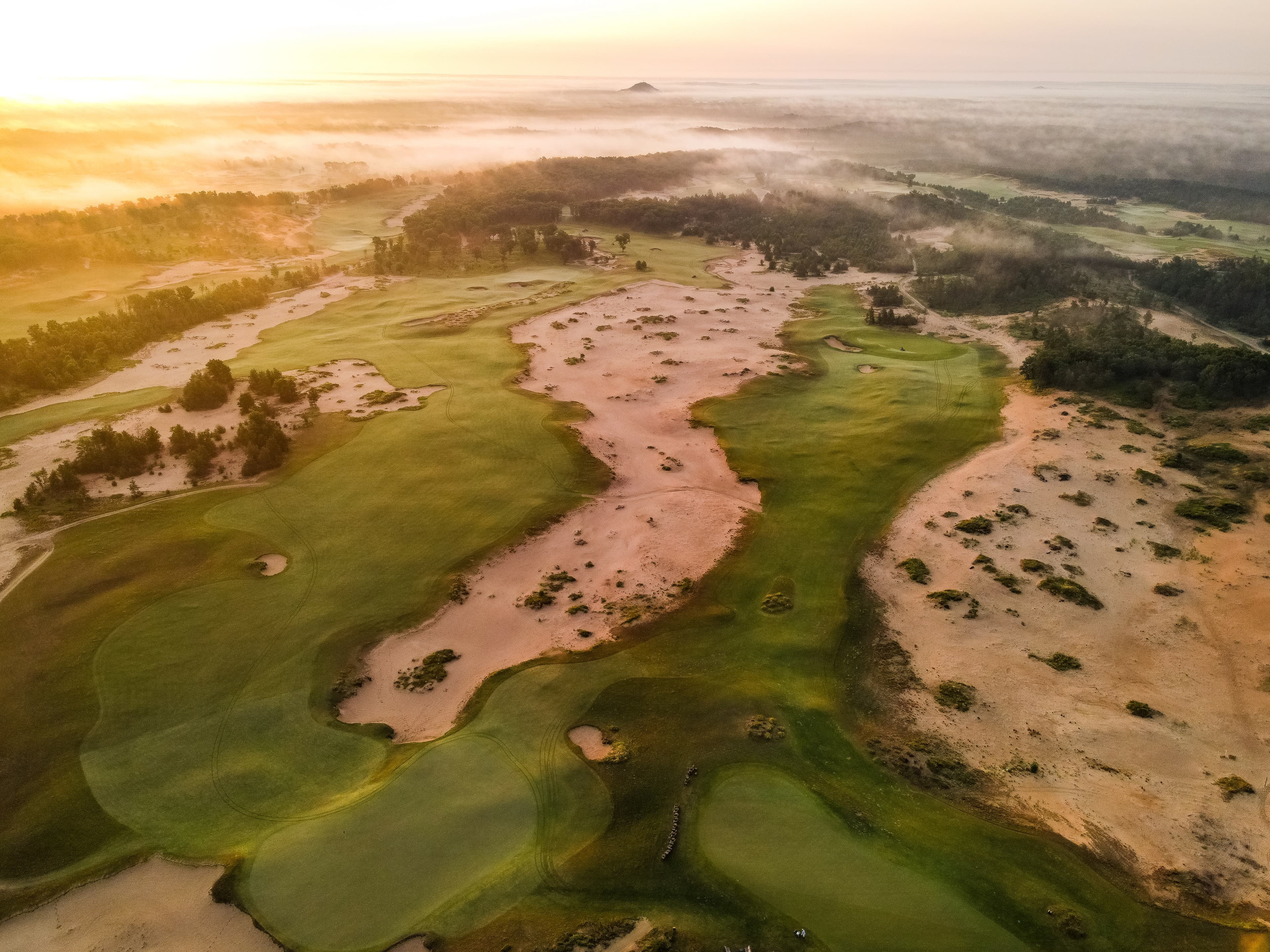
Bill Coore and Ben Crenshaw built Sand Valley on glacial sand deposits in central Wisconsin, and the result is a course that plays like links golf in a setting that looks nothing like a coastline. The sandy soil drains instantly, the turf stays firm through the season, and the wide fairways invite the kind of strategic, ground-based golf that links purists value. Sand Valley proves that links-style golf does not require an ocean. It requires the right soil, the right grass, and an architect willing to let the land dictate the design.
Erin Hills, Hartford, Wisconsin
The 2017 U.S. Open venue occupies drumlin terrain in southeastern Wisconsin, with rolling fescue-covered hills and virtually no trees. The course plays long from the championship tees but offers generous fairway widths and multiple angles into the greens. The fescue rough is penal when it grows out for championships, but in daily play Erin Hills presents a links-style challenge scaled to American proportions. The wind sweeps across the open terrain with nothing to break it, and the firm turf means approach shots that land short and run onto the green are viable alternatives to the aerial game.
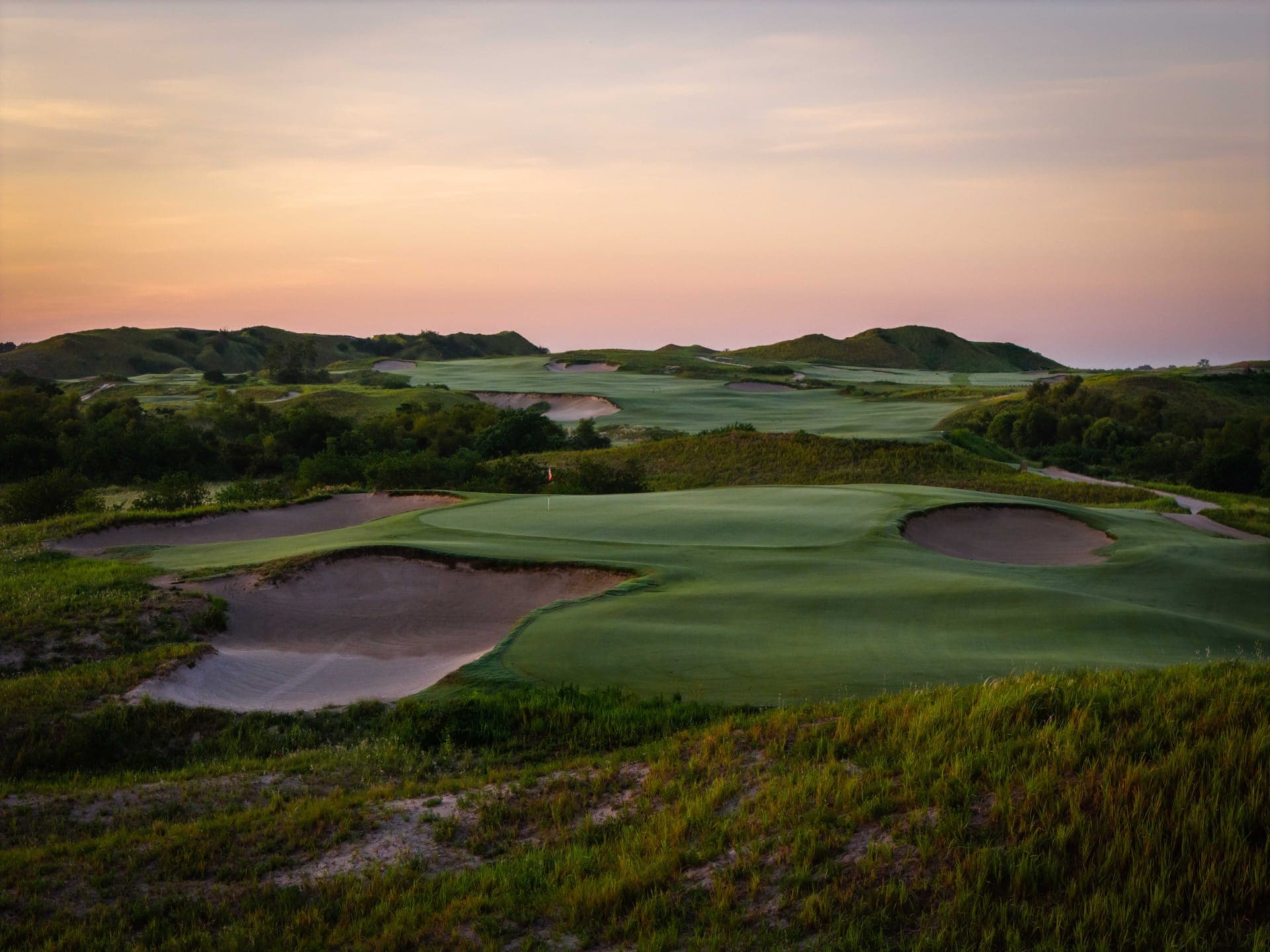
Streamsong (Red Course), Bowling Green, Florida
Tom Doak designed the Red Course on reclaimed phosphate mining land in central Florida, and the terrain is genuinely surprising. The sand ridges and elevation changes bear no resemblance to the flat, manicured Florida courses that dominate the state's golf inventory. Streamsong Red plays firm, fast, and strategic, with green complexes that reward the creative shot over the stock approach. The Florida location means no fescue and no ocean wind, but the design philosophy is thoroughly rooted in links principles. Doak built a thinking course on unlikely ground, and it works.
Mammoth Dunes, Nekoosa, Wisconsin
David McLay Kidd's design at Sand Valley Resort is the most generous links-style course in America. Fairways stretch to absurd widths, some exceeding 100 yards, and the result is a course that invites golfers of every ability to play without fear. The strategic depth comes from the green complexes, which are more demanding than the fairways suggest, and from the wind, which crosses the open terrain without obstruction. Mammoth Dunes is proof that difficulty and quality are separate variables. The course is not especially hard. It is exceptionally good.
What Connects These Courses
The common thread is not aesthetics but philosophy. These courses share a commitment to firm playing surfaces, strategic width, and designs that work with the existing terrain rather than imposing artificial features upon it. They reward the golfer who can keep the ball on the ground, who reads the wind before selecting a club, and who understands that the most creative shot is not always the most obvious one. Links-style golf in America has moved well beyond imitation. The best examples have established their own identity, rooted in the principles of the original game but expressed through distinctly American landscapes.
Streamsong Red