Arcadia Bluffs — The Bluffs
Arcadia Bluffs — The Bluffs
Links-style golf on 200-foot bluffs above Lake Michigan, ranked among Golf Digest's top 100 public courses.
Designed by Warren Henderson & Rick Smith (1999)
$175–$250
Book direct via the course website
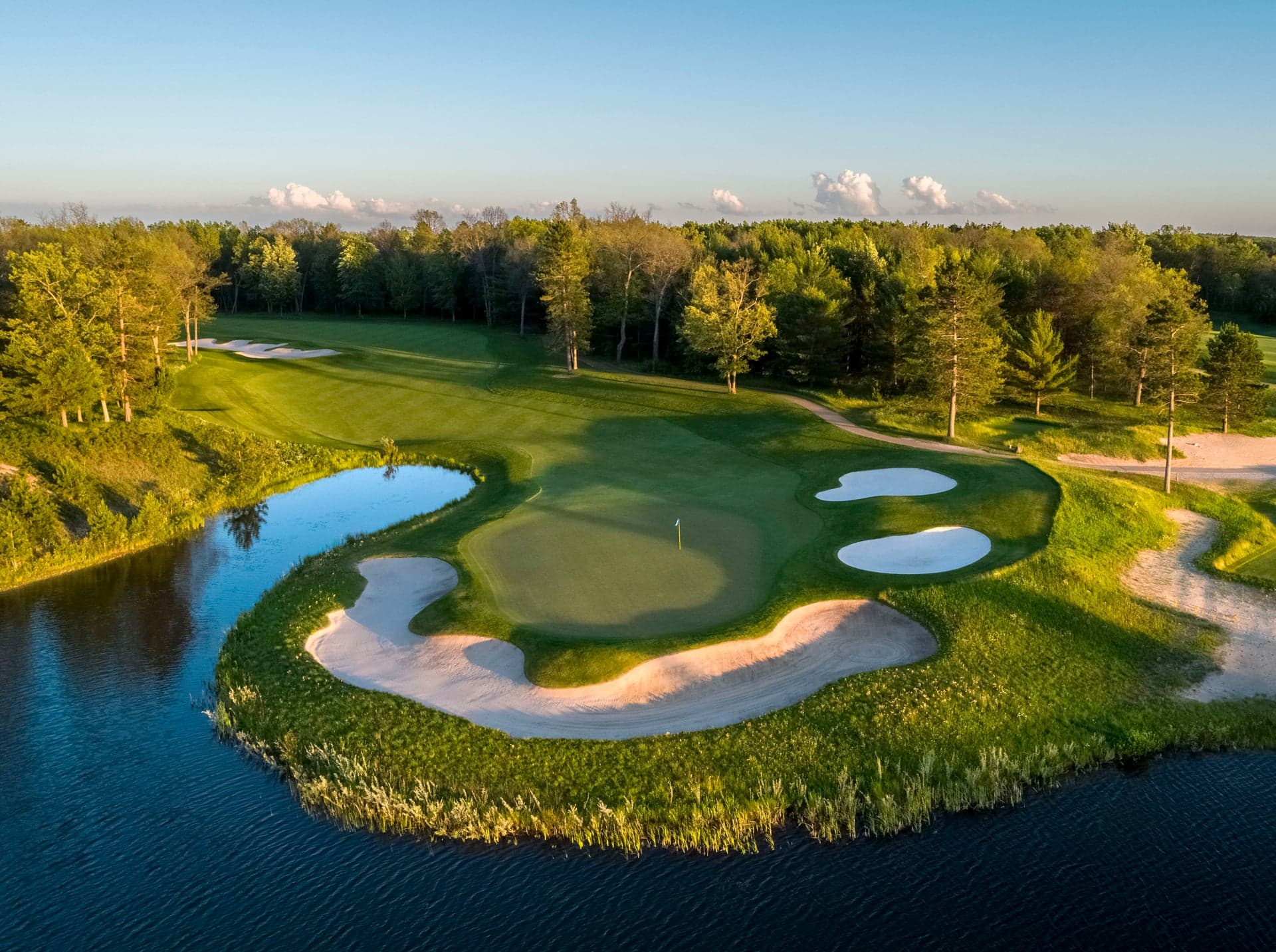
Arcadia Bluffs is the rare American links course that earns the label, perched 200 feet above Lake Michigan on genuine coastal bluffs where the wind is the course's primary defence. Warren Henderson and Rick Smith opened The Bluffs in 1999, and Golf Digest has carried it among its top 100 public courses ever since. The routing alternates between exposed clifftop holes and sheltered corridors set back from the lake, and the adjustment between the two is central to the round.
What to expect
You're playing 7,300 yards, par 72, slope 146. That slope is real. The fairways are wide by American standards, but holding them at full width when the wind is up requires a low, controlled flight. The fescue rough penalises wayward tee shots without making recovery hopeless. The greens are large, undulating, and quick.
The standout sequence runs along the cliff edge. The 11th, a par 3 that plays directly toward Lake Michigan, sits on an exposed shelf where there is nothing between you and the green but wind and nerve. The 13th, a par 5 along the cliff line, hands you a risk-reward second shot whose answer depends entirely on what the wind is doing in that moment.
By the numbers
- Par
- 72
- Yardage
- 7,300
Is it worth the green fee?
At $175 to $250, this is a meaningful spend for a public round in Michigan, and worth it. Authentic coastal links golf on terrain that wasn't manufactured for the purpose is rare in this country. If you've been disappointed by inland courses calling themselves links, this is where the difference becomes obvious.
Booking and trip fit
Walking is the way. Book a caddie if it's your first visit; reading the wind in the protected valleys versus the exposed ridges is local knowledge worth three or four strokes. Plan a four or five-day northern Michigan trip with Arcadia as the centerpiece, paired with the South Course on the same property and rounds at Forest Dunes, Boyne Highlands Heather, and a relaxed closing round at A-Ga-Ming Torch. Forty-five minutes south of Traverse City. June and September deliver the best mix of wind, conditioning, and lighter crowds.
The bottom line
Among the finest golf experiences in the Great Lakes region, particularly in early autumn when the bluffs turn gold.
Where to Stay
Accommodations near Arcadia Bluffs — The Bluffs
Boyne Highlands Resort
Resort
Boyne Highlands Resort
Northern Michigan, Michigan
Four-course resort property near Harbor Springs with the Heather and Donald Ross Memorial layouts, ski infrastructure, spa, and stay-and-play packaging.
From $150/nightOn-site (Heather, Donald Ross Memorial)
Direct websiteVisit website
Grand Traverse Resort & Spa
Resort
Grand Traverse Resort & Spa
Northern Michigan, Michigan
The largest full-service resort in Northern Michigan, with three on-site courses, bay views from the 17-story Tower, and spa facilities that anchor a complete destination property.
From $200/nightOn-site (The Bear by Jack Nicklaus); 35 mi to Arcadia Bluffs
Direct websiteVisit website

Hotel
Hampton Inn Traverse City
Northern Michigan, Michigan
Reliable chain hotel with free breakfast and pool, positioned eight miles from Grand Traverse Resort and within driving range of all Traverse City-area courses.
From $120/night8 mi to Grand Traverse Resort
ExpediaCheck availability

Resort
Inn at Bay Harbor (Autograph Collection)
Northern Michigan, Michigan
Lakefront Autograph Collection property adjacent to Bay Harbor Golf Club, with spa, marina, and the most refined lodging in the Petoskey corridor.
From $250/nightAdjacent (Bay Harbor Golf Club)
ExpediaCheck availability
Compare all stays near Arcadia Bluffs — The Bluffs
Live prices from Booking.com, Expedia and more — every nearby hotel and rental in one search.
Prices and availability from Booking.com, Expedia and others via Stay22. GolfTrailsHQ may earn a commission at no additional cost to you.
Other Courses Nearby
A-Ga-Ming — Torch
Mid-Range
A-Ga-Ming — Torch
Northern Michigan, Michigan
Hillside layout with panoramic views of Torch Lake, one of the clearest inland lakes in the United States. Twenty-five minutes from Traverse City.
$65–$105PublicJerry Matthews / Chick Harbert (1974, rerouted 2005)
Direct websiteVisit website
Arcadia Bluffs — South Course
Premium
Arcadia Bluffs — South Course
Northern Michigan, Michigan
An inland counterpart to The Bluffs with square tees and greens paying homage to golden-age architecture. Walking only.
$150–$225PublicDana Fry (2018)
Direct websiteVisit website
Bay Harbor Golf Club
Premium
Bay Harbor Golf Club
Northern Michigan, Michigan
Three distinct nines carved through a former shale quarry, a Lake Michigan shoreline, and a wooded preserve. Played in 18-hole combinations.
$200–$440ResortArthur Hills (1996)
Direct websiteVisit website
Boyne Highlands — Donald Ross Memorial
Mid-Range
Boyne Highlands — Donald Ross Memorial
Northern Michigan, Michigan
A composite course recreating 18 of Donald Ross's most celebrated holes from courses across the country.
$40–$91ResortNewcomb / Kircher / Flick (1989)
Direct websiteVisit website
Boyne Highlands — Heather
Mid-Range
Boyne Highlands — Heather
Northern Michigan, Michigan
Robert Trent Jones Sr.'s championship design and the flagship course at Boyne Highlands. Recently renovated.
$90–$176ResortRobert Trent Jones Sr (1966)
Direct websiteVisit website
Premium
Forest Dunes — Forest Dunes
Northern Michigan, Michigan
Tom Weiskopf's original Forest Dunes layout, named Best New Upscale Course in America by Golf Digest upon opening. Set among towering pines and natural sand.
$145–$215PublicTom Weiskopf (2002)
Direct websiteVisit website

Bucket List
Forest Dunes — The Loop
Northern Michigan, Michigan
The world's first reversible golf course, playing as the Black Course on odd days and the Red Course on even days. Walking only.
$145–$215PublicTom Doak (2016)
Direct websiteVisit website
Shanty Creek — The Legend
Mid-Range
Shanty Creek — The Legend
Northern Michigan, Michigan
Arnold Palmer design set in the hills above Lake Bellaire with significant elevation change and resort stay-and-play packages.
$65–$120ResortArnold Palmer (1986)
Direct websiteVisit website
Treetops Resort — Masterpiece
Mid-Range
Treetops Resort — Masterpiece
Northern Michigan, Michigan
Robert Trent Jones Sr.'s Gaylord design with elevation changes up to 300 feet. Named second-best new course in America by Golf Digest in 1987.
$80–$145ResortRobert Trent Jones Sr (1987)
Direct websiteVisit website
Plan Your Trip
Explore Northern Michigan
Full guide: courses, stays, getting there.
Continue →3 Itineraries
Pre-planned trips to Northern Michigan.
Continue →Off the Fairway
10 non-golf activities at Northern Michigan.
Continue →