Streamsong Resort: Best Courses Guide
Streamsong sits on 16,000 acres of reclaimed phosphate mining land in Polk County, Florida, roughly 80 miles from Tampa and about the same from Orlando. Nothing in the surrounding landscape of cattle ranches and citrus groves prepares the visitor for what the mining operation left behind: sand ridges, deep hollows, and exposed mineral terrain that more closely resembles the linksland of coastal Scotland than anything typically found in central Florida. Three architects saw this terrain at different moments over a five-year span and produced three courses that rank among the finest built in the United States this century. The question visitors ask most often is which course is the best. The honest answer is that it depends entirely on what the golfer values.
Where to stay in Streamsong
Planning the trip? Compare live prices across every nearby hotel and rental in one search.
Prices and availability from Booking.com, Expedia and others via Stay22. GolfTrailsHQ may earn a commission at no additional cost to you.
Streamsong Red — Coore and Crenshaw (2012)
The mining remnants here produced tall sand ridges that rise and fall across the routing, creating a sequence of holes that constantly shifts perspective. At 7,150 yards and par 73, the Red plays through these landforms with the light-touch philosophy that has defined Coore and Crenshaw's career from Sand Hills in Nebraska to Bandon Trails in Oregon. The architects moved as little earth as possible, trusting that the existing terrain was more interesting than anything they could manufacture.
Bill Coore and Ben Crenshaw built the Red course on the portion of the property with the most dramatic elevation changes.
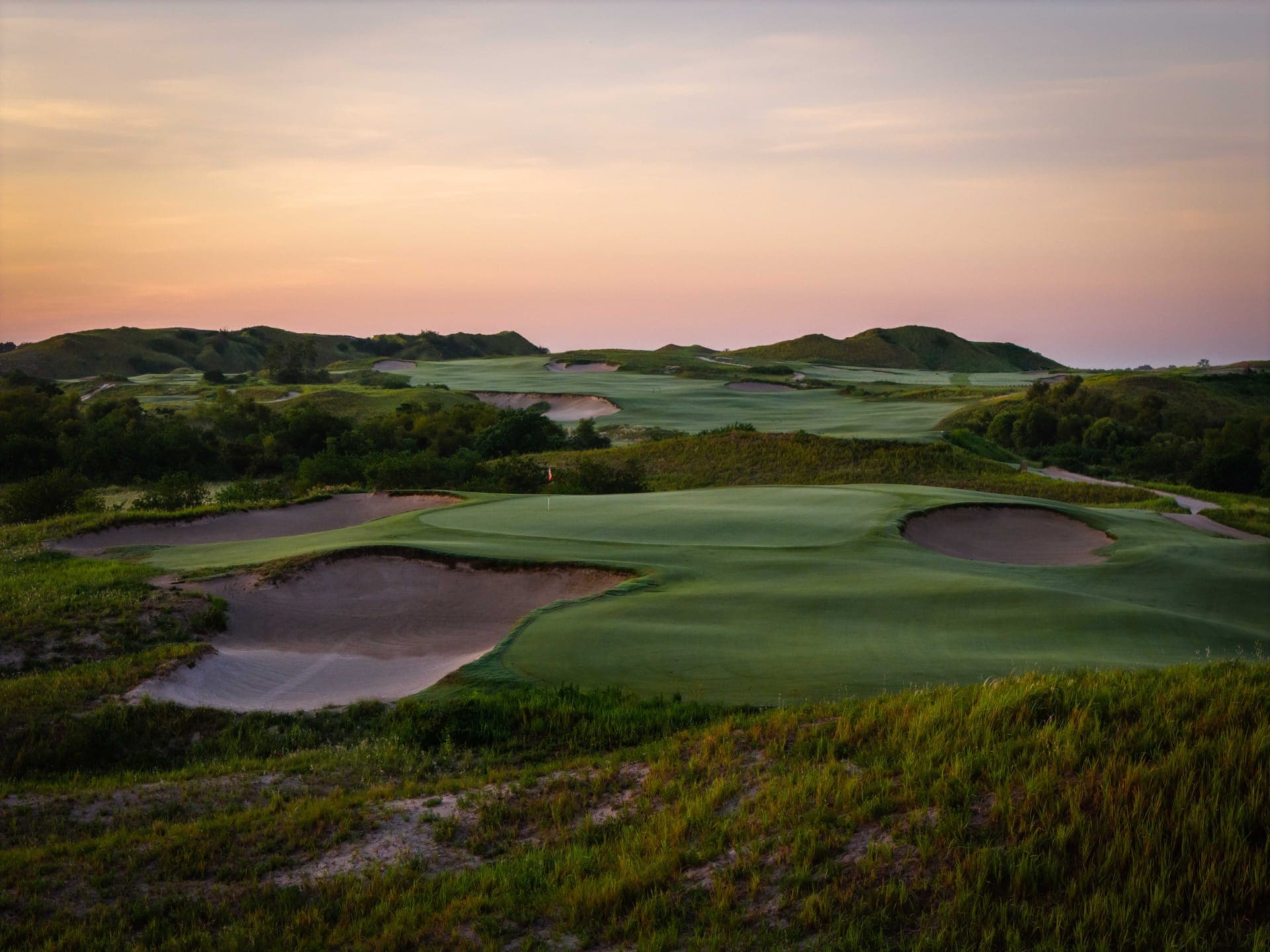
Streamsong Red
The result is a course that feels organic in a way that few modern designs achieve. Fairways are wide, but the internal contours within those fairways determine everything. A drive that finds the short grass on the wrong side of a subtle ridge leaves an approach complicated by an uneven stance, a partially obscured pin, or both. The greens reward creativity and a willingness to use the ground. Running approaches, bump-and-run recoveries, and low trajectories under the wind are all viable strategies, and frequently the preferred ones.
The 7th hole, a short par 4 with a punchbowl green, captures the Red's character precisely. Multiple lines exist from tee to green, and the correct choice depends on pin position, wind, and the golfer's confidence in a particular shot shape. The 16th, a reachable par 5 with a deep waste area guarding the green, presents a genuine risk-reward moment that rewards clear thinking over raw power. Throughout the routing, the Red asks the golfer to consider options rather than simply execute a stock shot to a defined target.
The Red suits golfers who enjoy the ground game, who find satisfaction in reading terrain, and who prefer a course that suggests rather than demands. It is the most approachable of the three Streamsong courses for mid-handicap players, though the greens will test everyone equally.
Streamsong Blue — Tom Doak (2012)
Tom Doak designed the Blue simultaneously with the Red's construction in 2012, working from the same reclaimed mining land but on a parcel with different characteristics. The Blue occupies slightly lower terrain with broader landforms, and Doak used this openness to build a course that operates through strategic depth rather than visual spectacle. First-time visitors often rank the Blue third among the three courses. Repeat visitors, and particularly those who study golf architecture, tend to revise that opinion upward with each return trip.
The fairways on the Blue are generous in width. This is deliberate, and it is also a trap. Width without understanding is not advantage here. The internal contours of those fairways create preferred sides for every approach, and a drive that finds the wrong half of the short grass leaves the golfer with a significantly more difficult second shot. Doak's genius on the Blue is in making the difficulty invisible to the casual observer while ensuring that the attentive player recognizes the choices being offered on every hole.
The greens are large and complex, with enough internal movement to create four or five functionally different pin positions on many surfaces. Firmness is maintained at a level that punishes the wrong angle of approach while rewarding the player who has thought two shots ahead. The par-3 set across the eighteen holes is particularly strong, each presenting a different combination of distance, wind exposure, and green shape.
At 7,200 yards and par 72, the Blue is numerically similar to the Red but plays as a different examination entirely. Where the Red rewards instinct and feel, the Blue rewards planning and patience. It is the course that reveals new layers on every visit, the one most likely to change a golfer's ranking of the three after a second or third round.
Streamsong Black — Gil Hanse (2017)
Gil Hanse arrived five years after the Red and Blue opened and built the Black on a separate parcel that produced broader, more open landforms. At 7,300 yards and par 73, it is the longest and most visually striking of the three courses. Hanse, whose work includes the renovation of Merion Golf Club and the Olympic Course in Rio de Janeiro, brought a minimalist bunkering style that uses fewer hazards than either sibling but places each one with surgical intent. Where sand does appear, it tends to be deep and steep-faced. Where it does not, the greens and the surrounding ground contours serve as the primary defense.
The playing surfaces on the Black are maintained firm and fast, more aggressively so than the Red or Blue in most conditions. Approach shots that arrive without the correct trajectory release through the greens and into collection areas that demand a creative short game. The greens themselves carry the boldest contours on the property, with slopes that make lag putting a genuine skill rather than an afterthought. The variance between a good round and a poor one on the Black is wider than on either of the other courses, and that variance is a feature of the design rather than a flaw.
The Black's open terrain and sand-based turf give it the most distinctly links-like character of the three courses. Wind is a constant factor on the exposed holes, and the routing ensures that it shifts direction throughout the round. The wide corridors off the tee offer generous landing areas, but the severe greens ensure that scoring requires precision in the approach game regardless of how well the driver is performing.
The Black suits the golfer who values firm conditions, minimalist architecture, and a course that insists on quality execution.
It is the most demanding of the three, particularly around and on the greens, and it rewards the player whose short game can match the challenge.
The Chain and The Gauntlet
Beyond the three championship courses, Streamsong offers two additional experiences that fill the margins of the day. The Chain, a 19-hole short course designed by Tom Doak, opened alongside the Black in 2017. It plays at roughly 2,400 yards with a par of 46, requires no tee times, and is walking only. The format is ideal for late afternoon rounds that finish in ninety minutes, and Doak applied the same design intelligence here that he brought to the Blue. The Gauntlet, a putting course, provides social entertainment in the hours before dinner. Neither is filler. Both are genuine design accomplishments at a smaller scale.
Southern Hills Plantation — The Off-Resort Option
Tip
Choosing Between the Three
The temptation to rank Streamsong's courses definitively is strong and should be resisted. All three hold positions in major national rankings, and the differences between them are matters of philosophy rather than quality. The Red is the most intuitive, the course that works with the golfer's instincts and rewards a creative ground game. The Blue is the most intellectual, the course that improves most dramatically with repeated play. The Black is the most demanding, the course that separates precision from approximation most directly.
Green fees across all three courses range from $200 to $325 depending on season, with peak rates from October through May and reduced pricing during the warmer months. play is open to overnight guests and day-play visitors at the resort, which means a Streamsong visit is inherently a multi-round commitment. Three nights is the minimum that does the property justice, enough to play all three championship courses with an afternoon session on The Chain. Four nights allows a second round on whichever course left the strongest impression.
The verdict