Streamsong / Central Florida: The Complete Golf Trip Guide
Eighty miles southeast of Tampa, past the last strip mall and the last chain restaurant, Highway 17 enters a stretch of central Florida that bears no resemblance to the state's coastal identity. The land rolls. Sand ridges rise sixty feet above the surrounding cattle prairie. The horizon is empty in every direction. This is Polk County, and for decades the primary industry here was phosphate mining, an extraction process that stripped the topsoil, churned the subsoil, and left behind a scarred landscape of sand dunes, deep depressions, and mineral waste. It was not beautiful. It was not useful. And then someone built three of the best golf courses in the southeastern United States on top of it.
Streamsong Resort opened in 2012 with a proposition that sounded improbable on paper: a destination golf resort in the middle of Florida cattle country, ninety minutes from the nearest city, with no beach, no theme park, and no surrounding town. The courses would be designed by architects whose names carried weight in design circles but meant nothing to the casual resort golfer. The terrain would be former phosphate mines. The isolation would be total.
A decade later, the improbable proposition has become one of the most respected golf destinations in the country, and the isolation that seemed like a liability has proven to be the defining asset.
Where to stay in Streamsong
Planning the trip? Compare live prices across every nearby hotel and rental in one search.
Prices and availability from Booking.com, Expedia and others via Stay22. GolfTrailsHQ may earn a commission at no additional cost to you.
The Courses
Three architects. Three courses. Three distinct philosophies operating on the same reclaimed mining land. This concentration of design talent on a single property is without precedent in American golf. Bandon Dunes has five courses, but they accumulated over two decades. Streamsong delivered three elite designs within five years, each one a complete statement from its architect.
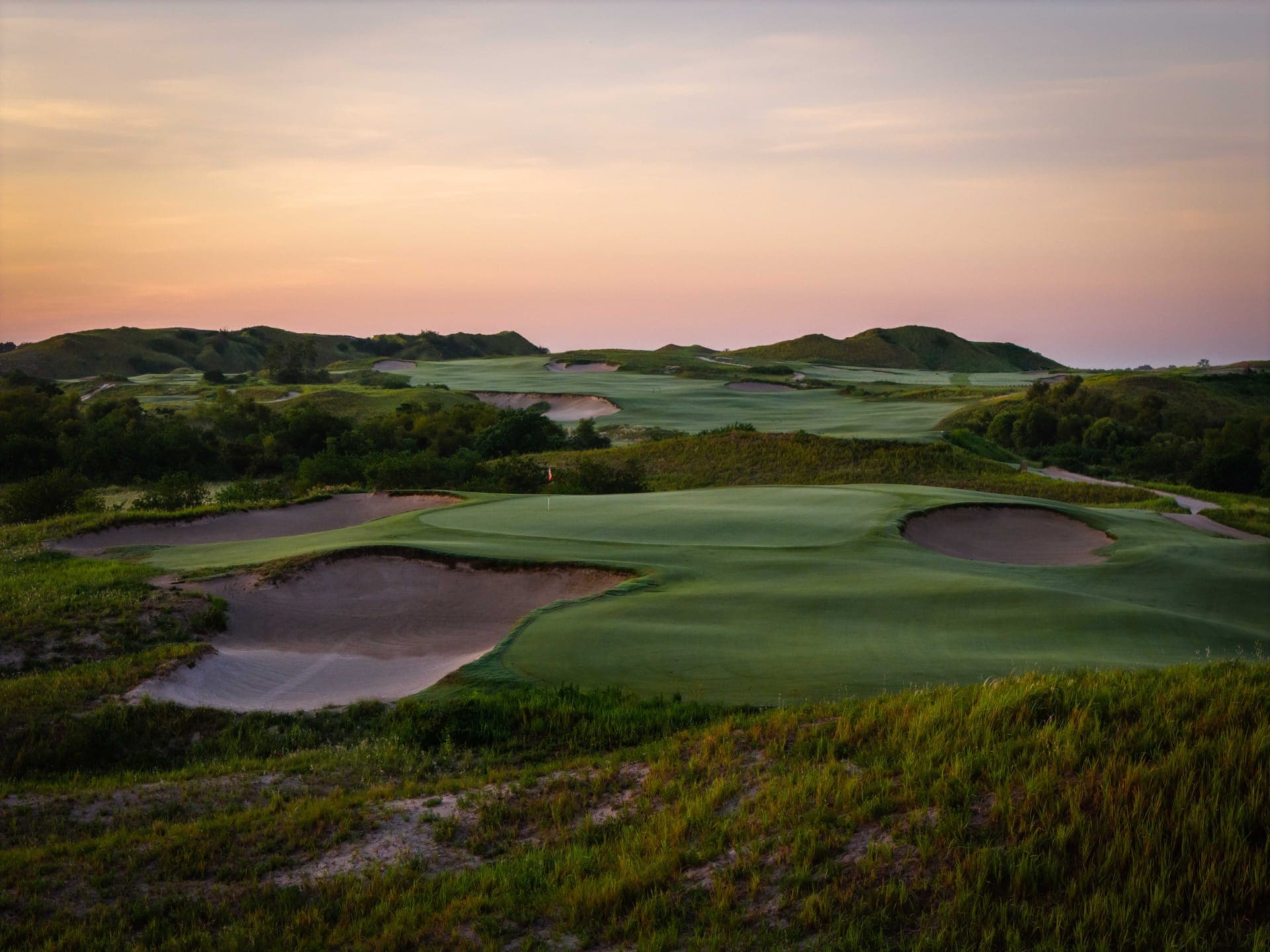
Streamsong Red
Streamsong Red opened in 2012 under Tom Doak's direction. At 7,148 yards and a par of 72, it occupies the most dramatic terrain on the property, routing through sand ridges that create elevation changes of forty to sixty feet between tee and green. The visual impact is immediate. Holes rise to exposed ridgelines where the wind is a genuine factor and drop into sheltered corridors where the challenge shifts to precision. Doak routed through the mining remnants rather than reshaping them, and the irregularity of the landforms gives the course a character that purpose-built features rarely achieve. The seventh, a short par four with a punchbowl green, rewards creativity. The twelfth, a long par three across a valley to an elevated shelf, rewards conviction. The Red makes the strongest first impression of the three courses and most clearly demonstrates what phosphate terrain can become under the right architect's eye.
Streamsong Blue, also by Doak and also opened in 2012, takes a fundamentally different approach on similar ground. At 7,177 yards with a slope of 142, it reads as the more welcoming course. The fairways are wider. The landing areas are more generous. This generosity is deliberate, and it is also misleading. The Blue's difficulty lives in the internal contours of its fairways and greens. A drive that finds the short grass but lands on the wrong side of a gentle ridge leaves an approach complicated by an uneven lie, a partially obscured pin, or both. The optimal line from the tee is often not the obvious one. Among golfers who have played all three courses multiple times, the Blue tends to gain ground with repetition. It is the course that architects and students of design most frequently cite as their favourite of the three, precisely because it reveals its logic slowly rather than announcing it.
Streamsong Black arrived in 2017 from Gil Hanse. At 7,311 yards with a par of 73 and a slope of 146, it is the longest and most difficult of the three by every measure. Hanse's minimalist bunkering style gives the Black a cleaner visual appearance than either Doak design, but the firmness of the playing surfaces and the boldness of the green contours make it the most punishing layout for golfers who play without a plan. The recovery game around the Black's greens is where the course separates itself. Collection areas and false fronts create situations that demand creativity with a wedge in hand. Where the Red rewards ambition and the Blue rewards thought, the Black rewards precision and adaptability.
All three courses share a green fee range of $275 to $395 depending on season. Walking is encouraged on all three, caddies are available, and first-time visitors should hire one without hesitation. The terrain's elevation changes and the greens' subtle contours are difficult to read without local knowledge, and a caddie who knows the courses will save strokes that no amount of yardage-book study can recover.
The Chain, a Tom Doak design that opened alongside the Black in 2017, is a 19-hole short course playing to a par of 46 at roughly 2,400 yards. It operates without tee times, is walking only, and costs $50 to $75 as an add-on. The Chain is designed for the golden hour, when the main courses have closed and the late-afternoon light turns the sand ridges amber. It is one of the finest short courses in the country and turns a two-round day into a three-round day without the fatigue of a third championship layout.
One operational fact overrides all others: Streamsong is a resort that also offers day-play tee times. Playing any course requires an overnight stay at the resort. Day golf can be booked within a 21-day window without an overnight stay.
Where to Stay
The accommodation decision at Streamsong is simple, because the courses require it. The resort's 228-room lodge sits between the three championship courses, and the car stays parked from check-in to checkout. Rooms run $300 to $500 per night during peak season. Stay-and-play packages that bundle accommodation with rounds are the standard booking method and typically reduce the effective per-round cost. The resort operates three restaurants, a full-service spa, bass fishing on private lakes, and a 15-station sporting clays course. It is comfortable without being ostentatious, which suits a property built around golf rather than around the idea of luxury.
The lodge functions as the social centre of the trip. Dinner after a day of walking 36 holes has a ritual quality, and the conversations that happen over post-round drinks at the lakeside fire pits are part of the Streamsong experience. This is not a resort where people retreat to their rooms at seven o'clock.
For golfers seeking to reduce costs, off-site options exist but carry trade-offs. The Holiday Inn Express in Bartow, twenty miles away at $80 to $130 per night, serves as a functional base. The Terrace Hotel in Lakeland, a boutique property at $130 to $200, offers more character at forty miles' distance. The Hampton Inn in Lakeland runs $100 to $160. Staying off-site saves money on lodging but adds daily driving and, critically, separates the golfer from the resort's evening atmosphere. The savings are real. The trade-off is meaningful.
Getting There
Tip
The drive itself is part of the transition. The landscape changes gradually as the Tampa sprawl gives way to farmland and the farmland gives way to the open prairie of the phosphate country. By the time the resort entrance appears, the world outside has simplified to grass, sky, and sand. The decompression happens before check-in, which is by design.
When to Visit
Peak season runs November through April. January and February deliver ideal conditions: highs in the low 70s, lows in the low 50s, firm turf, consistent sunshine, and humidity that feels moderate by Florida standards. March and April warm to the upper 70s and low 80s. Weekend tee times fill well in advance, and weekday availability from January through March requires early booking.
These six months produce the best course conditions and the highest demand.
May and October are the shoulder months that reward flexible schedules. May highs average 88 degrees, warm but manageable with early tee times. October averages 85 as summer humidity breaks. Both months carry reduced rates, improved availability, and the same course quality. For golfers who can choose their dates, these two months represent the best intersection of value and playability.
June through September is off-peak for good reason. July and August highs average 92 degrees with humidity that compounds the heat substantially. Daily afternoon thunderstorms arrive between two and five o'clock and can end play for the day. Green fees drop to their annual floor, but the physical demands of walking 19 holes in central Florida summer heat are significant. If visiting in these months, book the earliest available tee times and plan to be finished by early afternoon.
Regardless of season, pack sunscreen and a hat. The mining terrain is exposed, shade is scarce on most holes, and Florida sun is unforgiving even in the cooler months.
What It Costs
A standard Streamsong trip builds around a two-or-three-night stay at the resort with rounds on all three championship courses and a session on The Chain. At peak-season rates, that means $300 to $500 per night for lodging, $275 to $395 per round for green fees, $50 to $75 for The Chain, and $40 to $90 per person for dinner. Caddie fees, typically $50 to $60 per bag plus tip, add a line item that first-time visitors sometimes underestimate. The total for a three-night, three-round peak-season trip runs approximately $1,800 to $3,000 per person, depending on room category and whether packages are used.
Stay-and-play packages are the most efficient booking method and should be the default approach. They bundle lodging and rounds at rates below the a la carte total, and they simplify the logistics of coordinating tee times across all three courses.
Shoulder-season pricing reduces the total by 20 to 30 percent. Off-peak drops further. The courses do not change quality with the calendar. The conditions firm up in the cooler months, but the designs are compelling year-round.
For context: a comparable trip to Bandon Dunes runs $2,500 to $4,000 per person for three nights and four rounds. Pebble Beach, with a single round at the flagship course, exceeds that range before lodging is factored in. Streamsong delivers three courses from architects of equivalent reputation at a lower total cost than either comparison, with significantly easier logistics.
The Case for Streamsong
The question that Streamsong answers is one that most golfers never think to ask: what happens when you give three of the best course architects in the world the same improbable canvas and the freedom to interpret it independently? The answer, it turns out, is three courses that share a landscape but almost nothing else in design philosophy, creating a trip where every round feels like a different conversation with the same terrain.
The isolation is real. There is no town to walk after dinner, no beach at the end of the day, no cultural district to explore on a rest morning. The resort grounds and the courses themselves are the destination. For golfers who treat the golf as the primary purpose of the trip rather than one component of a broader vacation, that narrowness is not a concession. It is the entire appeal.
The verdict