Pinehurst: Course History & Design Story
Pinehurst exists because a Boston philanthropist needed somewhere warm to recover from his health. James Walker Tufts, who had made his fortune manufacturing soda fountains, purchased 5,000 acres of logged-over timberland in the North Carolina Sandhills in 1895 for roughly one dollar per acre. The land had been stripped of its longleaf pine forests and was considered economically exhausted. Tufts saw an opportunity for a health resort in the mild winter climate, and he engaged Frederick Law Olmsted to plan the village. Golf was, initially, an afterthought.
Where to stay in Pinehurst & the Sandhills
Planning the trip? Compare live prices across every nearby hotel and rental in one search.
Prices and availability from Booking.com, Expedia and others via Stay22. GolfTrailsHQ may earn a commission at no additional cost to you.
Donald Ross Arrives
The resort's first golf course, a rudimentary nine-hole layout, opened in 1898. It was replaced by an eighteen-hole course in 1899, designed by John Dunn Tucker. Both were adequate for the resort's early clientele, who viewed golf as one recreation among many. The arrival of Donald Ross in 1900 changed the trajectory of Pinehurst, the Sandhills, and, arguably, American golf architecture.
Pinehurst No. 2
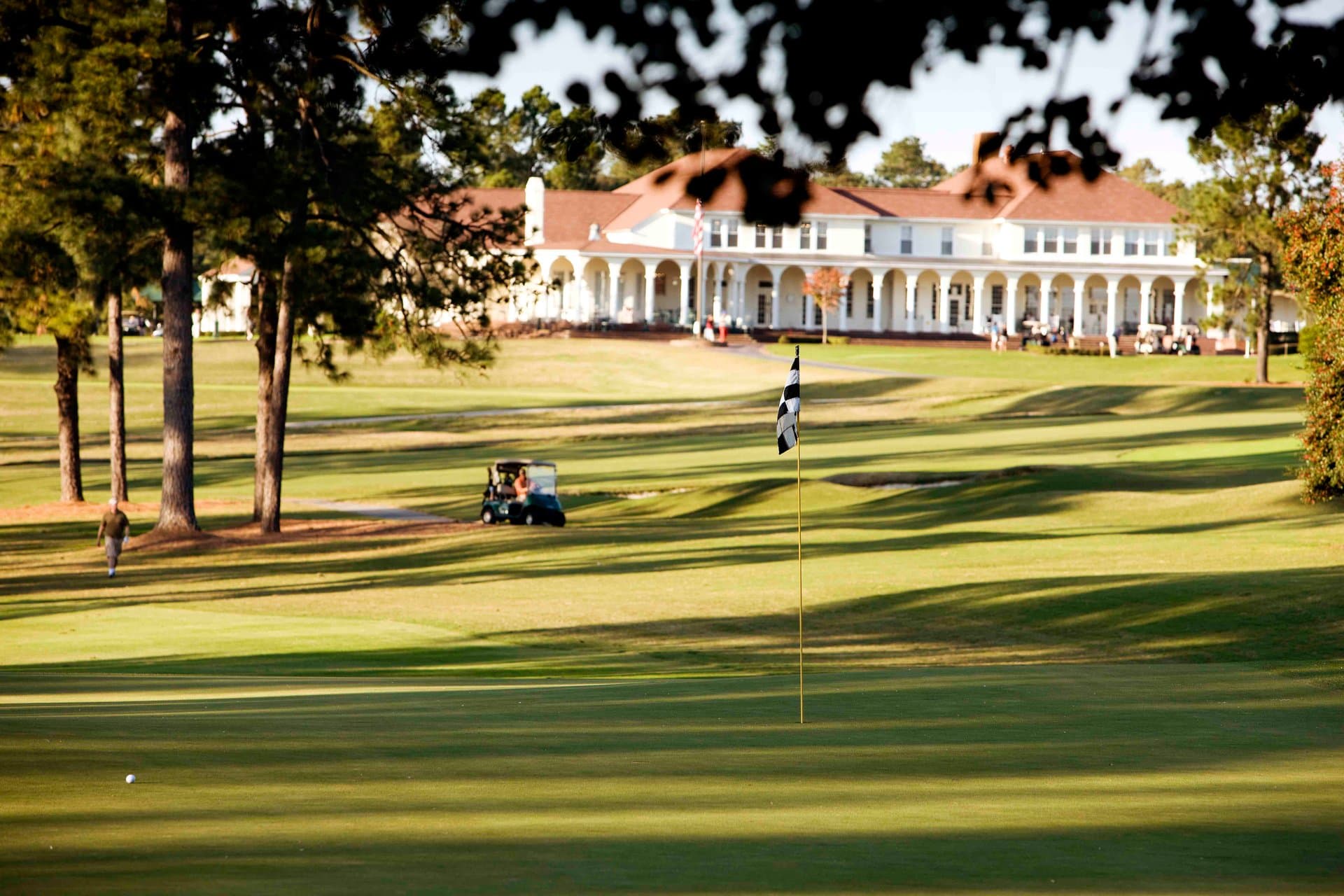
Ross was a young Scotsman from Dornoch who had trained under Old Tom Morris at St Andrews. Tufts hired him as the head professional and golf superintendent, roles that encompassed everything from giving lessons to maintaining the turf to designing new holes. Ross began redesigning the existing course, which became Pinehurst No. 1, and then turned to the project that would define his career: Pinehurst No. 2.
The course that Ross built on No. 2 evolved over decades rather than arriving in a single construction campaign. He began work in 1901 and continued refining the design through multiple iterations until the 1940s. The routing moved through the Sandhills landscape of wire grass, longleaf pine, and sandy soil, terrain that drains quickly, resists lush turf growth, and produces firm, fast playing conditions when maintained according to the land's natural inclinations.
The greens at No. Ross designed them as crowned, convex shapes that shed balls from their edges, rewarding approaches that land in the correct quadrant and penalizing those that miss by even modest margins. The difficulty is not immediately visible. From the fairway, the greens appear receptive. The slopes reveal themselves only when a ball that seemed well-struck rolls off the putting surface and settles in a collection area from which an up-and-down requires genuine skill. This principle, the idea that a green complex can be both visually simple and strategically demanding, became the central concept in Ross's design philosophy and influenced generations of architects who followed.
2 are the course's defining feature and the most influential putting surfaces in American golf.
The Championship Course
The USGA recognized No. 2's significance early, awarding the resort its first major championship in 1936 (the PGA Championship, match play format). The U.S. Open came to Pinehurst in 1999 and returned in 2005, 2014, and 2024. The 1999 Open, won by Payne Stewart with a putt on the 72nd hole that has been immortalized in a bronze statue outside the clubhouse, remains the event most closely associated with the course. Stewart died in a plane crash four months later, and the statute occupies a place in the resort's identity that extends well beyond golf.
The 2014 U.S. Open was unprecedented in USGA history: both the men's and women's championships were contested on the same course in consecutive weeks. The decision was partly logistical and partly symbolic, a statement that No. Both events validated the choice. The course, set up with firm and fast conditions that rewarded ground-game creativity, received uniformly positive reviews from players and observers.
2's design was rigorous enough to test the best players regardless of gender.
The Coore and Crenshaw Restoration
The most significant intervention in No. 2's modern history was the 2010 to 2011 restoration led by Bill Coore and Ben Crenshaw. Over decades, the course had drifted from Ross's original vision. Bermuda rough had been allowed to encroach on the native sandy waste areas. Trees had been planted or allowed to grow in locations that narrowed corridors Ross had intended to be open. The result was a course that played as a target-golf test rather than the strategic, ground-based design Ross had built.
Coore and Crenshaw removed over 40 acres of maintained rough and replaced it with native wire grass and sandy waste areas, restoring the visual and strategic character of the original landscape. They removed hundreds of trees that had compromised sight lines and strategic options. The greens were not altered; Ross's crowned surfaces remained intact, and the restoration focused entirely on the surrounds, approaches, and corridors that frame the putting surfaces.
The result returned No. 2 to a condition closer to Ross's intent than anything the course had presented since mid-century. The sandy waste areas give players options: bump-and-run approaches, creative recovery shots, and strategic choices about angle and trajectory that bermuda rough had eliminated. The course now plays as a thinking golfer's test rather than a power test, a distinction that aligns with Ross's design philosophy as documented in his own writings.
Beyond No. 2
Pinehurst Resort operates nine courses in total, and the surrounding Sandhills region adds dozens more within a thirty-minute drive. No. 4, redesigned by Gil Hanse in 2018, is the strongest complement to No. 2 on the property. Hanse introduced strategic width, bold bunkering, and green complexes that offer multiple approaches depending on pin position and wind direction. The course operates at a significantly lower green fee than No. 2 and is considered by some visitors to be the more enjoyable round.
No. 8, designed by Tom Fazio in 1996, provides the resort's most visually dramatic layout, with water features and elevation changes that depart from the Sandhills aesthetic. Nos. 1, 3, 5, 6, 7, and 9 range from Ross originals to more modern constructions, and collectively they allow a visitor to play a different course every day for a week without leaving the property.
The verdict