Orlando: Best Holes Ranked
Central Florida golf operates under a set of constraints that most resort markets do not share. The terrain is flat. Water is everywhere. Elevation change, where it exists, is manufactured. The best course architects to work in the Orlando corridor have turned these limitations into design tools, using lakes, wetlands, and strategic bunkering to create holes that demand precision over power and course management over brute distance.
What follows is a ranking of eight holes across six courses, selected for the quality of the strategic question each poses, the consequence of a poor answer, and the way the hole uses the Central Florida landscape as something more than a backdrop. Yardages are from the standard resort tees unless noted.
Where to stay in Orlando
Planning the trip? Compare live prices across every nearby hotel and rental in one search.
Prices and availability from Booking.com, Expedia and others via Stay22. GolfTrailsHQ may earn a commission at no additional cost to you.
1. Bay Hill Club & Lodge, Hole 18 — Par 4, 441 yards
The finishing hole at Bay Hill has decided more Arnold Palmer Invitational outcomes than any other single hole on the PGA Tour. The tee shot plays from an elevated position to a fairway that narrows as it approaches the water's edge on the right. The approach, typically a mid- to long-iron, must carry over the corner of the lake to a green that slopes toward the water. There is no bail-out right. Conservative players aim left and accept a difficult up-and-down from the bunker complex. Aggressive players challenge the water line and either find birdie range or find the hazard. The hole is a closing argument, and it tolerates no ambiguity.
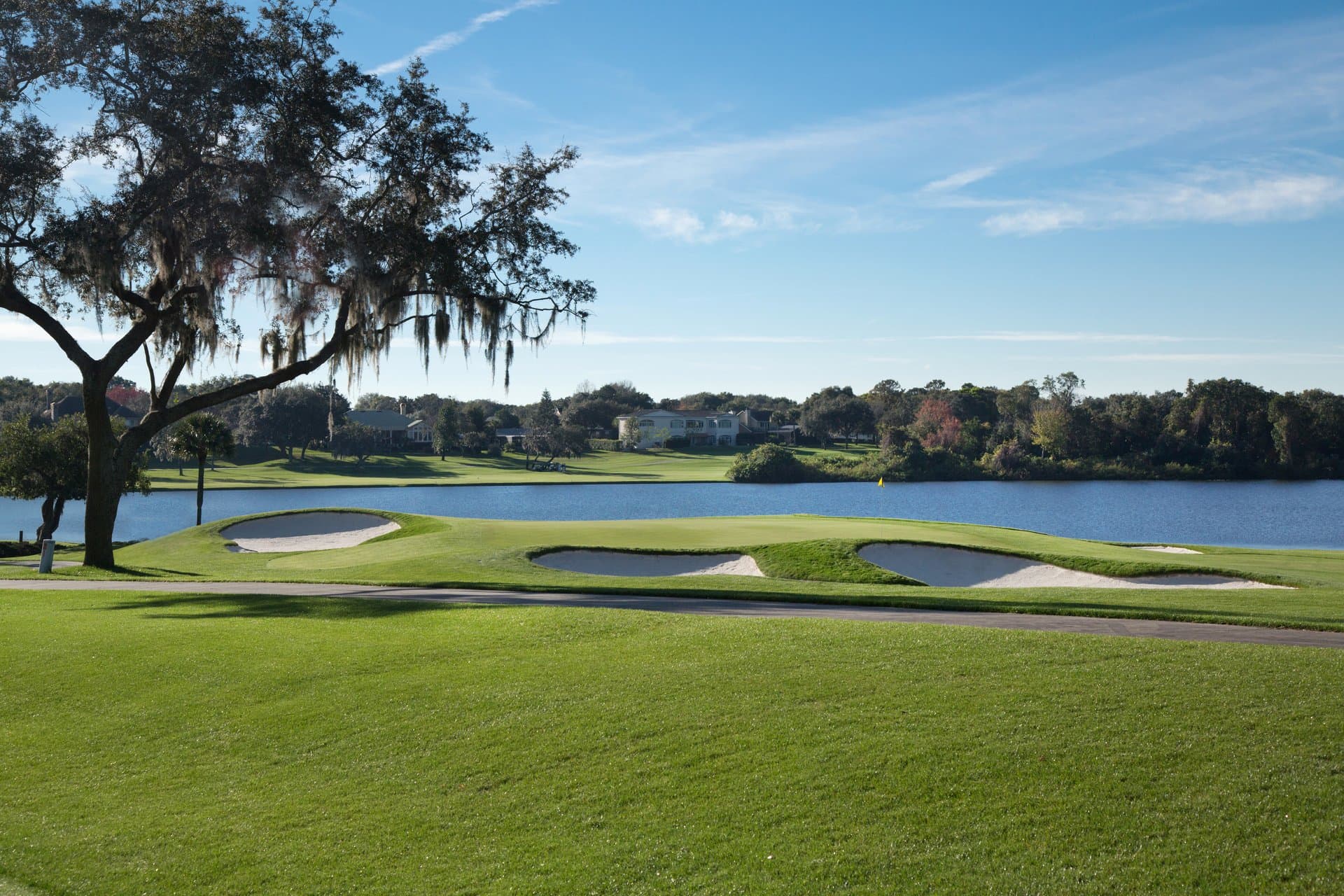
Falcon's Fire Golf Club
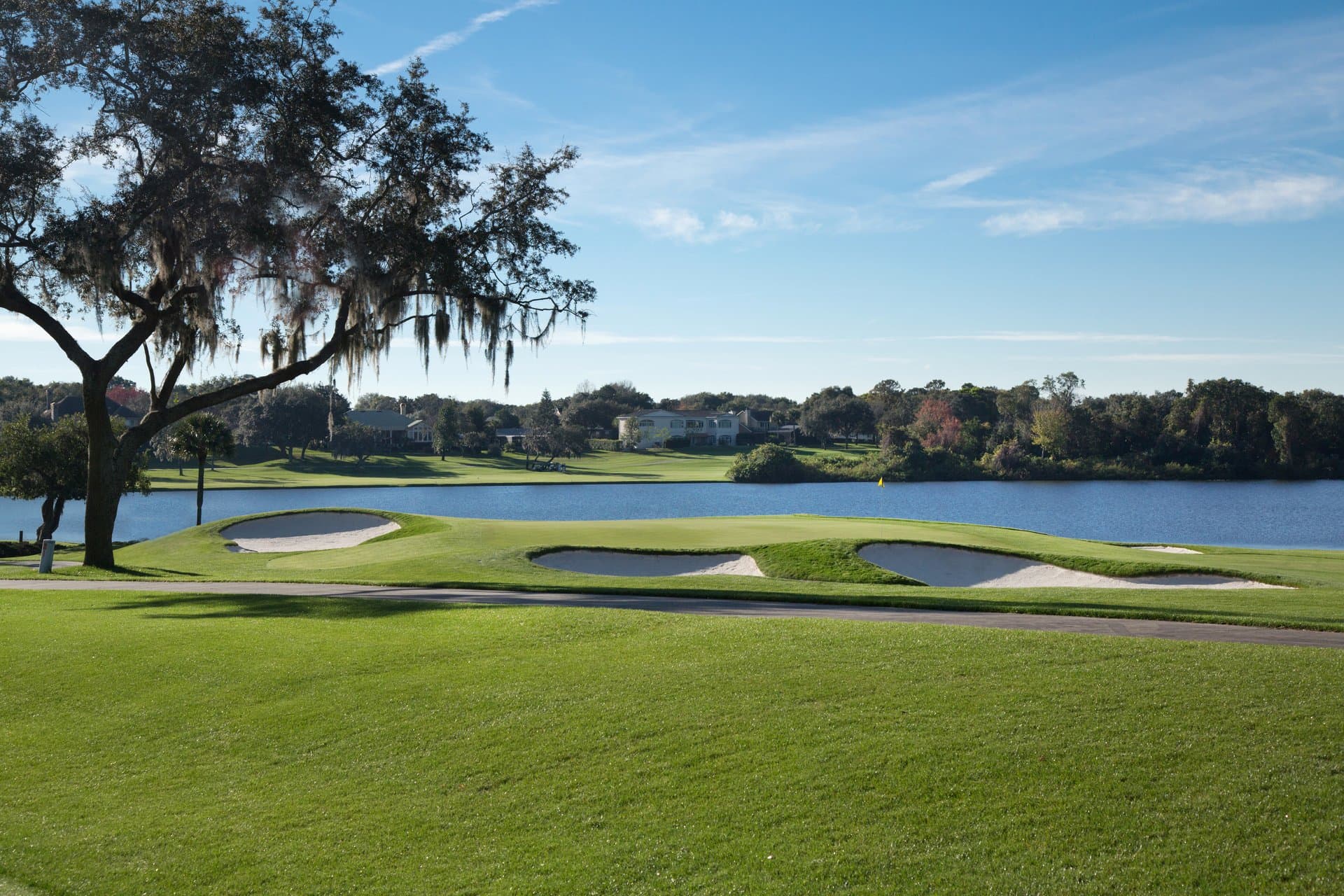
Shingle Creek Golf Club
2. Bay Hill Club & Lodge, Hole 6 — Par 5, 558 yards
The fairway doglegs left around a lake that guards the entire left side from 200 yards out to the green. Longer players who find the right side of the fairway off the tee have a legitimate chance to reach the green in two, but the carry over water requires both distance and precision. A slight pull finds the lake; a slight push finds the bunkers short-right. Played as a three-shotter, the hole is manageable. Played aggressively, it is the hole most likely to produce both eagles and double bogeys in the same foursome.
The best risk-reward hole in Central Florida presents its decision on the second shot.
3. Reunion Resort (Watson Course), Hole 7 — Par 3, 185 yards
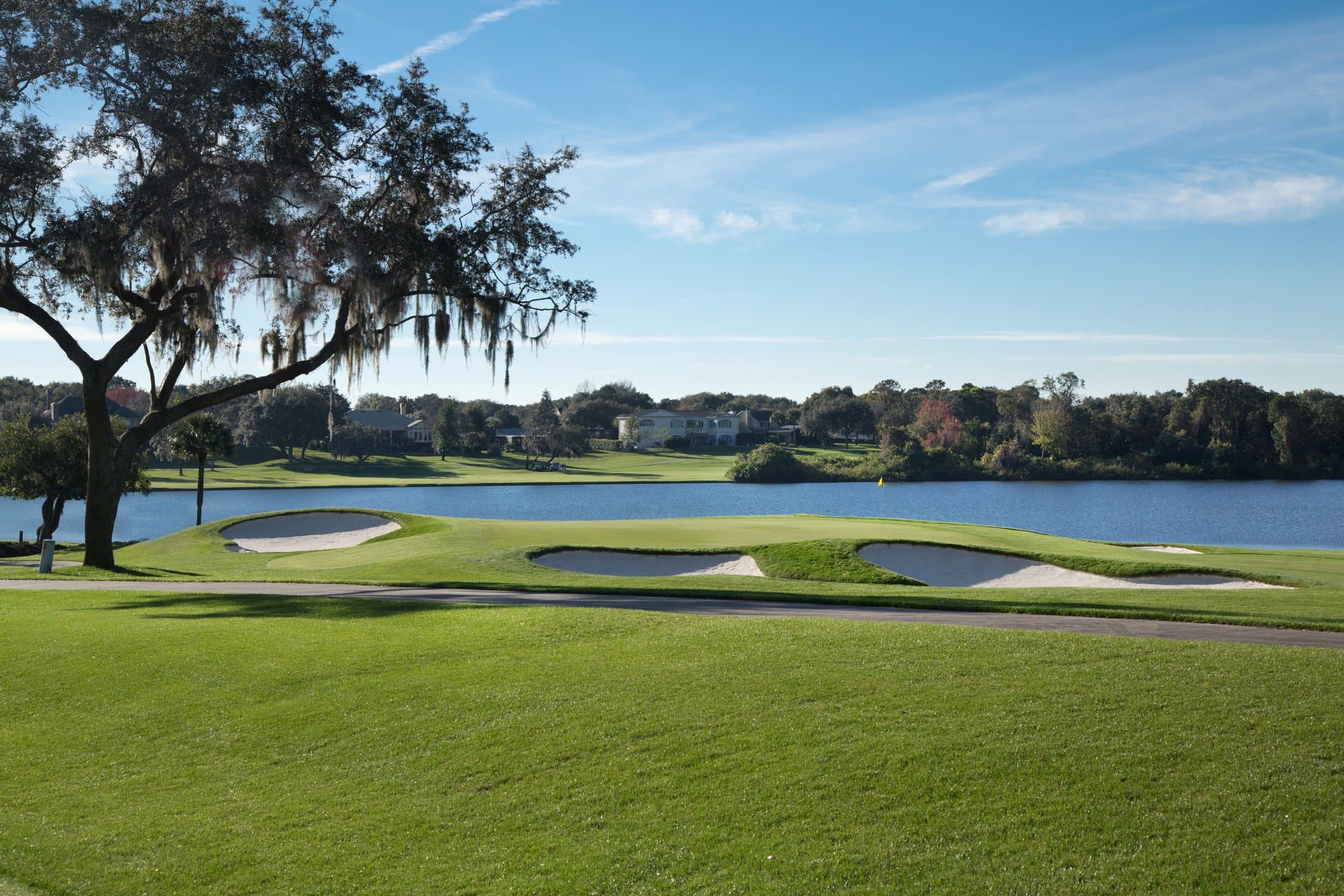
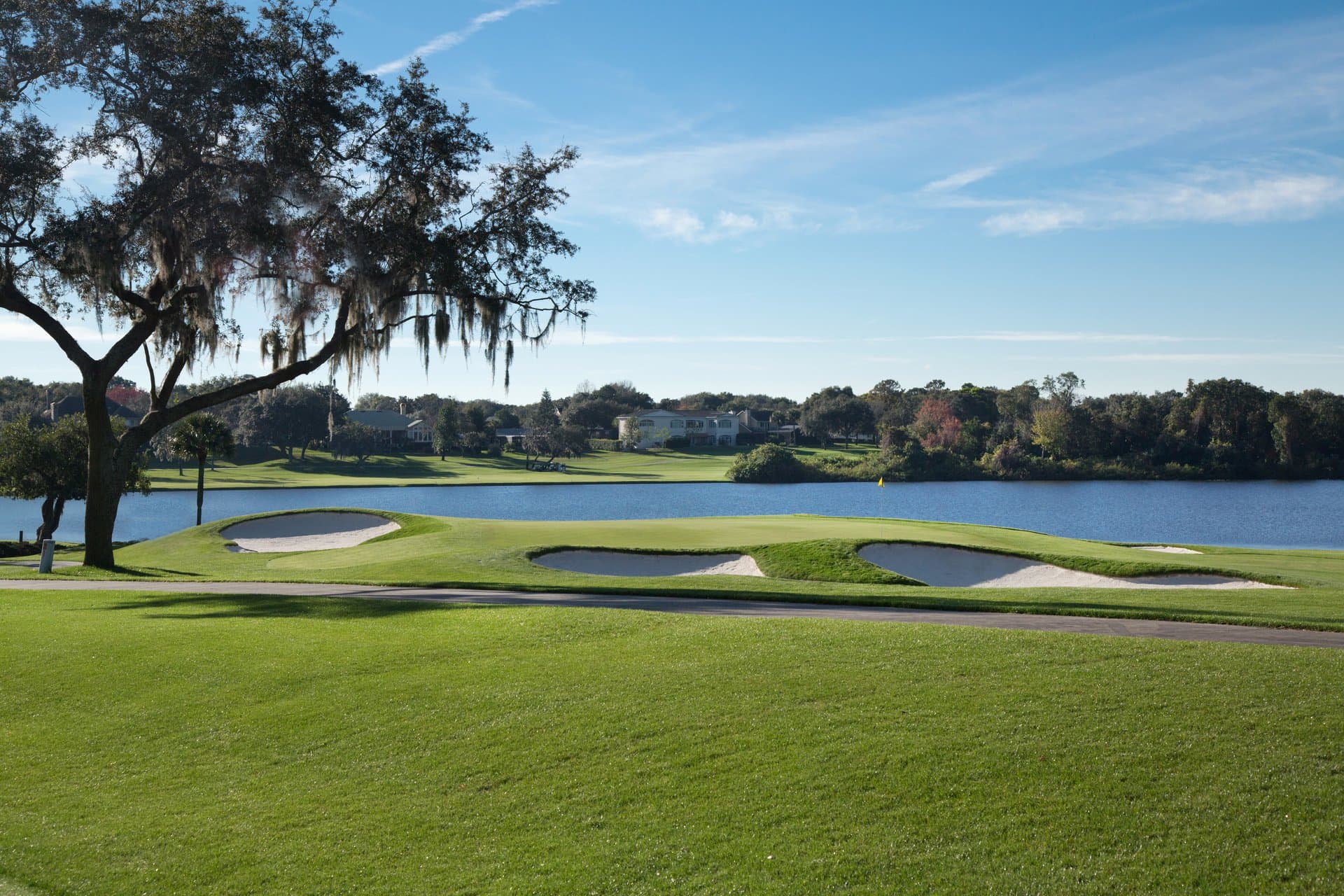
Tom Watson's par 3 over water is the most photographed hole at Reunion, and for good reason. The tee shot plays entirely over a lake to a green that is narrow at the front and widens toward the back. The pin position dictates everything: a front pin demands a precise mid-iron that lands softly on the shallowest portion of the putting surface, while a back pin allows a more aggressive swing with a larger landing area. Wind off the water is a constant variable, and the distance between a well-struck six-iron and a tentative one is the distance between a birdie putt and a penalty drop.
4. ChampionsGate (International), Hole 9 — Par 4, 449 yards
Greg Norman's International Course at ChampionsGate uses mounding and deep bunkers to create definition that the flat terrain would otherwise lack. The tee shot plays to a fairway flanked by steep-faced bunkers that narrow the landing zone to roughly thirty yards. The approach, a long iron or hybrid for most players, must find a green that is elevated above its surroundings and protected by a false front that rejects anything struck without sufficient carry. It is a hole that plays longer than its yardage and punishes imprecision at every stage.
The ninth is the best expression of this approach.
5. Orange County National (Panther Lake), Hole 18 — Par 4, 442 yards
The closing hole at Panther Lake wraps around a lake that runs the entire length of the left side. The tee shot rewards a draw that rides the water's edge, but anything that turns too aggressively disappears. The approach plays across the corner of the lake to a wide but shallow green. Phil Ritson and David Harman designed the hole to compress the round into a single decision: how much water are you willing to challenge on the final swing of the day. The answer reveals more about a golfer's state of mind than it does about technique.
6. Shingle Creek Golf Club, Hole 17 — Par 3, 197 yards
David Harman's late-round par 3 at Shingle Creek plays over marshland to an elevated green framed by bunkers and native vegetation. The carry is not optional, and the green's firm surface rewards a shot that lands at the front and releases toward the pin. Club selection is the primary test: the hole plays into the prevailing breeze on most afternoons, and the elevation change adds roughly half a club to whatever the yardage suggests. At the penultimate hole on the card, the margin for error narrows.
7. Reunion Resort (Palmer Course), Hole 15 — Par 4, 421 yards
Arnold Palmer's design at Reunion reaches its peak at the fifteenth, a dogleg-left par 4 with water guarding the inside of the turn. The tee shot demands a specific shape: a controlled draw that follows the fairway's curve without challenging the hazard. The approach plays to a green set behind a bunker complex that obscures the putting surface from anything less than the ideal angle. Players who took the conservative line off the tee face a longer, partially blind approach. The hole rewards commitment to a plan.
8. Falcon's Fire Golf Club, Hole 7 — Par 3, 201 yards
Rees Jones positioned this par 3 over a waste area to a green that is wider than it is deep, with bunkers guarding both flanks. The visual from the tee is intimidating, but the actual carry is less demanding than it appears. The real challenge arrives on the green, which features a pronounced ridge running through its center. Pin position determines strategy entirely: a front-left pin and a back-right pin are effectively two different holes. For a daily-fee course in the tourist corridor, this is an unusually cerebral one-shotter.
Tip