Kiawah Island / Charleston, SC: Best Courses Guide
The South Carolina Lowcountry has no shortage of golf, but Kiawah Island concentrates its offerings with unusual clarity. Five resort courses occupy a single barrier island 25 miles south of Charleston, anchored by a Pete Dye design that has hosted a Ryder Cup, two PGA Championships, and routinely appears on short lists of the most demanding resort-accessible courses in America. The surrounding Charleston area extends the range further, with off-island layouts that bring the total round count for a long weekend to four or five without repeating a course or a designer.
What distinguishes Kiawah from other Lowcountry destinations is the hierarchy. The Ocean Course operates at a tier few resort courses in the country can match. The remaining Kiawah Resort courses fill the mid-range with genuine design variety. And the Charleston-area layouts provide budget-conscious rounds that hold their own as golf, not just as filler. A visiting group can build a trip across all three tiers without ever feeling that a round was wasted.
Where to stay in Charleston & Kiawah Island
Planning the trip? Compare live prices across every nearby hotel and rental in one search.
Prices and availability from Booking.com, Expedia and others via Stay22. GolfTrailsHQ may earn a commission at no additional cost to you.
The Ocean Course
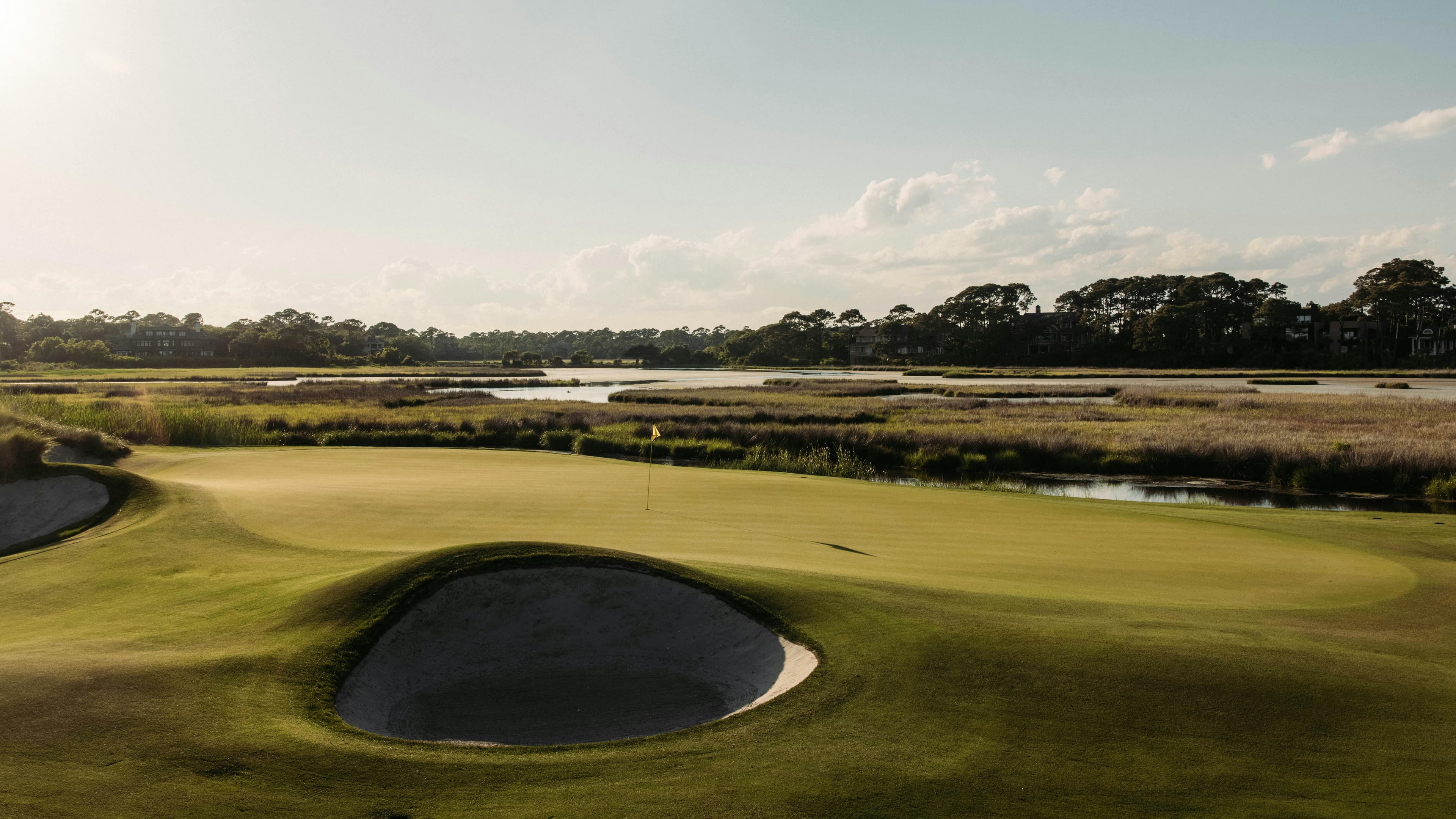
The Ocean Course, Pete Dye's 1991 design built to host that year's Ryder Cup, is the reason most golfers book a trip to Kiawah in the first place. At 7,356 yards and par 72, it is one of the longest and most exposed resort courses in the country. Every hole offers a view of the Atlantic or the adjacent marsh, and the wind off the ocean is not incidental to the design. It is the design. Dye elevated the fairways above the surrounding dunes to maximize exposure to coastal gusts, a decision that transforms a course that would be merely long in calm conditions into something altogether more serious when the wind arrives.
RiverTowne Country Club
The routing builds through marshland on the front nine before turning directly into the Atlantic on the back. The par-3 17th, with its green perched beside the ocean and the wind typically quartering from the left, demands a club selection that can shift two or three clubs depending on conditions. The 18th, a long par 4 that doglegs along the water, closes the round with the same severity it maintained throughout.
The stretch from the 14th through the 17th is among the most relentless finishes in American resort golf.
Green fees of $400 to $500 and above reflect both the course's competitive pedigree and its access restrictions. Only Kiawah Resort guests can book tee times. Walking is permitted but uncommon given the course's length and the distances between greens and tees. A caddie is the recommended way to experience the layout, both for the local knowledge on wind reads and for the pace advantage over a cart on the exposed terrain.
The Ocean Course is not the round for the first morning of a trip when the group is still shaking off travel fatigue.
It rewards preparation, patience, and an honest assessment of which set of tees will produce the most enjoyable four hours.
Osprey Point
Osprey Point, Tom Fazio's contribution to the Kiawah Resort collection, operates in a completely different register than the Ocean Course. Where Dye's design is exposed and combative, Fazio routed Osprey Point through maritime forest, lagoons, and tidal marshland with the visual softness and strategic variety that define his best work. The course is more forgiving off the tee, the greens are more receptive to approach shots, and the wind, filtered through the tree canopy, is a factor rather than a constant adversary.
At $150 to $250, Osprey Point functions as the ideal complement to an Ocean Course round. The contrast in design philosophy is genuine, not merely a difference in difficulty. Fazio's routing rewards aggressive play on the par 5s while demanding precision on a set of par 3s that use water and bunkering to protect modest yardages. The lagoon holes on the back nine are the visual highlight, with egrets and herons providing the kind of backdrop that reminds a golfer the Lowcountry is as much an ecosystem as a landscape.
Turtle Point
Turtle Point, Jack Nicklaus's 1981 design renovated in 2016, claims something no other Kiawah Resort course outside the Ocean Course can offer: three consecutive holes routed directly along the beach. The stretch from the 15th through the 17th runs parallel to the Atlantic, with the sand and surf visible from fairway level. It is a short sequence, but it redefines the round. The preceding holes move through classic Lowcountry terrain of marsh and maritime forest, competent and attractive without being exceptional. The beach holes elevate the experience.
At $150 to $250, Turtle Point occupies the same price band as Osprey Point. The choice between them often comes down to preference: Fazio's lagoon routing versus Nicklaus's beachfront finish. Groups playing both will find two distinct courses that share a commitment to resort-quality conditioning and a pace of play that keeps a round under four and a half hours.
Cougar Point and Oak Point
Kiawah Resort's remaining two courses, Cougar Point and Oak Point, serve the value tier on the island. Cougar Point, a Gary Player design renovated by Fazio, winds through marshland with a more open feel than the resort's other interior courses. Oak Point, a Clyde Johnston layout located on the mainland side of the Kiawah River, sits just outside the resort gates and plays through a mix of forest and wetlands.
Both courses carry green fees in the $100 to $175 range and provide solid Lowcountry golf without the design ambition of the Ocean Course or the scenic highlights of Turtle Point and Osprey Point. For groups playing four or five rounds during a trip, these courses fill the schedule without straining the budget. They are not destination courses on their own, but within the context of a Kiawah trip, they round out the rotation.
Off-Island Options
The Charleston area supplements Kiawah's resort inventory with courses that justify the 30- to 45-minute drive.
Wild Dunes, on the Isle of Palms north of Charleston, operates two Tom Fazio designs. The Links Course is the stronger of the two, with several holes running along the harbor and a closing stretch that catches ocean wind. The Harbor Course is shorter and more sheltered. Both sit in the $100 to $200 range and provide a credible alternative to a second round on one of Kiawah's mid-tier courses.
Patriots Point Links, in Mount Pleasant overlooking Charleston Harbor, offers the most affordable golf in the immediate Charleston orbit. The views of Fort Sumter and the Ravenel Bridge are better than the course architecture, but at $40 to $70, a round here serves as an efficient way to play on an arrival or departure day when a full resort round is impractical.
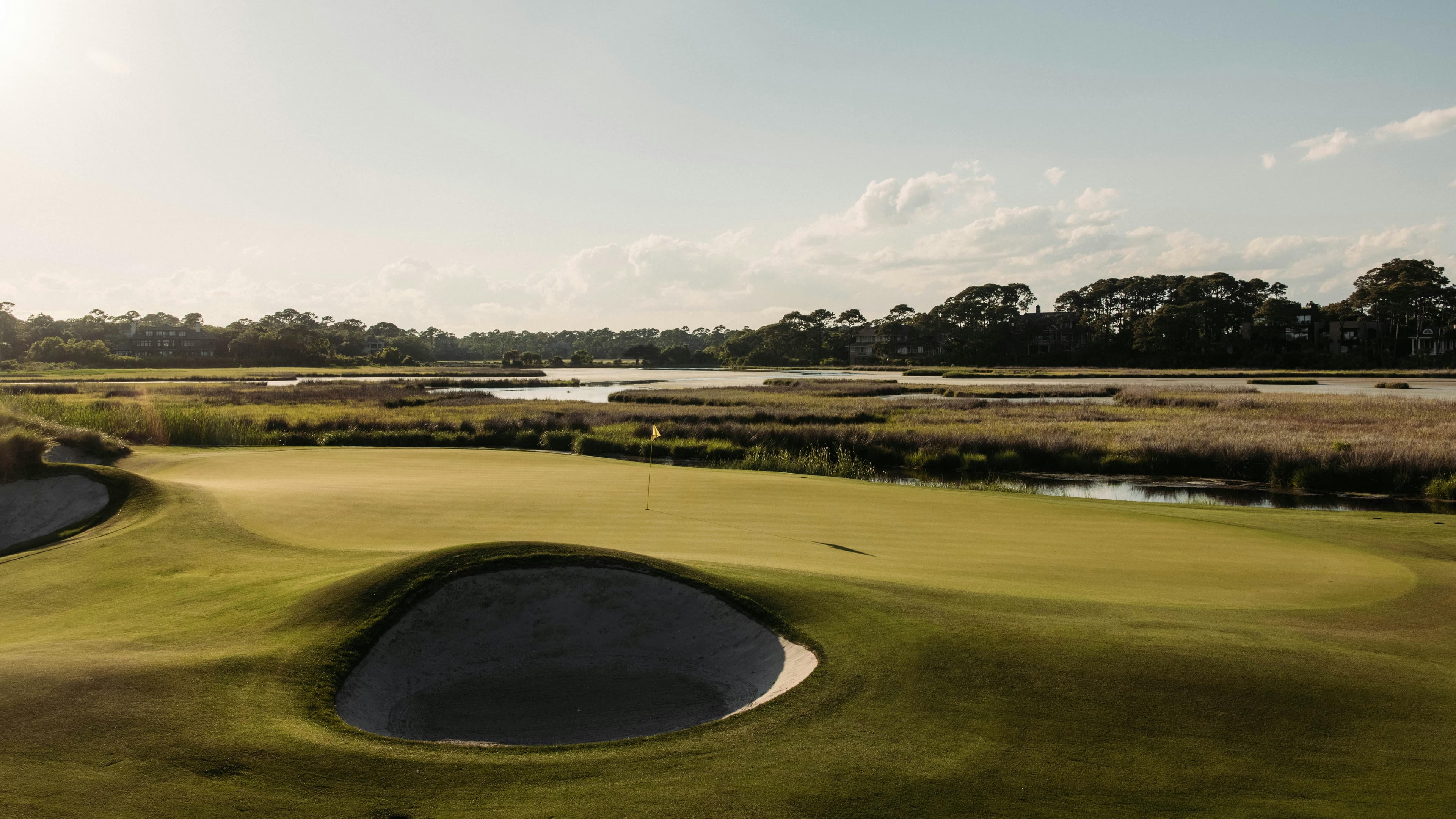
RiverTowne Country Club, an Arnold Palmer design on Johns Island between Kiawah and Charleston, threads through tidal marsh with enough design interest to warrant the drive. Green fees of $80 to $140 position it as a mid-range off-island option.
Charleston Municipal, the city's public course, provides budget-friendly golf at $25 to $45 for golfers who want to play without leaving downtown Charleston. The course is functional rather than memorable, best suited to the afternoon when the group splits between golf and the city's historic district.
Tip
How to Build a Multi-Round Trip
The most effective Kiawah trip structure places the Ocean Course as the centerpiece, not the opener. Arrive, settle in, and play Osprey Point or Turtle Point on the first full day to establish a rhythm. Reserve the Ocean Course for the second day, when the group is loose and acclimated to the Lowcountry humidity and wind patterns.
A three-round long weekend pairs the Ocean Course with one Fazio or Nicklaus round and one off-island value play at Wild Dunes or RiverTowne. A four-round trip adds Cougar Point or Oak Point as the fourth slot. Groups extending to five rounds can incorporate Patriots Point or Charleston Municipal on an arrival day without committing significant time or budget.
The budget math is straightforward. The Ocean Course will account for roughly half the total green fee spend on a three-round trip. Balancing it with mid-tier and value rounds keeps the overall cost per round in a range that compares favorably to other premium resort destinations. Peak season runs from March through May and again in October, with summer offering reduced rates alongside afternoon heat that limits comfortable play to morning tee times.
The verdict