Hilton Head: Best Holes Ranked
Hilton Head Island holds fewer courses than the Grand Strand to its north, but the concentration of quality is higher per mile of coastline. Pete Dye, Robert Trent Jones, Arthur Hills, Jack Nicklaus, and George Fazio all left work here, each responding to the same Lowcountry ingredients of maritime forest, tidal marsh, and ocean frontage. What follows is a ranking of the island's strongest individual holes, selected not for scenery alone but for the precision of the strategic question each one poses.
Where to stay in Hilton Head
Planning the trip? Compare live prices across every nearby hotel and rental in one search.
Prices and availability from Booking.com, Expedia and others via Stay22. GolfTrailsHQ may earn a commission at no additional cost to you.
1. Harbour Town Golf Links — No. 18 (Par 4, 472 yards)
Five decades of RBC Heritage tournament finishes, thousands of approach shots played with the red-and-white striped lighthouse framing the backdrop, and a design that asks the right questions under pressure. The tee shot plays along Calibogue Sound, with water left and trees right compressing the landing zone to a strip that punishes anything less than a committed swing. The approach, typically a mid-iron, must find a green that slopes toward the water and rejects anything that lands without conviction. Pete Dye understood that great finishing holes should not require a miracle, only sustained precision. This one does exactly that.
The most iconic finishing hole in American resort golf earns that status through accumulation.
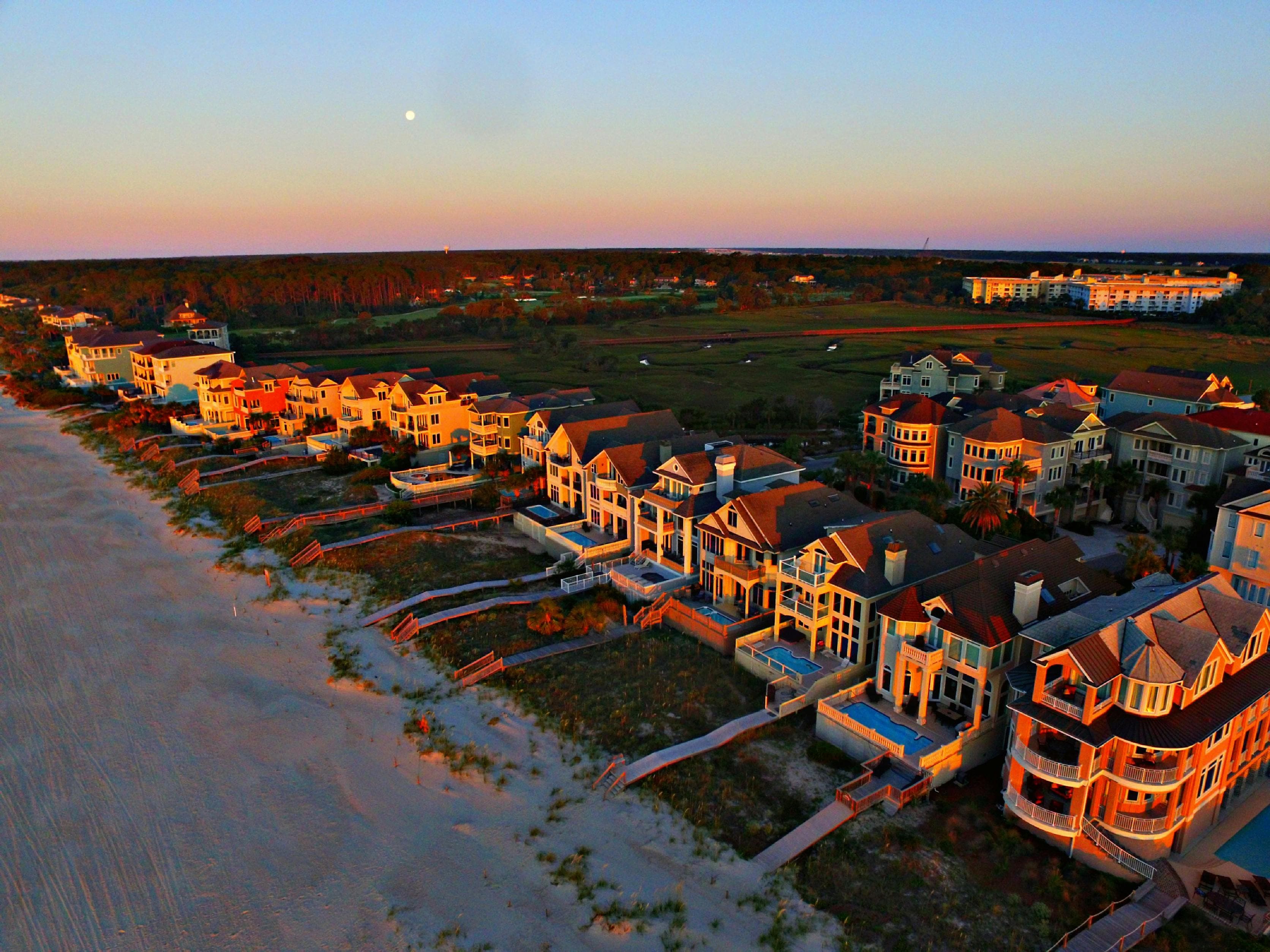
Harbour Town Golf Links
2. Harbour Town Golf Links — No. 17 (Par 3, 185 yards)
Dye placed this par 3 at the point in the round where nerves are at their most exposed. The tee shot carries a pond to a green tucked against the edge of Calibogue Sound, with bunkers positioned to catch anything that drifts right to avoid the water. At 185 yards, the club is typically a 5- or 6-iron depending on the wind, and the breeze off the sound adds a variable that changes by the hour. The green is small enough that even a well-struck shot in the correct direction can end up in a difficult position if the distance is off by ten feet. It is the kind of hole where par feels earned and bogey arrives without warning.
3. Palmetto Dunes (Robert Trent Jones Course) — No. 10 (Par 4, 400 yards)
Robert Trent Jones brought the Atlantic Ocean into play on the front nine of his Palmetto Dunes routing, but the 10th is where course and coastline meet most directly. The tee shot plays along the beach, with ocean views opening to the left and dense Lowcountry vegetation guarding the right. The fairway tilts gently toward the sea, feeding anything with draw spin toward trouble. The approach plays to a green set at a slight angle to the fairway, rewarding a specific line off the tee that most players instinctively avoid. Jones designed the hole so that the safe play off the tee produces a harder approach, and the aggressive play simplifies it. That exchange is the signature of his best work.
4. Harbour Town Golf Links — No. 13 (Par 4, 365 yards)
At 365 yards, the 13th is one of the shortest par 4s on the PGA Tour rotation, and one of the most debated. The hole runs along the edge of a salt marsh that encroaches from the left, while live oaks narrow the right side of the fairway. The drive is driveable for the longest hitters, but the marsh punishes any pull or hook with a stroke-and-distance penalty that collapses a scorecard. Most players lay back with an iron, leaving a wedge to a green that tilts away from the angle of approach. Dye's genius here is restraint: the hole offers temptation and proportional consequences, then gets out of the way.
5. Palmetto Dunes (Arthur Hills Course) — No. 11 (Par 4, 410 yards)
Arthur Hills routed this hole along the beachfront, and the proximity to the Atlantic is not decorative. The prevailing onshore wind alters both club selection and trajectory on the approach, and the green complex is contoured to shed any ball that arrives without sufficient spin to hold. The tee shot requires a line that avoids coastal scrub on the left while leaving an angle that opens the green for the second shot.
The hole is the centerpiece of a three-hole oceanfront stretch that ranks among the best in Lowcountry golf.
6. Sea Pines (Heron Point) — No. 9 (Par 4, 425 yards)
Jack Nicklaus designed Heron Point as the successor to the old Sea Marsh course, and the 9th captures his approach to strategic architecture. The hole doglegs left around a lagoon that guards the inside of the turn, and the drive must carry enough of the corner to leave a reasonable approach while avoiding the water. The green is elevated and well-bunkered, with a false front that rejects anything that lands short of the proper tier. At 425 yards, it is a legitimate two-shot hole that rewards both power and precision without privileging either.
7. Port Royal Golf Club (Robber's Row) — No. 15 (Par 4, 430 yards)
George Fazio designed Robber's Row through some of the densest maritime forest on the island, and the 15th uses that canopy to define every element of the hole. The tee shot must thread a corridor of live oaks to reach a fairway that narrows at driving distance. The approach plays to a green protected by deep bunkers front-left and a steep collection area behind. There is no bailout. The hole demands two precise shots in sequence, and anything less produces bogey or worse. It is the strongest hole on a course that deserves more attention than it receives among Hilton Head best courses.
8. Palmetto Hall (Arthur Hills Course) — No. 17 (Par 3, 200 yards)
Hills built this par 3 over a lake to a green that sits on a peninsula, with water on three sides and a single bunker guarding the only dry miss. At 200 yards, the shot demands a long iron or hybrid that must carry the water and land softly enough to hold a putting surface that slopes toward the lake at the rear. The visual from the tee is unambiguous: hit the green or accept the consequences. Wind across the open water adds a dimension that the tree-lined holes elsewhere on the course do not prepare players to expect.
The verdict