Branson Hills Golf Club: Course Review and Playing Guide
Par: 72 | Yardage: 7,262 (tips) | Designer: Chuck Smith & Bobby Clampett (2005) | Type: Public | Green Fee: $60–$120 | Walking: Permitted
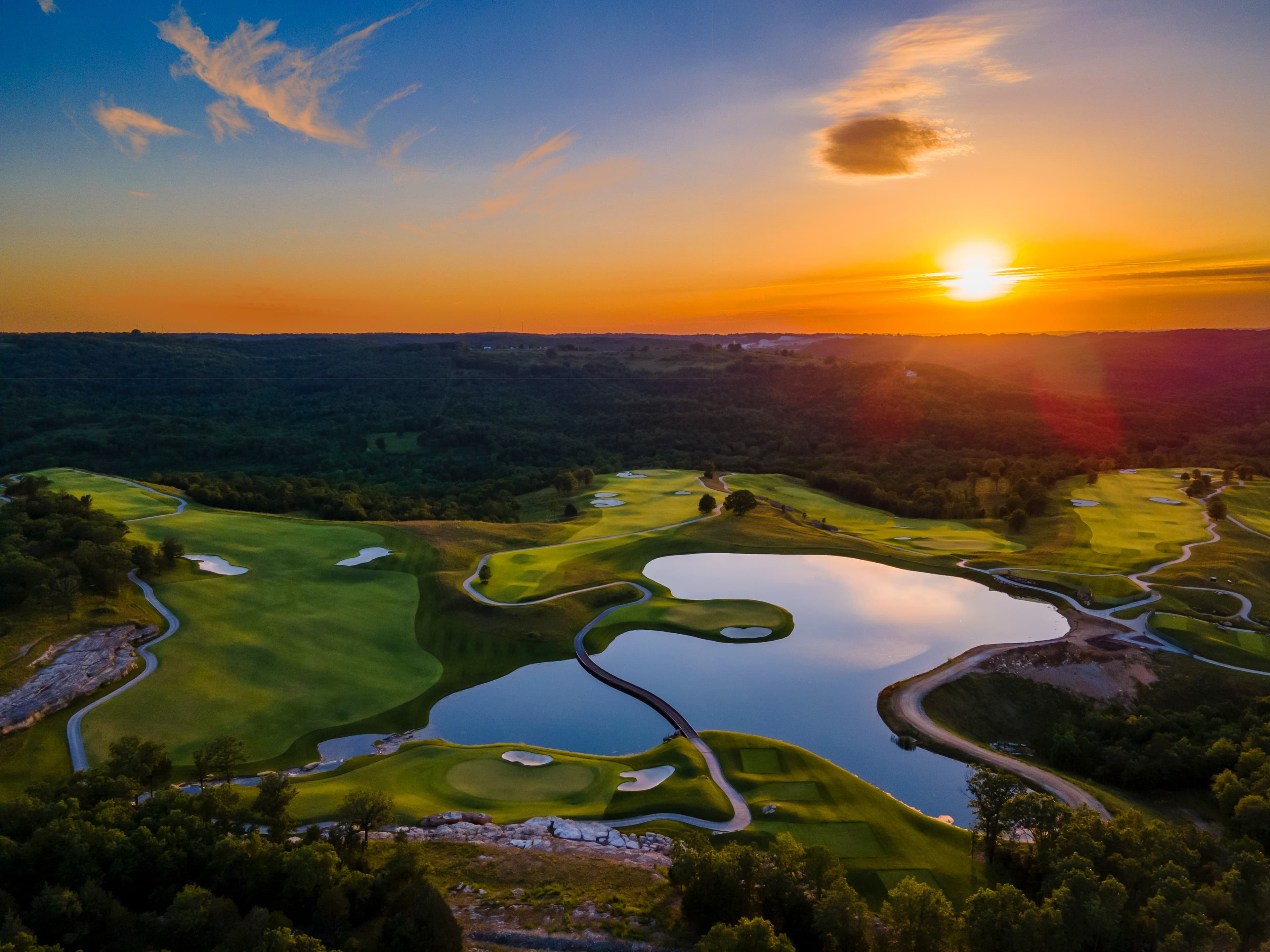
Branson Hills Golf Club opened in 2005 on a 200-acre site in the Ozark hills west of Branson, Missouri. Chuck Smith and Bobby Clampett, the former PGA Tour player who has since established a design practice focused on the Midwest and South, shaped 18 holes through native Ozark terrain that features limestone outcroppings, hardwood forests, and elevation changes that exceed what most golfers expect from this part of the country. The course has operated as a public facility since opening and has consistently been recognized as the strongest public layout in the Branson area. In a region where golf competes with entertainment shows, lake recreation, and theme parks for the visitor's attention, Branson Hills makes its case purely through the quality of the golf.
Where to stay in Branson & the Ozarks, Missouri
Planning the trip? Compare live prices across every nearby hotel and rental in one search.
Prices and availability from Booking.com, Expedia and others via Stay22. GolfTrailsHQ may earn a commission at no additional cost to you.
The Design Story
Smith and Clampett worked with a site that presented both opportunities and constraints typical of Ozark terrain. The hills provide dramatic elevation change, the native vegetation offers mature tree cover, and the limestone bedrock creates natural features that would be expensive to replicate artificially. The constraints are related: the rocky terrain limited earthmoving options, and the narrow ridgelines between hollows forced a routing that moves with the land's contours rather than across them.
The result is a course that feels discovered rather than constructed. Fairways follow the natural fall of the terrain along ridgetops and through valleys, and the green sites occupy positions that the land suggested rather than positions that were imposed. Several greens sit on natural benches carved by erosion into the hillsides, and the bunker placements reinforce the relationship between the design and the underlying geology. The course does not look like an Ozark version of anything else. It looks like what happens when competent designers let a strong site lead the design process.
The bunkering is moderate in quantity and strategic in placement. Clampett, whose playing career gave him detailed knowledge of how professional-level golfers manage risk, positioned the bunkers to create genuine choices rather than mere punishment. On several par 4s, the aggressive line from the tee brings a fairway bunker into play while opening a preferred angle to the green. The conservative play avoids the sand but leaves a longer or more obstructed approach. These risk-reward calculations are the course's strategic foundation, and they function at every level of play because the choices scale with the player's capability.
How the Course Plays
The front nine moves through a mixture of open ridgetop holes and tighter corridors through mature hardwoods. The 5th is a par 5 that follows a ridge with the fairway tilting toward the trees on the right, creating a driving challenge where the slope of the landing area pulls the ball toward trouble. The 9th, a par 4 that plays uphill to a green defended by deep bunkers, is the most demanding hole on the outward half.
The back nine provides the stronger golf. The 10th is a long par 4 that plays from an elevated tee through a narrow corridor of oaks, and the approach is played uphill to a green that rejects anything short. The 13th is a par 3 that plays over water to a green built into a hillside, and the yardage from the back tee makes it a legitimate long-iron or hybrid test. The finishing stretch from 15 through 18 traverses the property's most dramatic terrain, with the 16th offering a risk-reward par 5 where the second shot must carry a ravine to reach the green in two.
The 18th is a par 4 that returns to the clubhouse along a ridgeline, the fairway exposed to whatever breeze is moving through the hills. It is a strong finishing hole that demands both an accurate drive and a precise approach, and it provides a fitting conclusion to a back nine that has steadily increased its demands.
What the Green Fee Purchases
Tip
The course does not carry a tournament pedigree or a famous designer's name, and it makes no effort to manufacture prestige. What it offers instead is honest, well-designed golf on terrain that elevates the experience above what the green fee might suggest. For traveling golfers passing through the Ozarks, Branson Hills is the round that justifies adding a set of clubs to the trip. The Branson complete golf guide covers additional options in the area.
Practical Considerations
Branson Hills is located approximately 10 minutes west of downtown Branson on Highway 465. The drive south on US-65 takes roughly an hour. Northwest Arkansas Regional Airport in Bentonville is an alternative at about two hours, often with competitive fares.
Springfield-Branson National Airport, about 45 miles north, provides the most direct commercial air service.
The golf season runs from March through November, with peak conditions from April through October. Ozark summers bring heat and humidity along with afternoon thunderstorms, and morning tee times are advisable from June through August.
Spring and fall provide the most comfortable playing conditions, and the fall color in the surrounding hardwood forests adds visual depth to an already scenic round.
The verdict