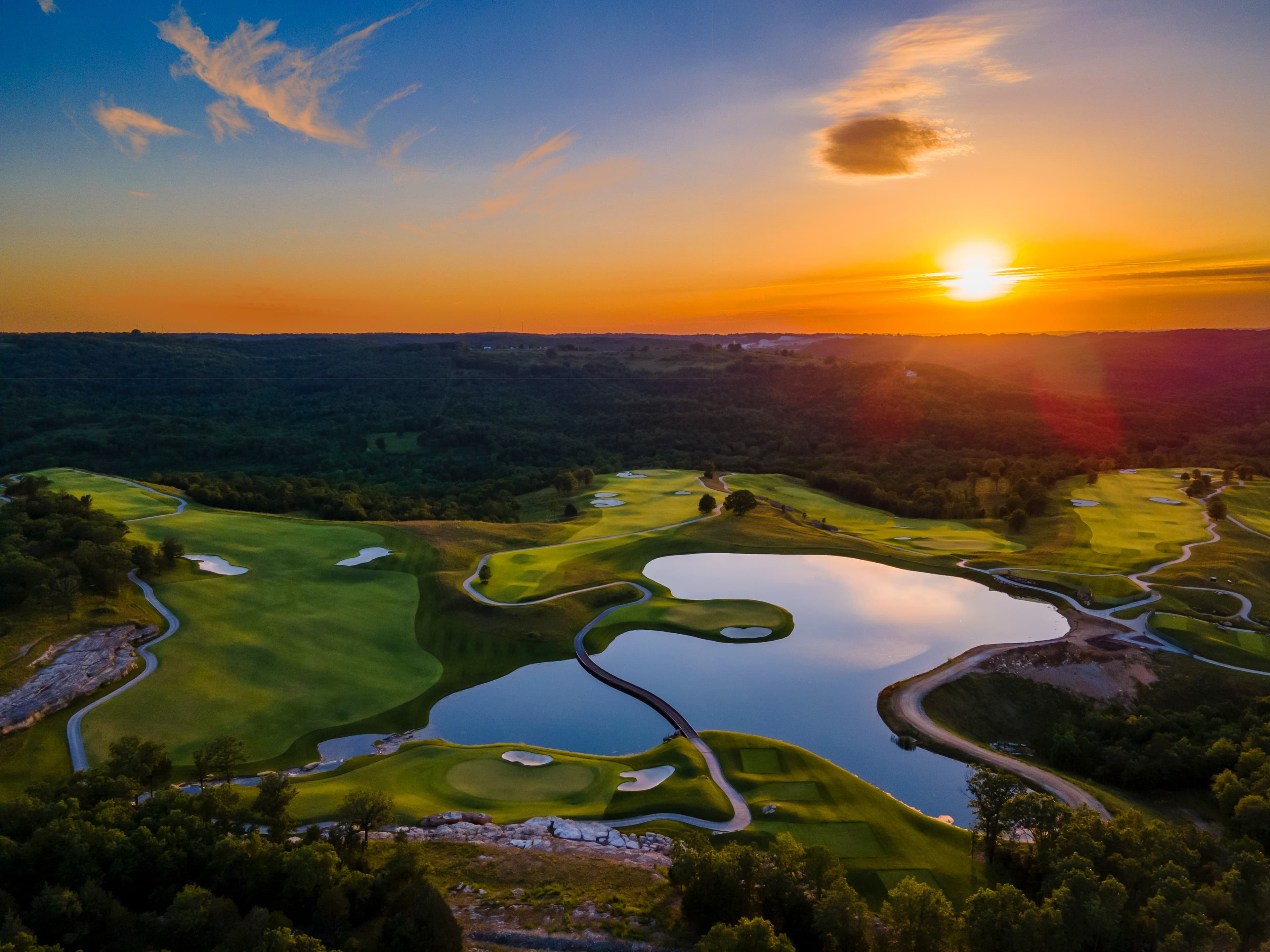
Branson / Ozarks: The Complete Golf Trip Guide
The Ozark Mountains of southwest Missouri do not conform to any conventional image of a golf destination. The terrain is deeply folded limestone and dolomite, the hollows thick with hardwood forest, and the lakes that fill the valleys are man-made reservoirs created by damming the White River system in the mid-20th century. It is dramatic country, though in a quieter register than the mountain courses of the Carolinas or the desert layouts of the Southwest. And within this landscape, anchored by the entertainment town of Branson, a golf trip assembles itself around a set of courses that offer championship design at prices that remain firmly in the value category.
The Branson area's golf identity has sharpened considerably over the past two decades. The arrival of Johnny Morris's Big Cedar Lodge and its associated golf properties, including the Jack Nicklaus-designed Top of the Rock par-three course, elevated the region from a collection of decent public courses into a destination with a genuine headliner. Combined with Branson Hills, Payne Stewart Golf Club, and several other solid layouts within thirty minutes of downtown Branson, the area fills a three- to four-day golf trip without straining the itinerary or the budget.
Where to stay in Branson & the Ozarks, Missouri
Planning the trip? Compare live prices across every nearby hotel and rental in one search.
Prices and availability from Booking.com, Expedia and others via Stay22. GolfTrailsHQ may earn a commission at no additional cost to you.
The Courses
Top of the Rock, located at Big Cedar Lodge south of Branson, is a nine-hole par-three course designed by Jack Nicklaus and completed in 2014. Describing it as a par-three course, while technically accurate, dramatically understates the experience. The routing traces the ridgeline above Table Rock Lake, and the combination of waterfall features, cave-like rock formations, and panoramic lake views produces a visual intensity that most full-length courses cannot approach. Holes range from 80 to 175 yards, playing through and across natural Ozark terrain that has been shaped with evident investment and care. The course hosts the Bass Pro Shops Legends of Golf tournament on the PGA Tour Champions, and the broadcast images regularly surprise viewers unfamiliar with the Ozarks landscape. Green fees run $95 to $175 for nine holes, a premium for a short course but justified by the singular nature of the experience.
Branson Hills Golf Club
Ledgestone Country Club
Branson Hills Golf Club, a Chuck Smith design that opened in 2007, is the area's strongest full-length course. The routing plays across 200 acres of Ozark ridgeline and valley terrain, with significant elevation changes that produce both strategic variety and expansive views. The par-five fifteenth, which drops nearly 200 feet from tee to fairway, is the signature hole and offers one of the more dramatic tee shots in Missouri golf. The course is well-conditioned, the design is challenging without being punitive, and the $49 to $99 green fee represents excellent value for the quality delivered.
Payne Stewart Golf Club, a municipal course in Branson named for the Missouri-born PGA Tour champion who died in 1999, carries an emotional resonance for many visitors. The course itself is a solid parkland design by Bobby Clampett, playing through forested Ozark terrain with strategic bunkering and reasonable fairway widths. At $39 to $79, it provides an accessible and meaningful round. The clubhouse contains a small museum of Payne Stewart memorabilia, and the course's stewardship of his legacy is handled with appropriate dignity.
Thousand Hills Golf Resort, a 50-par executive course designed by Robert Trent Jones Jr., sits close to the Branson entertainment strip and offers a playable round in under three hours. The short-course format makes it suitable for groups with mixed abilities or for an afternoon addition to a morning championship round. Green fees run $29 to $59.
Ledgestone Country Club, a Tom Clark design south of Branson near Table Rock Lake, plays through wooded Ozark terrain with bentgrass greens that putt well throughout the season. At $55 to $95, Ledgestone provides a quality alternative for groups seeking a fourth or fifth round without repeating a course. The layout rewards shot-making over distance, with several holes requiring precise iron play into greens protected by natural rock outcroppings and mature timber. The fifteenth, a par three over a ravine to a shelf green, is the hole that lingers in memory. Ledgestone provides a pleasant change of pace from the bigger, more dramatic courses in the rotation.
Buffalo Ridge, another Big Cedar Lodge property designed by Tom Fazio, plays through open grassland that contrasts sharply with the forested character of most area courses. The course opened as a private club and has limited public access through Big Cedar Lodge packages, with green fees in the $100 to $185 range when available. Tiger Woods' Payne's Valley, also at Big Cedar, adds another option at $185 to $250, though its pricing positions it as a premium experience relative to the rest of the Branson market.
Where to Stay
The resort sprawls across wooded lakeshore property and offers lodging that ranges from standard lodge rooms ($179 to $299) to lakeside cabins and cottages ($299 to $599). Golf packages bundling Top of the Rock and, when available, Buffalo Ridge or Payne's Valley represent the most efficient path to the premium courses. The resort's dining options, spa, marina, and recreational facilities provide substantial non-golf programming.
Big Cedar Lodge, Johnny Morris's flagship resort on Table Rock Lake, is the premier property in the Branson area and the most natural base for a golf-focused trip.
For groups focused primarily on Branson Hills, Payne Stewart, and the public courses, the Branson entertainment corridor offers abundant lodging at value pricing. The Hilton Branson Convention Center Hotel ($119 to $199) and Chateau on the Lake ($139 to $259) provide the upper tier. The Radisson Hotel Branson ($99 to $169) and numerous chain properties along Highway 76 fill the mid-range at $79 to $139.
Vacation rental cabins in the Ozark hills surrounding Branson provide an appealing option for groups. Properties with four to six bedrooms, decks overlooking forested hollows, and hot tubs rent for $150 to $350 per night and create a gathering atmosphere that hotel rooms cannot replicate. The cabin-rental market in the Branson area is deep and competitive, with platforms showing hundreds of properties at any given time. Quality varies, but well-reviewed cabins with modern amenities are readily available, and the experience of returning from a round to a hillside deck above the tree canopy is specific to the Ozarks in a way that a hotel corridor is not.
Getting There
Springfield-Branson National Airport (SGF) is the primary commercial airport, located 45 minutes north of Branson. The airport receives direct service from Dallas, Denver, Atlanta, Chicago, and several other hubs, with American, United, Allegiant, and Frontier among the operating carriers. Fares are generally competitive.
Branson Airport (BKG), a smaller facility south of town, receives limited scheduled service from a handful of cities. When routes align, it offers a closer alternative, but flight options are too inconsistent to serve as a primary planning assumption.
A rental car is essential. The Branson area's attractions, courses, and lodging are spread across a 30-minute radius of winding Ozark roads that do not support practical public transit.
The driving option works well for groups within a regional radius. Kansas City is four hours north, St. Louis is four hours northeast, Tulsa is three hours southwest, and Little Rock is three hours southeast. Interstate and highway routes are straightforward, and the final approach into the Ozarks from any direction introduces the topography gradually, the terrain folding and rising until the hollows and ridgelines of the golf courses feel like an extension of the drive.
When to Visit
The Branson golf season runs from April through October, with the ideal window concentrated in spring and fall.
Tip
Temperatures ease from summer's heat into the 60s and 70s, the humidity drops, and the hardwood forests that define most area courses produce fall color that peaks in mid to late October. The visual transformation of the landscape is substantial, and its effect on the playing experience is not ornamental but genuinely atmospheric.
September through late October is the second prime window and possibly the finest time for a Branson golf trip.
Summer golf in Branson is feasible but demanding. June through August temperatures reach the upper 80s to mid-90s, with humidity levels that southern Missouri generates reliably. Early morning tee times are advisable. Hydration is not optional. The upside of summer is that tee sheets open up, particularly midweek, and some properties offer reduced rates to compensate for the conditions. Groups that can tolerate the heat will find the courses in peak condition and the availability at its most generous.
The Ozark spring wildflower season, from mid-April through May, adds a visual dimension worth noting. Dogwoods, redbuds, and native wildflowers bloom throughout the wooded courses, and the effect on the playing experience is quietly transformative.
What It Costs
Branson is a value golf destination by any measure, and the pricing differential relative to course quality is the region's strongest argument.
A three-night trip playing four rounds runs $800 to $1,600 per person. The lower end reflects lodging along the Branson corridor, play at Branson Hills, Payne Stewart, and two supporting courses, and casual dining. The upper end includes Big Cedar Lodge, a Top of the Rock round, and a premium course like Buffalo Ridge or Payne's Valley.
Green fees across the full Branson inventory range from $29 at Thousand Hills to $250 at Payne's Valley during peak season. A four-round itinerary mixing one premium round (Top of the Rock at $125), one strong mid-tier round (Branson Hills at $79), and two value rounds (Payne Stewart and Ledgestone at $65 each) totals approximately $335 in green fees. That number is striking in the context of what those courses actually deliver.
Dining in Branson is inexpensive. Casual restaurants along the entertainment strip and Highway 76 run $12 to $25 per person. Big Cedar Lodge's dining ranges from $25 to $60. The area does not support a fine-dining scene comparable to larger resort destinations, but the overall dining cost contributes meaningfully to the trip's value proposition.
The Branson entertainment district, with its live shows, Silver Dollar City theme park, and Table Rock Lake recreation, provides evening and non-golf programming at modest cost. Show tickets run $30 to $60. Silver Dollar City admission is $50 to $80. Table Rock Lake itself offers fishing, boating, and swimming that fill a non-golf day. These are optional additions, but they give the destination a completeness that pure golf destinations often lack, and they provide companions who are not playing with a genuine itinerary of their own.
The Branson area does not ask to be compared with Bandon or Pinehurst. It does not position itself against the coastal resort destinations or the historic golf capitals. What it offers instead is a concentration of well-designed courses in an Ozark landscape that provides genuine visual and topographic character, at prices that make a three- or four-day trip accessible to golfers who might otherwise settle for a single premium round elsewhere. Top of the Rock alone justifies the trip for its sheer originality. Branson Hills justifies it on design merit. And the broader package, courses, lodging, entertainment, natural setting, assembles into a golf trip that delivers more than the destination's low national profile would suggest. The Ozarks keep their own counsel. The golf is better than the secret implies.