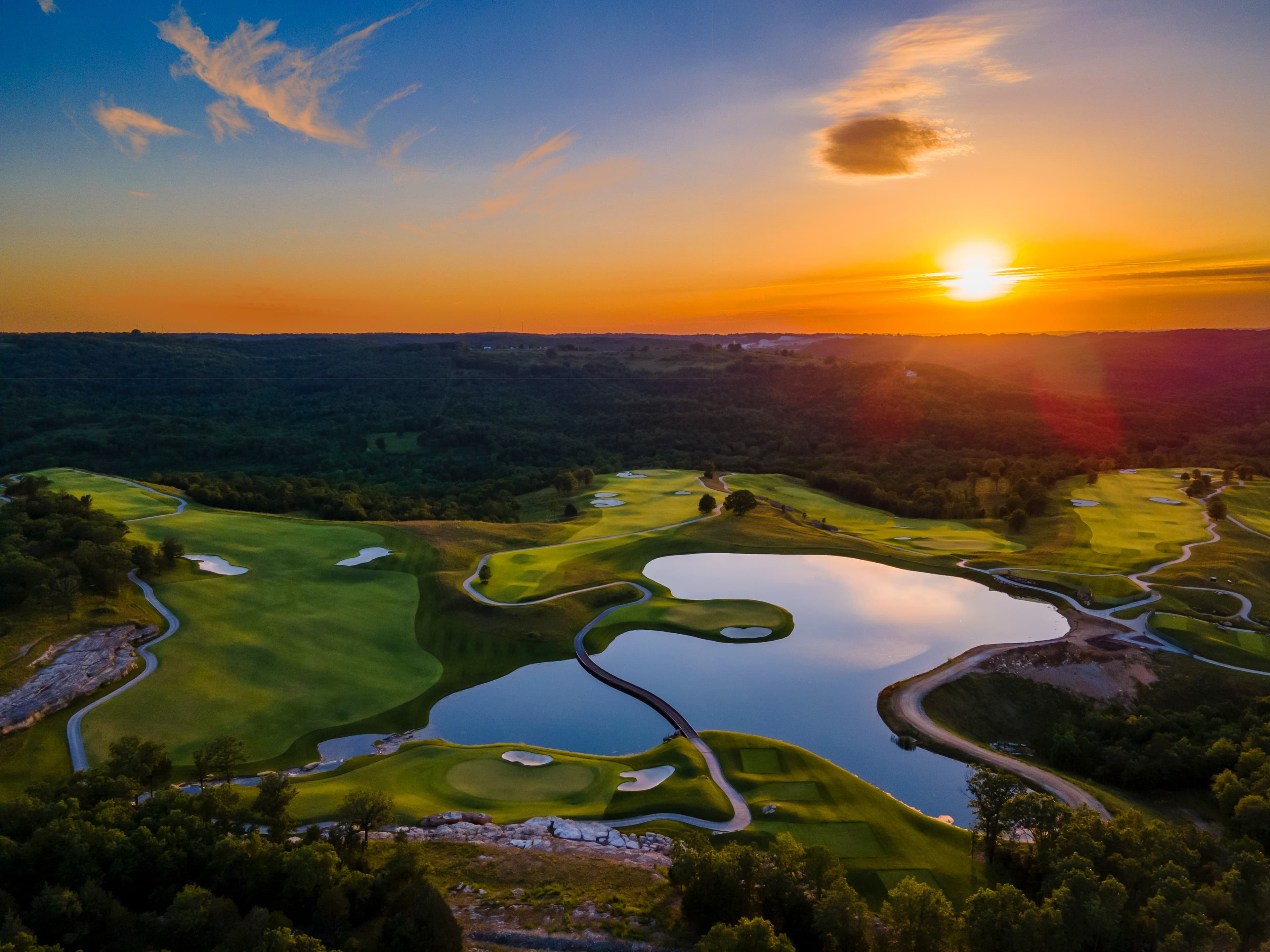
Branson Hills: Why This Course Belongs on Your Bucket List
Par: 72 | Yardage: 7,275 (tips) | Designer: Chuck Smith (2000) | Type: Public | Green Fees: $65–$110 (seasonal) | Walking: Permitted
The Ozarks are not typically mentioned in conversations about elite public golf, and that absence has worked to Branson Hills Golf Club's advantage for more than two decades. The course, designed by Chuck Smith and opened in 2000, sits on a property in the hills south of Branson, Missouri, with elevation changes that rival mountain courses at a fraction of the green fee. It has accumulated a quiet reputation among golfers who have played it and a near-total anonymity among those who have not. The former group is right.
Where to stay in Branson & the Ozarks, Missouri
Planning the trip? Compare live prices across every nearby hotel and rental in one search.
Prices and availability from Booking.com, Expedia and others via Stay22. GolfTrailsHQ may earn a commission at no additional cost to you.
The Terrain Advantage
Branson Hills occupies a site where these features are pronounced. The course moves through more than 200 feet of elevation change across 18 holes, with tee shots that play from ridge tops into valleys and approaches that climb back to greens perched on natural benches.
The Ozarks Plateau is an ancient geological formation, a region of eroded limestone and dolomite that produces a landscape of steep hollows, ridgelines, and exposed rock.
Branson Hills Golf Club
Chuck Smith, a Missouri-based architect who understood Ozarks terrain from decades of working in the region, routed the course to maximize the topography without requiring heroic forced carries or blind shots. The elevation changes are dramatic but manageable. Forward tees reduce the more severe drops to comfortable distances, and the fairway widths accommodate the difficulty of controlling ball flight on steeply sloped terrain. The design respects the full range of golfers who will encounter it while never dumbing down the strategic demands for accomplished players.
What Makes It Exceptional
Branson Hills plays long from the back tees, but the yardage figure is misleading. Several holes play significantly downhill, reducing effective distances by 20 to 40 yards, while others play uphill with enough severity to add a full club or more. Learning to recalibrate distance judgment on nearly every shot is the central challenge of the course, and it produces a round that demands more mental engagement than flat-terrain golf typically requires.
The par 3s exploit the elevation to create a collection of short holes that vary dramatically in character. One plays steeply downhill to a green set in a natural amphitheater, with the surrounding hillside framing the target. Another demands a long carry at a nearly level angle to a green defended by deep bunkers. The variety prevents any single club or shot shape from dominating, and the settings around these holes consistently produce the round's most memorable visual moments.
The greens are large by public course standards and feature enough internal contour to create distinct quadrants that play very differently depending on pin position. The putting surfaces drain well and roll consistently, reflecting a maintenance program that has improved steadily since the course opened. Approach shots that find the correct portion of the green leave manageable birdie putts; those that miss the quadrant often leave 40-foot lag putts across subtle breaks that are more complex than they initially appear.
The Value Equation
At peak-season rates that rarely exceed $110, Branson Hills delivers a golf experience that competes with courses charging two to three times as much. For golfers accustomed to paying $200 or more for quality daily-fee golf, a round at Branson Hills recalibrates expectations about what public golf can deliver.
The conditioning is consistently strong, the design is genuinely interesting, and the setting provides visual drama that most courses in this price range simply cannot offer.
The value extends beyond the green fee. Branson's entertainment district, with its concentration of restaurants, shows, and family attractions, provides non-golf programming that makes the destination work for mixed groups. Accommodations range from budget-friendly to resort-level, and the overall cost of a multi-day trip to Branson remains substantially below what comparable destinations on either coast would require.
Why It Earns Its Place
Branson Hills belongs on a bucket list not because it carries the fame of a tournament venue or the cachet of a celebrity designer, but because it delivers an experience that exceeds its profile by a wide margin. The combination of extreme elevation, sound architecture, excellent conditioning, and accessible pricing creates a course that consistently surprises first-time visitors.
Tip
The verdict