The destination
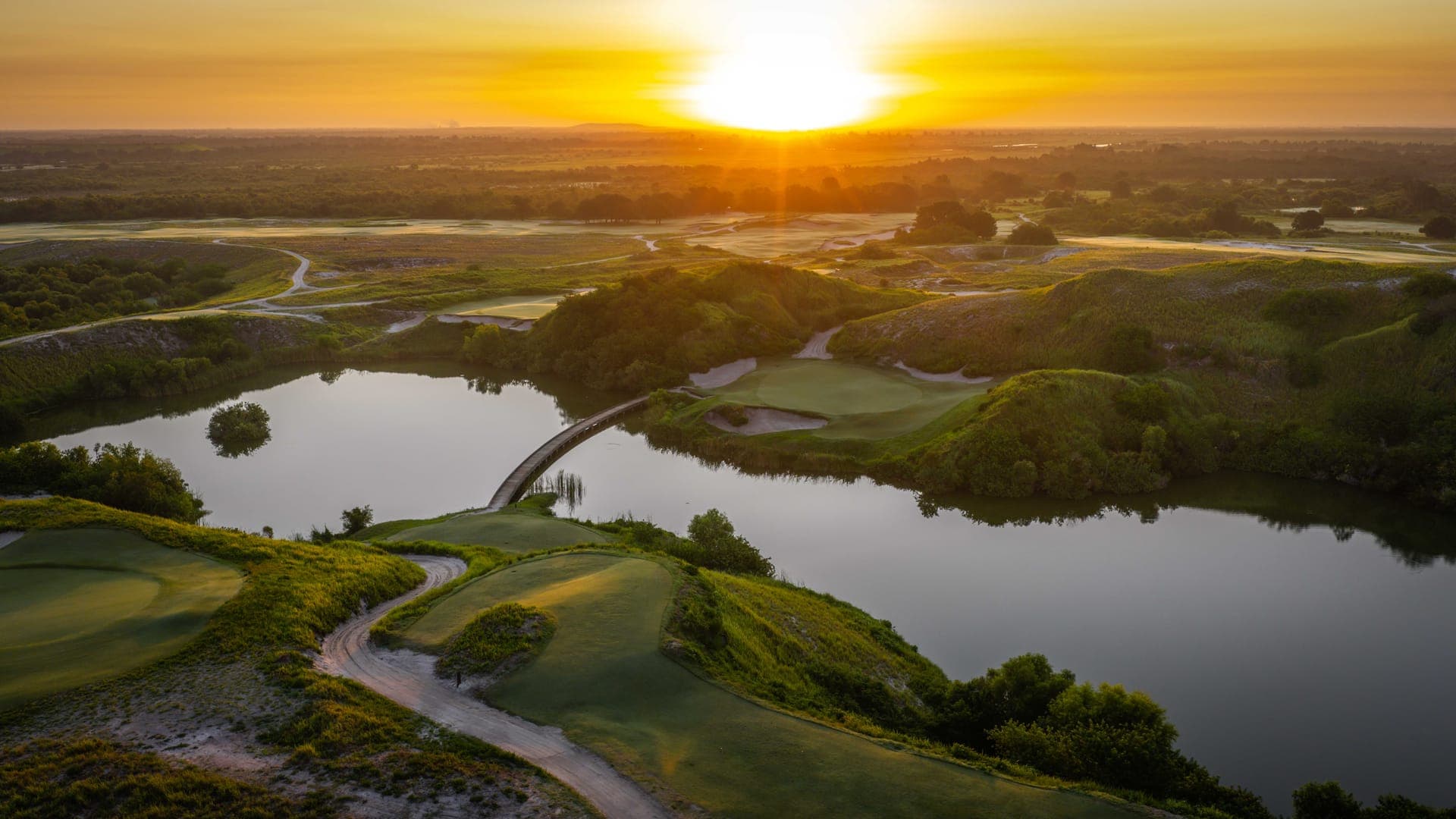
Florida has a lot of golf. Most of it occupies the predictable geography of the state's coastline and suburban sprawl: flat courses carved through housing developments, resort layouts wrapped around retention ponds, fairways framed by palm trees and condominiums. Streamsong Resort exists in a different Florida entirely. Built on 16,000 acres of reclaimed phosphate mining land in Bowling Green, roughly 80 miles southeast of Tampa, the resort sits in terrain most visitors would not associate with the state at all. The land rolls. Sand ridges rise 60 feet above the surrounding prairie. The horizon is uninterrupted by buildings, traffic, or signage.
This isolation is the point. Streamsong was conceived as a golf destination with no distractions from the golf itself, and the execution has been faithful to that premise since the resort opened in 2012.
Where to stay in Streamsong
Live prices from Booking.com, Expedia and more — every nearby hotel and rental in one search.
Prices and availability from Booking.com, Expedia and others via Stay22. GolfTrailsHQ may earn a commission at no additional cost to you.
The courses
Streamsong operates three 18-hole courses, plus The Chain, a 19-hole short course for late-afternoon rounds.
Streamsong Red opened with the resort in 2012, designed by Bill Coore and Ben Crenshaw. It plays at 7,148 yards with a slope of 140, routed through the most dramatic terrain on the property, with sand ridges creating elevation that feels transplanted from the Sand Hills of Nebraska rather than anything native to Florida. Walking is encouraged and caddies are available. Green fees run $275 to $395 depending on season.
Streamsong Blue, Tom Doak's design also from 2012, takes a different strategic approach on the same terrain. At 7,177 yards with a slope of 142, it is marginally more difficult on the scorecard than the Red, but the fairways are wider and the challenge lives in subtle internal contours rather than visible hazards. Golfers who prefer to think their way around a course rather than overpower it tend to rank the Blue as their favorite of the three.
Streamsong Black arrived in 2017 from Gil Hanse and Jim Wagner. At 7,311 yards with a par of 73 and a slope of 146, it is the longest and most difficult of the three. Hanse's minimalist bunker style gives the Black a cleaner visual appearance than either Doak design, but firm, fast conditions and demanding routing make it the most punishing layout for golfers who play without a plan. All three courses share the same green fee range.
The Chain, a Coore and Crenshaw design from 2023, is a 19-hole short course playing to a par of 46 at roughly 2,400 yards. It operates without tee times, is walking only, and runs $50 to $75 as an add-on to a full round. The course is designed for the golden hour, when the main courses have closed and the light turns the sand ridges amber. It is one of the best short courses in the country.
A critical operational detail: Streamsong is guests-only. Playing any course requires an overnight stay at the resort.
Where to stay
Streamsong Resort is the obvious and, for its own courses, the only option. The 228-room lodge sits between the three championship courses, and the car stays parked from check-in to checkout. Rooms run $300 to $500 per night, and stay-and-play packages that bundle accommodation with rounds are the standard booking method. The resort operates three restaurants, a full-service spa, and on-site activities including bass fishing, sporting clays, and archery.
Beyond golf
Central Florida's interior is rural, and the non-golf offering is limited by geography. At the resort, the spa is the primary companion activity, with bass fishing and sporting clays available as rest-day diversions. Beyond the resort, Bok Tower Gardens in Lake Wales, roughly 45 minutes north, is a National Historic Landmark featuring a 205-foot Art Deco singing tower within 250 acres of gardens designed by Frederick Law Olmsted Jr. Circle B Bar Reserve near Lakeland is a 1,267-acre nature preserve. In Lakeland itself, Florida Southern College houses the largest single-site collection of Frank Lloyd Wright architecture in the world: 12 buildings designed for the campus between 1941 and 1958.
When to go
Peak runs from November through April. January and February highs average 72 to 74 with lows in the low 50s, producing ideal conditions for walking golf. March and April warm into the upper 70s. May and October are shoulder, with warm afternoons but playable mornings and reduced rates. June through September brings 92-degree highs, oppressive humidity, and daily afternoon thunderstorms.
Getting there
Tampa International Airport (TPA) is the primary gateway, with direct flights from most major US cities and an 80-mile drive of 75 to 90 minutes. Orlando International (MCO) is an alternative at 90 miles. A rental car is not optional. Two to three nights is the natural shape: fly in, check in, play everything, fly out.
For golfers who treat the golf as the primary purpose of the trip, the isolation is not a concession. It is the appeal.