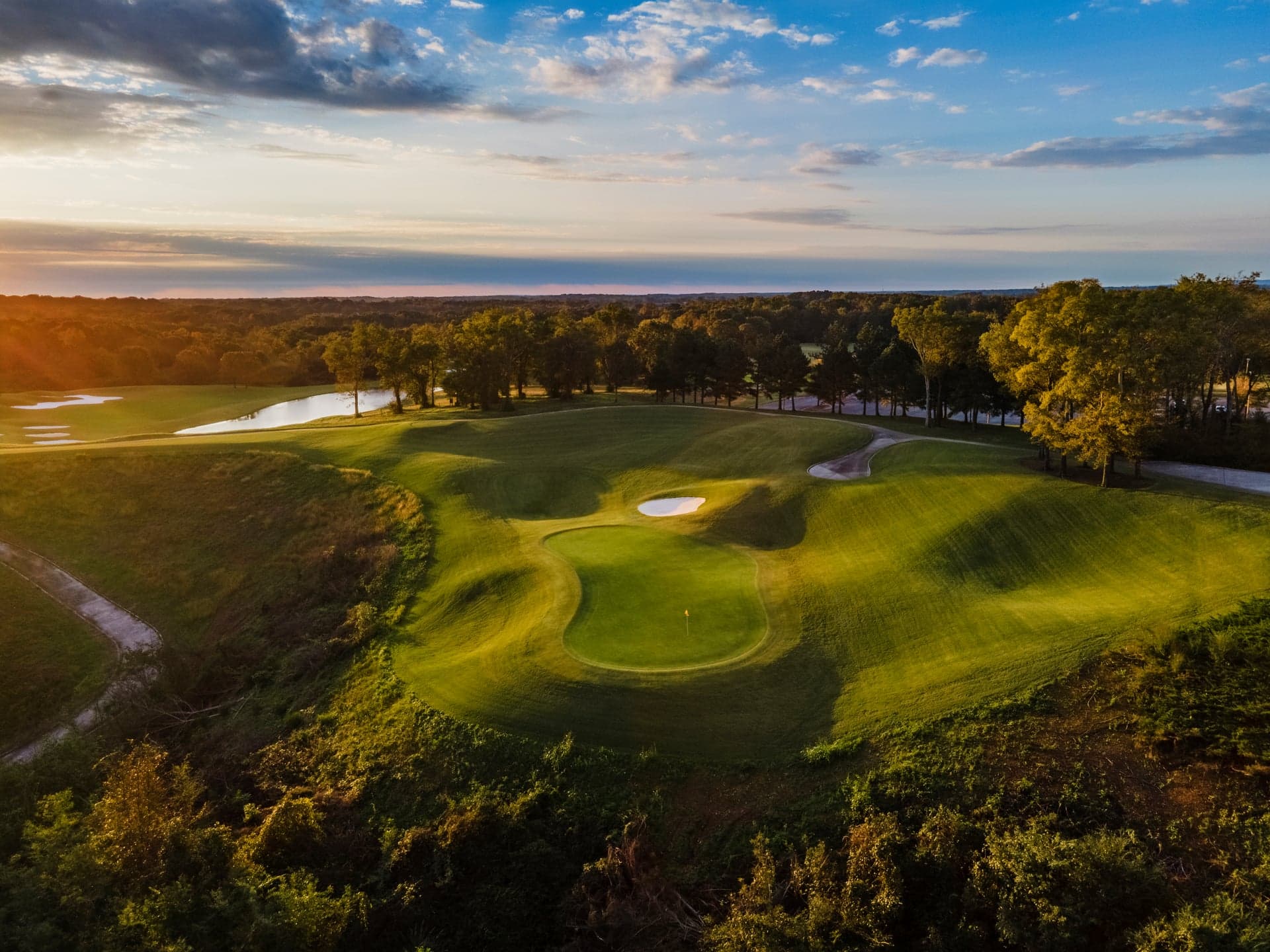
The destination
The Robert Trent Jones Golf Trail is a collection of 26 championship courses spread across 11 sites in Alabama, stretching from the Tennessee River in the north to Mobile Bay in the south. It is the largest golf construction project ever undertaken in the United States, and its origin story remains one of the more unusual in the sport. In the early 1990s, David Bronner, CEO of the Retirement Systems of Alabama, decided that championship golf courses could attract visitors, create jobs, and generate returns for the state pension fund. He hired Robert Trent Jones Sr., then in his late eighties, and his longtime associate Roger Rulewich to design a system of courses that would be public, affordable, and built to a standard that matched the best private clubs in the region.
The first courses opened in 1992. Three decades later, the Trail remains state-operated, public, and priced between $45 and $190 per round with cart included. The economic logic was unconventional. The financial results were not. The Trail has generated over $2 billion in economic impact for Alabama. For golfers, the relevant fact is simpler: this is the best value in American public golf, and it is not particularly close.
Where to stay in Robert Trent Jones Golf Trail, Alabama
Live prices from Booking.com, Expedia and more — every nearby hotel and rental in one search.
Prices and availability from Booking.com, Expedia and others via Stay22. GolfTrailsHQ may earn a commission at no additional cost to you.
The courses
Six courses make the strongest case for the trip. Ross Bridge in Hoover, just south of Birmingham, is the flagship. Roger Rulewich and Bobby Vaughan opened it in 2005 at 8,191 yards from the tips, the fifth-longest course in the world at the time. The routing moves through pine forests, past two lakes, and across 200 feet of elevation change. At $125 to $190, it is the most expensive course on the Trail and the one that most closely resembles the resort experience found at destinations charging twice the price.
Fighting Joe at The Shoals in Muscle Shoals was the first Trail course to exceed 8,000 yards when it opened in 2004. The layout sits above Wilson Lake on the Tennessee River, and the combination of length, exposed terrain, and Rulewich's demanding green complexes makes it the most physically challenging course on the Trail. At $55 to $95, the green fee barely registers against the architecture.
Capitol Hill's Judge Course in Prattville, near Montgomery, earned a declaration from GOLF Magazine that it was worthy of hosting a US Open. Designed by Jones Sr. and Rulewich in 1999, the Judge features dramatic elevation, expansive bunkering, and a routing that builds tension across 7,813 yards. At $65 to $105, it may be the most underpriced championship course in the southeastern United States.
Grand National Links in Opelika, one of the original 1993 Jones Sr. courses, wraps around a 600-acre lake as part of a 54-hole complex. Cambrian Ridge in Greenville offers 27 holes, and the Canyon nine, reconstructed in 2016, is the one that lingers, carved from former hunting grounds with extreme elevation. Oxmoor Valley Ridge in Birmingham was the original Trail site, opened in 1992 on former US Steel mining land, with exposed shale providing both hazard and visual character. At $45 to $75, it is the Trail's entry point and a course that overdelivers at every price level.
Where to stay
Accommodation depends on which courses anchor the itinerary. Renaissance Birmingham Ross Bridge Golf Resort and Spa is the only full-service resort on the Trail, with 259 rooms and Ross Bridge on the doorstep. Auburn Marriott Opelika at Grand National provides on-site access to the Grand National complex and is the strongest value among the Trail-adjacent resorts. Renaissance Shoals Resort and Spa places golfers within ten minutes of Fighting Joe.
Beyond golf
Alabama's history provides the substance that elevates the Trail from a golf trip to something broader. The Birmingham Civil Rights Institute, adjacent to the 16th Street Baptist Church, is a National Historic Landmark that covers the Civil Rights Movement with the depth the subject demands. Montgomery's Civil Rights Trail connects the Rosa Parks Museum, the Legacy Museum, and the National Memorial for Peace and Justice across a walkable downtown corridor. The US Space and Rocket Center in Huntsville houses NASA artifacts including a Saturn V rocket. The USS Alabama Battleship Memorial Park in Mobile offers access to a World War II battleship.
Getting there
The Trail is not a resort destination. It is a road trip. Birmingham-Shuttlesworth International Airport (BHM) serves as the geographic hub, with Ross Bridge and Oxmoor Valley within 20 minutes and most other sites reachable within two hours. The Shoals sits two hours north. A full Trail run covering all six featured courses requires five to six nights and a willingness to put miles on the rental car.
March through May and September through November are the strongest months. Summer offers discounted rates and empty tee sheets, but temperatures in the low 90s demand early starts. Winter is playable, with January highs averaging 53. The 2026 Trail Card at $49.95 provides discounts across all 11 sites and is the first purchase any visitor should make.
