
The Robert Trent Jones Golf Trail: The Complete Golf Trip Guide
In 1992, the Retirement Systems of Alabama, under the direction of CEO David Bronner, commissioned Robert Trent Jones Sr. to design a network of golf courses across the state. The concept was unprecedented in American golf: a trail of championship-quality courses stretching from the Tennessee Valley to the Gulf Coast, funded by pension assets and priced at public-golf rates, with the explicit purpose of driving tourism and economic development to a state that had neither on the national golf radar.
Three decades later, the Robert Trent Jones Golf Trail comprises 11 sites and 26 courses spread across Alabama, from Huntsville in the north to Mobile in the south. The scale is staggering. The value is difficult to overstate. And the quality, while uneven across 468 holes, reaches genuine championship caliber at the trail's best sites. A golf trip along the RTJ Trail is not a single destination experience. It is a road trip through an entire state, and the logistics of that undertaking reward careful planning.
Where to stay in Robert Trent Jones Golf Trail, Alabama
Planning the trip? Compare live prices across every nearby hotel and rental in one search.
Prices and availability from Booking.com, Expedia and others via Stay22. GolfTrailsHQ may earn a commission at no additional cost to you.
The Courses
The RTJ Trail's 11 sites vary in quality, setting, and character. The following assessment covers the five sites that represent the trail at its best and around which a practical trip should be organized.
Ross Bridge
Ross Bridge (Birmingham)
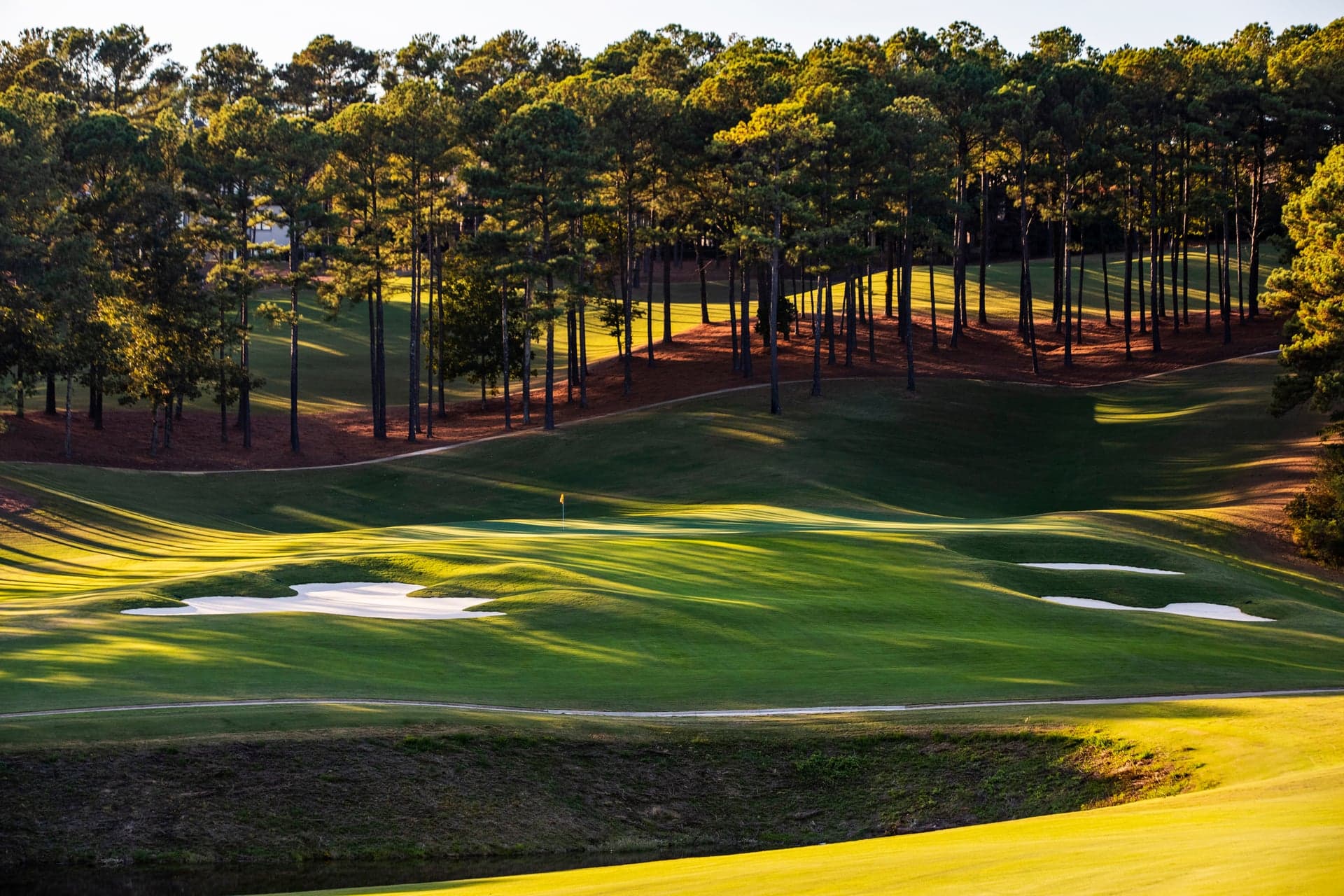
Ross Bridge is the trail's flagship course and its most ambitious design. The layout plays across 8,191 yards from the back tees, making it one of the longest courses in the world, though the practical playing experience from the appropriate tee boxes is far more reasonable. The course weaves through and around a series of lakes, with a dramatic closing stretch along the water that produces legitimate tension on every approach. The Renaissance Ross Bridge Golf Resort and Spa sits adjacent, creating a self-contained golf resort experience that the other trail sites cannot match. Green fees run $59 to $79, a pricing structure that, given the course's design ambition and conditioning, borders on implausible. The resort offers rooms from $149 to $299 with stay-and-play packages.
Capitol Hill (Prattville)
Capitol Hill, located just north of Montgomery, operates three 18-hole courses on a single site, making it the trail's most concentrated golf destination. The routing plays along the Alabama River with significant elevation changes, strategic water hazards, and greens complexes that demand precision. The Legislator and the Senator courses provide quality alternatives at the same green-fee structure. All three courses share a clubhouse and practice facility, and playing 36 holes in a single day at Capitol Hill is both logistically simple and physically rewarding. Green fees are $49 to $69 per round across all three courses.
The Judge course is the strongest of the three and the one that most fully realizes the RTJ Trail's design aspirations.
Grand National (Opelika)
Grand National, in the Auburn-Opelika area of east-central Alabama, offers two 18-hole courses and a short course built around a 600-acre lake. The Lake Course is the site's headline, with multiple holes playing along or across the water in a routing that uses the terrain's natural contours effectively. The Links Course, despite its name, plays through a more open and elevated landscape with broader views. The setting is the trail's most visually appealing, and the Lake Course in particular rewards the trip to Opelika. Green fees mirror the trail standard at $49 to $69.
Oxmoor Valley (Birmingham)
Oxmoor Valley, located twenty minutes south of downtown Birmingham, provides the trail's most rugged topographic experience. The Ridge Course and the Valley Course play through deeply folded terrain in the foothills of the Appalachian range, with elevation changes that exceed what most golfers expect from Alabama. The Ridge Course, with its narrow fairways cut through dense forest and its dramatic downhill par threes, is the more memorable of the two. Green fees are $49 to $69.
The Short Course, an 18-hole par-three layout, is among the best short courses on any trail or resort property in the country.
Magnolia Grove (Mobile)
Magnolia Grove, near Mobile in the state's southern coastal plain, offers two 18-hole courses and a short course in a landscape defined by moss-draped live oaks and magnolias. The Crossings Course is the stronger of the two, with a more varied routing and better strategic interest. The setting has a distinctly Southern character that differentiates it from the upland sites, and for groups routing their trip from Birmingham south to the Gulf Coast, Magnolia Grove provides a fitting conclusion. Green fees hold at the trail standard of $49 to $69.
Other Notable Sites
Hampton Cove (Huntsville) offers two courses in the Tennessee Valley and serves as the trail's northern anchor. Silver Lakes (Anniston/Gadsden) features three nine-hole courses with distinctive red-clay bunkering. Cambrian Ridge (Greenville) and Highland Oaks (Dothan) round out the trail in the southern and southeastern portions of the state. Each site is competently designed and well-maintained. None rises to the level of the top five, but each serves its geographic function within the trail's statewide network.
Where to Stay
The RTJ Trail's dispersed geography means that accommodation planning follows your routing rather than centering on a single base.
In Birmingham, the Renaissance Ross Bridge Golf Resort ($149 to $299) is the trail's best lodging option and the most complete resort experience in the system. The property's proximity to both Ross Bridge and Oxmoor Valley makes Birmingham a logical base for two or three days of play. Downtown Birmingham hotels, including the Elyton Hotel ($139 to $229) and the Redmont Hotel ($109 to $189), provide alternatives with access to the city's growing dining scene.
In Prattville/Montgomery, the Marriott Prattville ($109 to $179) sits adjacent to Capitol Hill and provides convenient access to the three courses. Montgomery itself offers a broader selection at $89 to $159, with the added benefit of the state capital's historical sites and restaurants.
In Opelika/Auburn, hotels near Grand National run $89 to $149. The college-town atmosphere of Auburn, home to Auburn University, provides dining and entertainment options that other trail stops lack. On fall football weekends, hotel availability tightens considerably and rates spike; planning around the Auburn home schedule is advisable for groups visiting Grand National in September through November.
In Mobile, the Battle House Renaissance ($159 to $269) and other downtown properties serve Magnolia Grove while placing guests in Mobile's historic district, which offers the best non-golf urban experience on the trail.
For groups willing to move bases, a north-to-south routing with one night each in Birmingham, Montgomery, and Mobile covers the trail's best sites with manageable daily drives.
Getting There
Alabama is served by multiple airports, which both enables and complicates trip planning.
Birmingham-Shuttlesworth International Airport (BHM) is the primary gateway, receiving direct service from Atlanta, Dallas, Charlotte, Houston, Chicago, Denver, and other hubs. For trips focused on the northern and central trail sites, BHM is the logical arrival and departure point.
Montgomery Regional Airport (MGM) serves Capitol Hill and central Alabama with connecting service through Atlanta, Dallas, and Charlotte. Mobile Regional Airport (MOB) provides access to Magnolia Grove and the southern trail with similar connecting options. Huntsville International Airport (HSV) anchors the northern end.
A rental car is mandatory. The RTJ Trail is a driving trip by definition. The distance from Huntsville to Mobile is approximately 350 miles, a five-and-a-half-hour drive on Interstate 65. A practical trip focusing on the top five sites involves drives of one to two hours between stops, with the longest single segment being Birmingham to Opelika at 90 minutes.
When to Visit
Alabama's climate permits year-round golf, and the RTJ Trail operates twelve months without closure.
The prime windows are March through May and September through November. Spring brings temperatures in the 65 to 80 degree range, blooming azaleas and dogwoods across the courses, and the state's most pleasant conditions. Fall delivers similar temperatures with the addition of autumn color, particularly at the upland sites around Birmingham.
Tip
Winter is mild by northern standards. December through February temperatures range from the mid-40s to low 60s, with occasional cold fronts dropping below freezing in the northern portion of the state. Green fees are at their annual low, and the courses are quiet. Golfers comfortable with cool mornings and a jacket in the cart will find winter an acceptable and affordable season.
What It Costs
The RTJ Trail's value proposition is its defining characteristic and the reason it deserves attention from golfers who might otherwise overlook Alabama entirely.
Green fees across the trail hold to a remarkably narrow range of $49 to $79 per round, with Ross Bridge at the top and most sites clustered around $49 to $69. This pricing delivers courses designed by one of the most celebrated architects in golf history, maintained to resort standards, and routed through terrain that produces genuine strategic and visual interest.
A four-day trip playing six rounds across three trail sites runs $800 to $1,500 per person. That figure covers lodging, green fees, rental car, fuel, and meals. The lower end reflects value hotels and conservative dining. The upper end includes the Ross Bridge resort and full-service restaurants.
A six-round itinerary at trail prices totals $300 to $475 in green fees. That number, for six rounds of championship golf, would not cover a single peak-season round at many resort destinations featured on this site.
Dining in Alabama is inexpensive and often excellent. Birmingham's food scene has earned national recognition, with the Avondale and Lakeview neighborhoods offering restaurants that span barbecue to farm-to-table at $15 to $50 per person. Montgomery's downtown has seen a dining revival anchored by several strong restaurants near the riverfront. Mobile brings Gulf Coast seafood into the equation at prices that coastal resort towns cannot match. The culinary dimension of an RTJ Trail road trip is a legitimate supporting attraction, and groups who build their evening plans around the local food scene will find each stop distinct in character.
Cart fees are included in the green fee at all trail courses. Walking is permitted but impractical at most sites due to distances between greens and tees.
The Robert Trent Jones Golf Trail remains one of the most remarkable and underappreciated developments in American public golf. The concept was audacious at inception and has aged into something that functions exactly as intended: a statewide network of courses that gives golfers a reason to visit Alabama and rewards them handsomely when they do. The courses are not all of equal merit. The road trip format is not for everyone. And Alabama will never carry the aspirational weight of a Pebble Beach or a Pinehurst. But the golfer who measures a destination by the ratio of quality to cost, who values variety of terrain and routing over a single marquee name, and who finds satisfaction in covering ground through a state with more character than its reputation suggests, will find the RTJ Trail among the most compelling values in American golf. The numbers speak plainly. Twenty-six courses, eleven sites, and green fees that other destinations charge for a halfway-house hot dog. The trail does not need to argue its case. The arithmetic does it.

