Where to stay in Pinehurst & the Sandhills
Live prices from Booking.com, Expedia and more — every nearby hotel and rental in one search.
Prices and availability from Booking.com, Expedia and others via Stay22. GolfTrailsHQ may earn a commission at no additional cost to you.
Getting There
Raleigh-Durham International Airport (RDU) is the primary gateway, 73 miles and roughly one hour and twenty minutes from the village. It receives full commercial service from all major airlines with direct flights from most East Coast hubs and a growing number of Midwest and West Coast cities. The drive from RDU follows US-1 South through a stretch of central North Carolina that transitions from suburban Raleigh to open farmland to the longleaf pine corridors of the Sandhills. It is not a scenic drive in the dramatic sense, but it is an easy one.
Piedmont Triad International (GSO) in Greensboro offers an alternative at 84 miles, roughly one hour and thirty minutes. Fayetteville Regional (FAY) is closer at 35 miles but operates limited commercial service through American Eagle. For private aviation, Moore County Airport (SOP) sits minutes from the resort and can accommodate aircraft up to a 737 on its 6,502-foot runway.
Driving distances from regional cities are manageable. Raleigh is 72 miles, Charlotte is 91 miles, and Washington, D.C., is 336 miles. The Raleigh and Charlotte catchments make Pinehurst a natural weekend trip for several million residents, which explains the strength of the Thursday-through-Sunday booking pattern.
A rental car is not optional. There is no public transit between RDU and Pinehurst, ride-sharing services are unreliable in the Sandhills, and the courses and restaurants are distributed across a region that requires a car to navigate. Daily rental rates from RDU run $30 to $45, with weekly rates around $300 to $310. Booking six to seven weeks in advance typically secures the best pricing. Guests staying exclusively on the Pinehurst Resort campus can use resort shuttles between on-site courses and lodging, but any venture to Mid Pines, Pine Needles, Tobacco Road, Talamore, or Southern Pines dining requires a vehicle.
Understanding the Package Model
This is the single most important practical detail for planning a Pinehurst trip, and it confuses first-time visitors more than any other element. Pinehurst Resort does not sell standalone green fees. You cannot call the pro shop, pay a fee, and play No. 2 the way you would book a tee time at a public course. All golf on the resort's ten numbered courses requires an overnight stay, and the pricing is bundled into packages that combine accommodation and golf.
The basic structure works as follows. Package rates are quoted per person, per night, based on double occupancy. A Bed and Breakfast package at The Carolina Hotel starts at approximately $240 to $310 per night depending on season. That base rate includes lodging and breakfast. Golf is then added through the package tier or as individual course surcharges. Most packages include access to Courses 1, 3, and 5 at no additional surcharge, with additional rounds on those courses running $95 each. Courses 6, 7, 8, and 9 carry additional-round surcharges of $275. Course No. 4 runs $395 as an add-on. No. 2 carries a $250 surcharge if not included in the package tier. A second round on No. 2 costs $595 during peak season and $360 off-peak, with caddie fees additional. The Cradle, the resort's par-3 short course, is included at no surcharge. A two-night minimum stay is required for No. 2 access.
The practical implication is that trip budgeting at Pinehurst is fundamentally different from a la carte golf destinations. The total cost of a three-night trip playing No. 2, No. 4, and No. 8, with lodging at The Carolina, will run in the range of $1,500 to $2,500 per person depending on package tier and season. That number sounds steep until you consider that it includes three nights at a AAA Four Diamond hotel, three rounds on courses that include a perennial top-five U.S. layout and a former Best New Course in America, full breakfast daily, and access to the resort's pool, spa, and short course. Viewed as a per-element cost, the package pricing is competitive with what a comparable combination of lodging and green fees would cost at Pebble Beach, Bandon, or Kiawah, and in most configurations it is meaningfully less.
The key to navigating the system is to decide which courses matter most before selecting a package tier. If No. 2 is the priority, build the trip around a package that includes it. If No. 4 and No. 8 are the draw, a lower-tier package with those courses added may represent better value. The resort's booking team is accustomed to building custom configurations, and a phone call typically clarifies pricing faster than navigating the website.
For golfers who want to avoid the package model entirely, Mid Pines, Pine Needles, Tobacco Road, Talamore, and Legacy all operate on traditional green fee structures. A trip built around these courses with off-campus lodging represents a fundamentally different price point, typically $150 to $300 per round depending on course and season, with accommodation at Homewood Suites ($136 to $160 per night) or similar properties. This approach sacrifices No. 2 and No. 4 but gains flexibility and significant savings.
When to Visit
The Sandhills divide cleanly into three seasons. Peak runs through April, May, September, and October, when temperatures settle in the 60s and 70s, humidity is manageable, and the courses are in their best condition. October is the consensus best month. Green fees and package rates are at their annual highs, and advance booking is essential.
Shoulder months of March, June, and November offer 15 to 25 percent savings below peak rates. March mornings can be cool but warm quickly. June begins the humidity season without yet reaching the July and August extremes. November carries the last of the autumn colour and mild daytime temperatures before winter settles in.
Off-peak runs December through February and July through August. Winter is mild by Northern standards. January highs average 50 degrees and mornings drop into the 30s, but snow is rare and golf continues year-round for those willing to layer. The courses are quiet, pace of play improves, and package rates drop 30 to 50 percent. Summer brings heat. July highs average 90 degrees with humidity that makes afternoon rounds taxing. Early morning tee times are the standard, and the savings are substantial.
The early March and early June windows offer what may be the best value-to-weather ratio in the Sandhills calendar. Conditions are good, demand has not yet reached peak levels, and pricing reflects the shoulder classification.
The Village and Surrounding Area
Pinehurst Village is walkable in a way that very few American golf resort towns are. The Olmsted-designed street plan curves through the residential area and converges on a small commercial center with shops, restaurants, and the resort entrance. Guests staying on the resort campus can walk to dinner, to the pro shop, and to Golf House Pinehurst without starting a car. This walkability is part of the design, dating to 1895, and it gives the village a character that purpose-built resort communities cannot replicate.
Southern Pines, five miles east on Route 2, has emerged as the area's dining and cultural center. Broad Street carries a mix of independent restaurants, coffee shops, galleries, and the Sunrise Theater. The quality has improved meaningfully in recent years, and an evening in Southern Pines is now a genuine complement to a day on the courses rather than a consolation for limited resort dining options.
Golf House Pinehurst, the combined USGA headquarters and World Golf Hall of Fame campus, opened in May 2024 and sits within the resort grounds between The Carolina Hotel and the main clubhouse. The facility houses historical exhibits, the Hall of Fame induction gallery, and USGA archives. Admission is $10 general, $5 for North Carolina residents, and free for USGA members and children under 12. Hours run 9 a.m. to 4 p.m. daily. For golfers who care about the game's history, this is not a rainy-day backup plan. It is a destination in its own right, and an afternoon here adds a dimension to the trip that additional rounds cannot.
Weymouth Woods Nature Preserve and Sandhills Horticultural Gardens both offer free access to well-maintained walking trails and gardens. Seagrove, 30 minutes north, is worth a half-day trip for the pottery studios alone. The equestrian culture of the Sandhills, centred on the 4,000-acre Walthour-Moss Foundation trails in Southern Pines, provides a distinctly non-golf activity option for companions or rest days.
Local Knowledge
The Sandhills region rewards a measured pace. Four rounds in three days is comfortable. Five rounds in four days is ideal for a trip that includes No. 2, an off-campus course like Tobacco Road or Mid Pines, and two resort courses. Over-scheduling is the most common mistake first-time visitors make. The village, Golf House, and Southern Pines all deserve time on the itinerary, and the courses themselves are best appreciated when the golfer arrives rested rather than fatigued from yesterday's 36.
Caddies are available on No. 2 and strongly recommended for first-time players. The greens on the Coore and Crenshaw restoration are subtler than they appear, and a caddie who reads them daily will save strokes that no amount of preparation can match. Caddie fees are additional to the package rate.
Tobacco Road is 30 minutes from the village in Sanford. A yardage book or the course's app is recommended for first-time players. Several holes feature blind shots that are genuinely unplayable without some form of guidance. This is not a criticism of the design. It is a feature of it. But preparation matters.
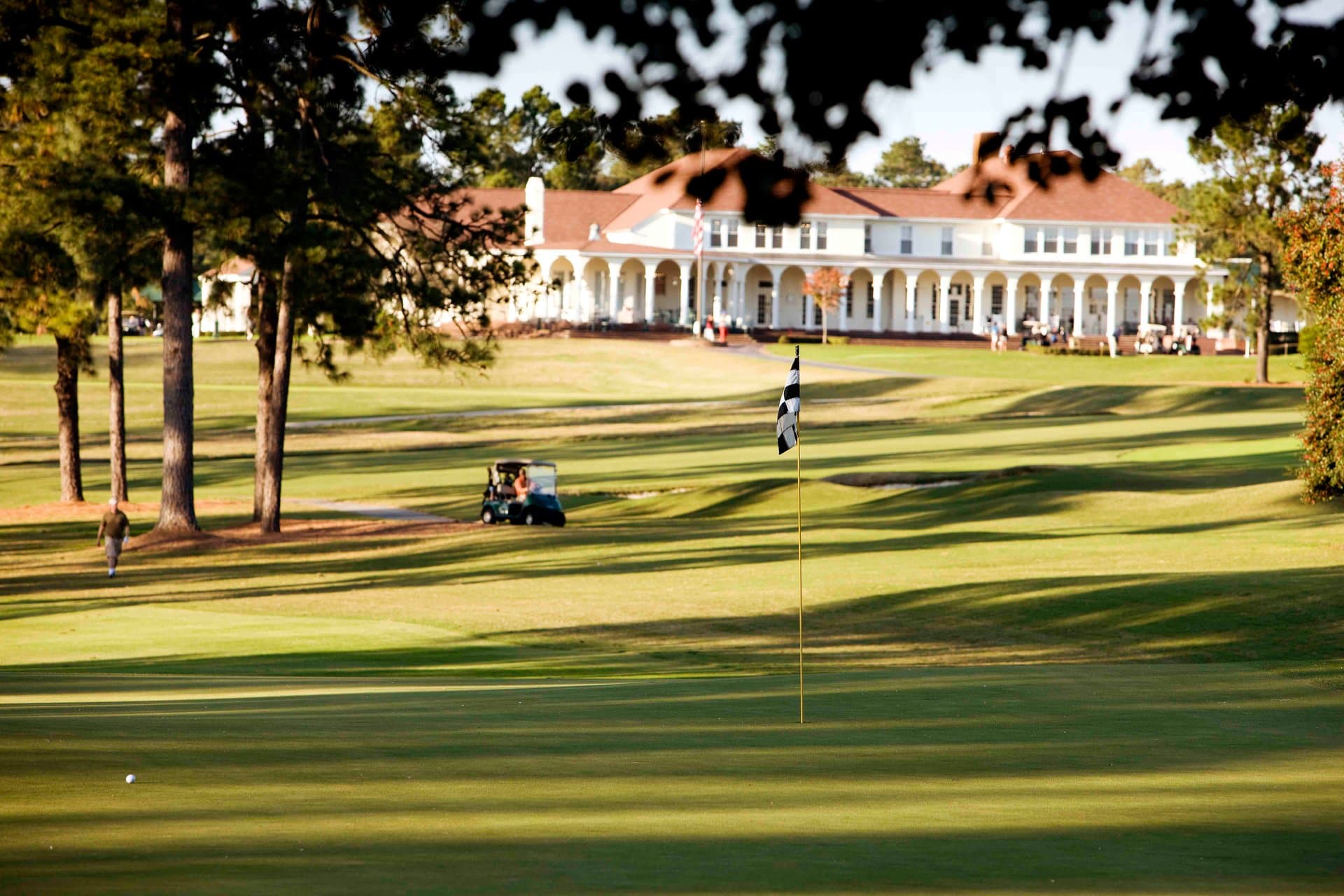
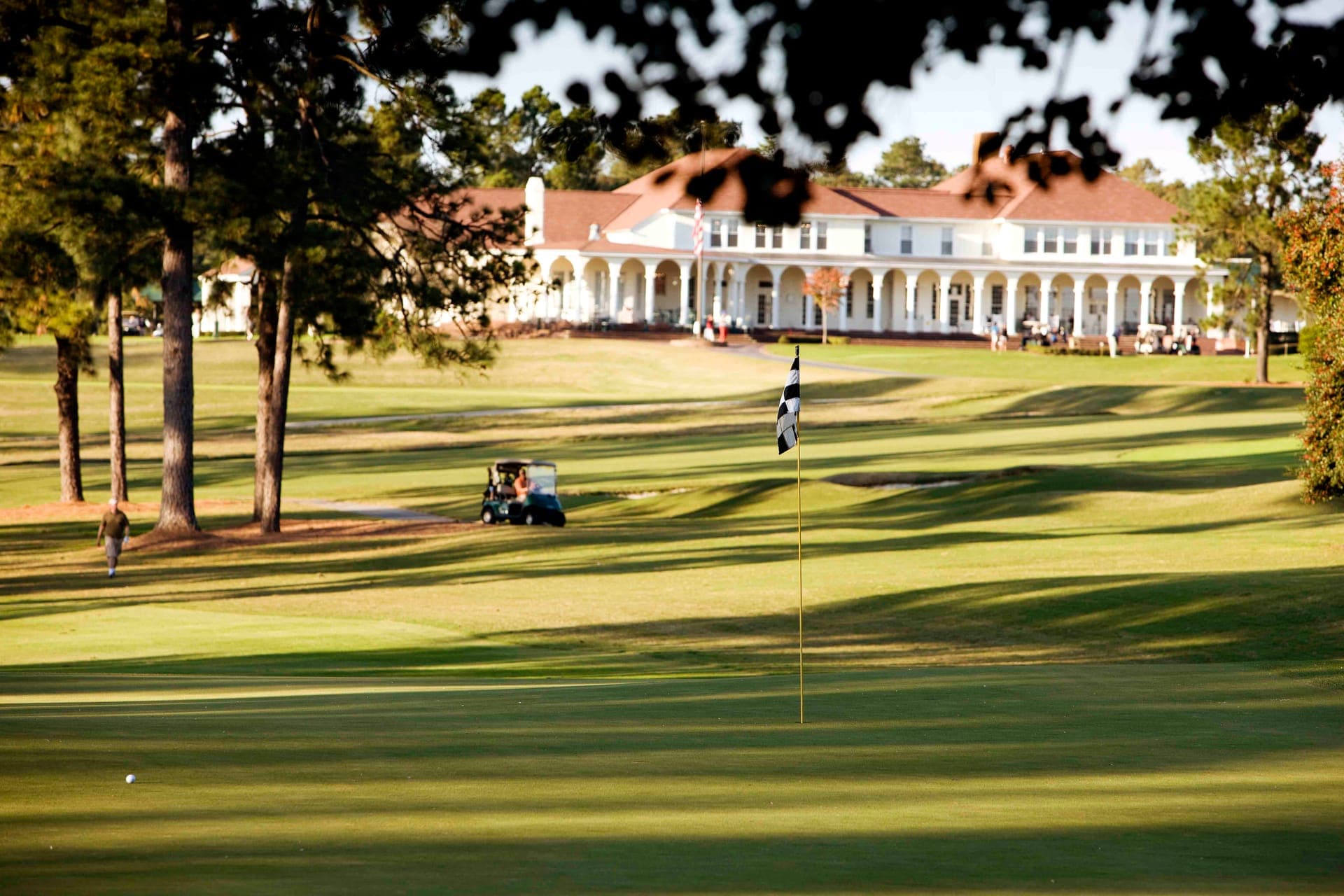
Annual precipitation in the Sandhills runs approximately 46 inches, with snow averaging only 3 inches per year. The sandy soil drains rapidly, which means the courses recover from rain faster than clay-based layouts elsewhere. A morning shower rarely cancels a round. The longleaf pine corridors that define the landscape are beautiful in every season, but they are particularly striking in autumn when the wiregrass turns golden against the green canopy. That image, more than any photograph of No. 2's crowned greens, captures what the Sandhills actually look like in person.