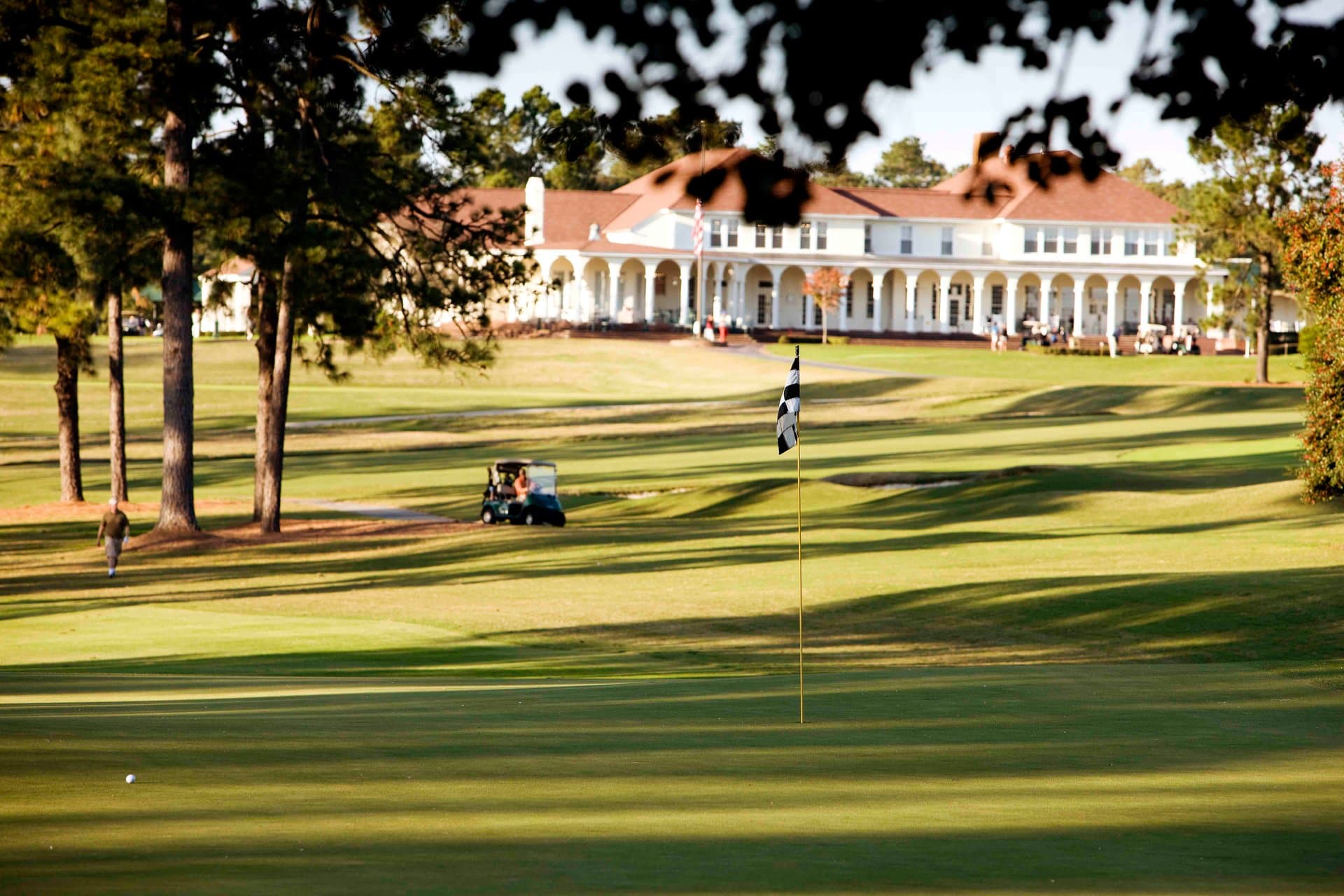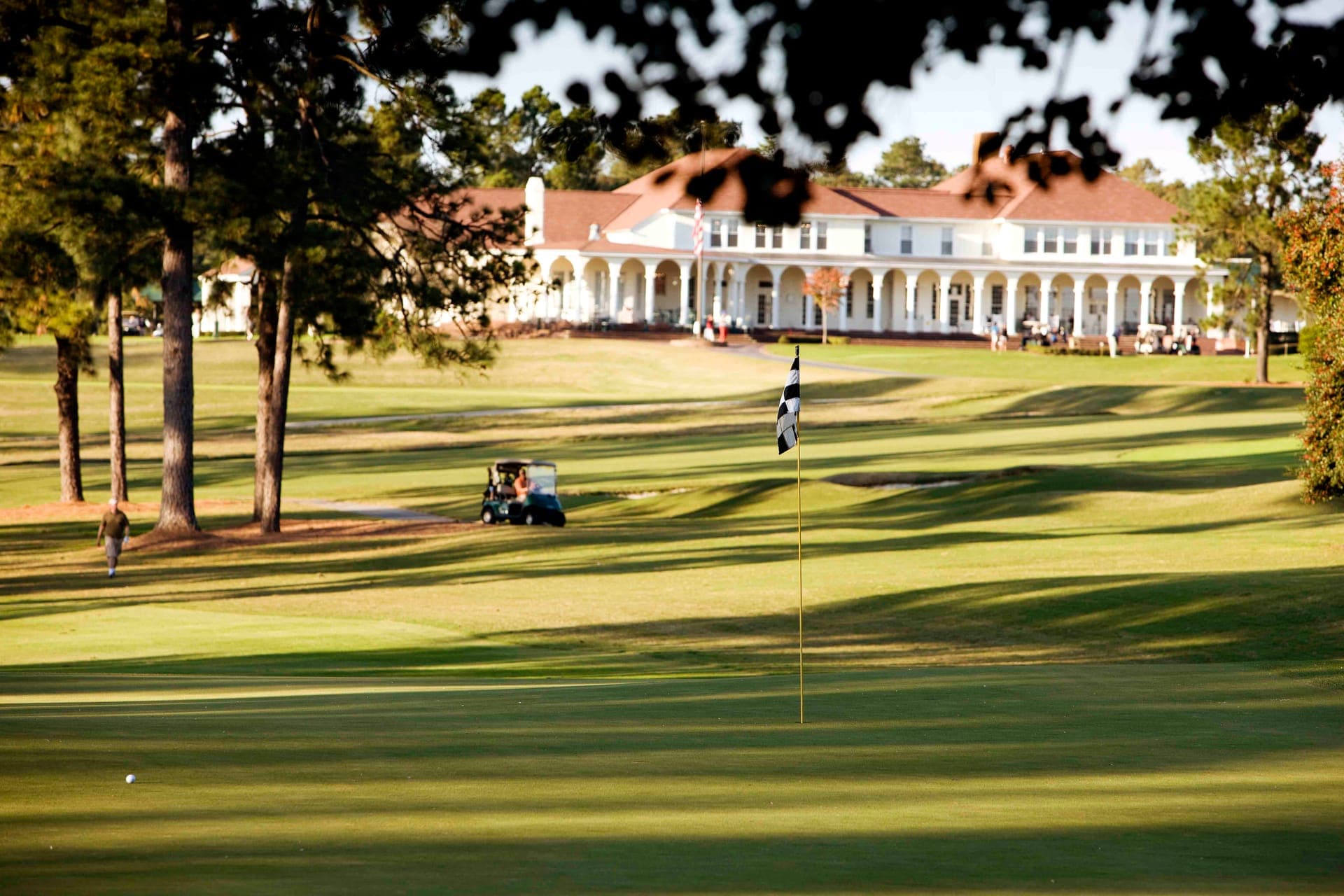
Pinehurst, North Carolina
In 1895, a Boston soda fountain magnate named James Walker Tufts bought 5,000 acres of depleted timberland in the North Carolina Sandhills for roughly a dollar an acre. He hired Frederick Law Olmsted to design a village. He hired Donald Ross to build a golf course. The village became Pinehurst. The golf course became No. 2. And the depleted timberland became, over the next 130 years, the most concentrated collection of consequential golf in America.
That history matters because it explains what Pinehurst is and what it is not. This is not a resort destination that happens to have golf. It is a golf destination that built a village around itself. The difference is felt immediately upon arrival. There is no commercial strip. No chain-restaurant sprawl. Pinehurst Village, population roughly 16,000, still follows Olmsted's original curving street plan, with a walkable center of small shops, restaurants, and the resort campus anchoring the eastern edge. Golf is not the primary activity here. It is the organizing principle.
The Courses
Pinehurst Resort alone operates ten numbered courses plus The Cradle, a par-3 short course. Add the independent layouts within a 30-minute drive and the Sandhills region offers more courses per square mile than any comparable area in the country. The density means that a visiting golfer can play dramatically different designs without ever sitting in traffic.
The headliner requires no introduction. Pinehurst No. 2 is a Donald Ross design that opened in 1907 and has been refined, altered, and ultimately restored to something close to its original intent. The Coore and Crenshaw restoration of 2011 stripped away the rough that decades of U.S. Open preparation had encouraged and returned the course to native wiregrass and sandy waste areas. The result plays differently from any other major championship course in the country. There are no trees lining the fairways. There is no primary rough in the traditional sense. The defence is in the crowned greens, the false fronts, and the collection areas that funnel anything marginally offline into difficult recovery positions. No. 2 hosted U.S. Opens in 1999, 2005, 2014, and 2024, with future championships locked in through 2047. It is one of fewer than ten courses in the world that can credibly claim to be the best.
Pinehurst No. 4 is the resort's other marquee layout. Originally a Donald Ross design from 1919, it was completely reimagined by Gil Hanse in 2018. Golf Digest named it the best new course in America that year. Where No. 2 asks for precision around the greens, No. 4 challenges the full range of shotmaking from tee to green. It hosted the 2019 U.S. Amateur. For golfers who play both, No. 4 is frequently the preferred round, a quiet opinion that speaks to the quality of Hanse's work rather than any deficiency in No. 2.
Beyond the resort gates, the Sandhills hold courses that would anchor any other destination. Tobacco Road, Mike Strantz's 1998 design carved from an old sand quarry in Sanford, is a 30-minute drive from the village and a complete departure from the Ross aesthetic. Its slope rating of 150 is among the highest in the country. Blind shots, dramatic elevation changes, and greens that reward creativity over formula make it polarising by design. Golfers either rank it among their favourite courses in the country or find it excessively theatrical. There is little middle ground, which is precisely the point.
Mid Pines Inn and Golf Club, a Ross design from 1921 restored by Kyle Franz in 2013, sits on Midland Road in Southern Pines directly across the street from its sister property, Pine Needles Lodge and Golf Club. Pine Needles, also a Ross design, has hosted four U.S. Women's Opens. The two courses together represent Ross at his most natural: gentle routing through longleaf pines, greens that work with the terrain rather than against it, and a scale that feels human in a way that modern championship courses sometimes do not. Playing Mid Pines and Pine Needles on consecutive days is one of the better two-day stretches available anywhere in American golf, and the combined cost is a fraction of what a single round at No. 2 would add to a resort package.
The resort's middle tier fills out the schedule. No. 8, designed by Tom Fazio in 1996 to celebrate the resort's centennial, pays deliberate tribute to Ross with false fronts and collection areas grafted onto Fazio's characteristically well-groomed presentation. No. 9, a Jack Nicklaus design and the only Nicklaus course in the Sandhills, offers something stylistically distinct from the Ross-heavy rotation. Both are available to resort guests on package terms and serve as strong secondary rounds.
Talamore Golf Resort, a Rees Jones design in Southern Pines, and Legacy Golf Links, a Jack Nicklaus II layout in Aberdeen, provide quality golf at significantly lower price points. Legacy's green fees sit around $119, making it the best value in the immediate area relative to design pedigree. These courses do not carry the historical weight of the Ross layouts, but they carry the Sandhills turf conditions, the longleaf pine corridors, and green complexes that demand attention. For groups assembling four or five rounds across a trip, mixing in a Talamore or Legacy round keeps the budget manageable without sacrificing the quality of the day.
The Institutional Home of American Golf
In May 2024, the USGA opened Golf House Pinehurst, its new headquarters campus located between The Carolina Hotel and the resort's main clubhouse. The move from Far Hills, New Jersey, to Pinehurst was more than administrative. It placed the governing body of American golf at the site of its most important championship venue. The World Golf Hall of Fame, previously housed in St. Augustine, Florida, relocated to the same campus. The combined facility offers exhibits, historical collections, and the Hall of Fame induction gallery. Admission runs $10 general, $5 for North Carolina residents, free for USGA members and children under 12.
The significance of having both institutions here is difficult to overstate. Pinehurst was already the most historically dense golf destination in the country. Now it is also the institutional centre. For golfers who care about the game's history and governance, this alone justifies a visit that extends beyond the golf courses.
Where to Stay
The resort operates three on-campus lodging options. The Carolina Hotel, a AAA Four Diamond property with 230 rooms, is the flagship: full-service spa, pool complex, multiple restaurants, and the kind of measured luxury that reflects its original 1901 construction. The Holly Inn, with 82 rooms and its own Four Diamond restaurant, dates to 1895 and carries a more intimate character. The Manor, renovated in 2019 with 43 rooms, operates at a notch below the other two in formality while maintaining full resort access.
Off campus, Mid Pines and Pine Needles both offer lodge-style accommodation directly connected to their golf courses. Talamore provides villa-style units with full kitchens that work well for groups seeking independence. The Homewood Suites in Olmsted Village puts visitors within two miles of No. 2 with Hilton-standard amenities and free breakfast. For budget-conscious golfers, the Quality Inn in Aberdeen offers functional rooms at $58 to $72 per night, roughly seven miles from the resort.
The critical thing to understand about staying in Pinehurst is the package structure. Pinehurst Resort does not sell standalone green fees to the public. Access to the resort courses requires an overnight stay, and rates are bundled into packages that combine lodging and golf. This means that trip budgeting is not a matter of adding room rates and green fees. It is a matter of selecting a package tier and understanding what each tier includes. The system can feel opaque at first, but it simplifies once you accept the bundled model. Details on navigating the packages are in the practical guide.
Beyond the Course
The Sandhills region operates at a quieter register than most golf destinations. There are no beach bars, no boardwalks, no amusement parks competing for attention. What exists instead is a landscape of longleaf pine forests, walking trails, and small-town Southern Pines, whose downtown along Broad Street has become a genuine dining and shopping destination in its own right.
Weymouth Woods Nature Preserve, south of Southern Pines, protects 900 acres of old-growth longleaf pine and offers well-maintained trails through one of the few remaining examples of the ecosystem that once covered the entire Sandhills region. Sandhills Horticultural Gardens, on the campus of Sandhills Community College, provides a free botanical walk that fills a pleasant hour.
The equestrian tradition runs deep. The Walthour-Moss Foundation offers 4,000 acres of riding trails in Southern Pines. Seagrove, 30 minutes north, has been a centre of American pottery since the 18th century and now holds dozens of studios open to visitors.
For a quiet afternoon between rounds, Pinehurst Village itself is walkable and rewards an unhurried pass. The shops, the architecture, the scale of the place. It all feels intentional in a way that most American resort towns do not. Olmsted designed it that way on purpose, and the village has respected that design for 130 years. The result is a golf destination that does not feel like a golf destination. It feels like a place where golf happens to have taken root, which is exactly what happened.
When to Go
October is widely regarded as the best month. Temperatures peak in the low 70s, humidity drops, and the longleaf pines are at their most photogenic. Spring, particularly April and May, delivers similar conditions. Summer is hot and humid, with July highs averaging 90 degrees, but the courses remain playable for early risers. Winter is mild by Northern standards. January highs of 50 degrees with mornings in the 30s make layering essential, but golf continues year-round, and off-season package rates drop 30 to 50 percent below peak.
Who It Serves
Pinehurst is for the golfer who cares about the game beyond their own scorecard. The history here is not decorative. It is layered into the land, the architecture, the institutions, and the culture of a village that has been defined by golf for more than a century. A first visit should include No. 2, because the course deserves to be experienced firsthand rather than understood through television coverage alone. But the trip that lingers is the one that also includes Mid Pines on a quiet Tuesday morning, Tobacco Road on a day when you want to be challenged in unfamiliar ways, and an afternoon at Golf House watching the Hall of Fame induction films.
The Sandhills do not rush. The courses do not shout. The village does not perform. Pinehurst earns its reputation through accumulation: round after round, visit after visit, each one adding a layer to a relationship with a place that has been building that kind of loyalty since Donald Ross first walked the sandy soil and decided this was where he would spend his life.