Arcadia Bluffs: Course Review and Playing Guide
Par: 72 | Yardage: 7,300 (tips) | Designer: Warren Henderson (1999) | Type: Public Resort | Green Fee: $150–$250 | Walking: Encouraged (caddie available)
The Bluffs Course at Arcadia Bluffs occupies a stretch of Michigan's Gold Coast that would be remarkable even without golf. Two hundred feet above the eastern shore of Lake Michigan, the property surveys a horizon of open water that could pass for an ocean. Warren Henderson opened the course in 1999, the same year Mike Keiser debuted Bandon Dunes on the opposite coast. Both projects shared a conviction that American golfers were ready for links-inspired design in remote settings. Bandon received the national attention. Arcadia Bluffs, quieter in its ambitions and more modest in its scale, built a devoted following on its own terms.
Where to stay in Northern Michigan
Planning the trip? Compare live prices across every nearby hotel and rental in one search.
Prices and availability from Booking.com, Expedia and others via Stay22. GolfTrailsHQ may earn a commission at no additional cost to you.
The Design Story
Henderson is not a name that appears on architecture rankings or generates feature-length profiles in the golf press. His portfolio is concentrated in the Midwest, and Arcadia Bluffs represents the project for which he will be remembered. The site itself demanded restraint. The bluffs, the wind, and the native fescue grasses provided the raw material. Henderson's task was to route 18 holes across a landscape that already possessed the visual and strategic vocabulary of links golf without forcing the terrain into shapes it did not want to take.
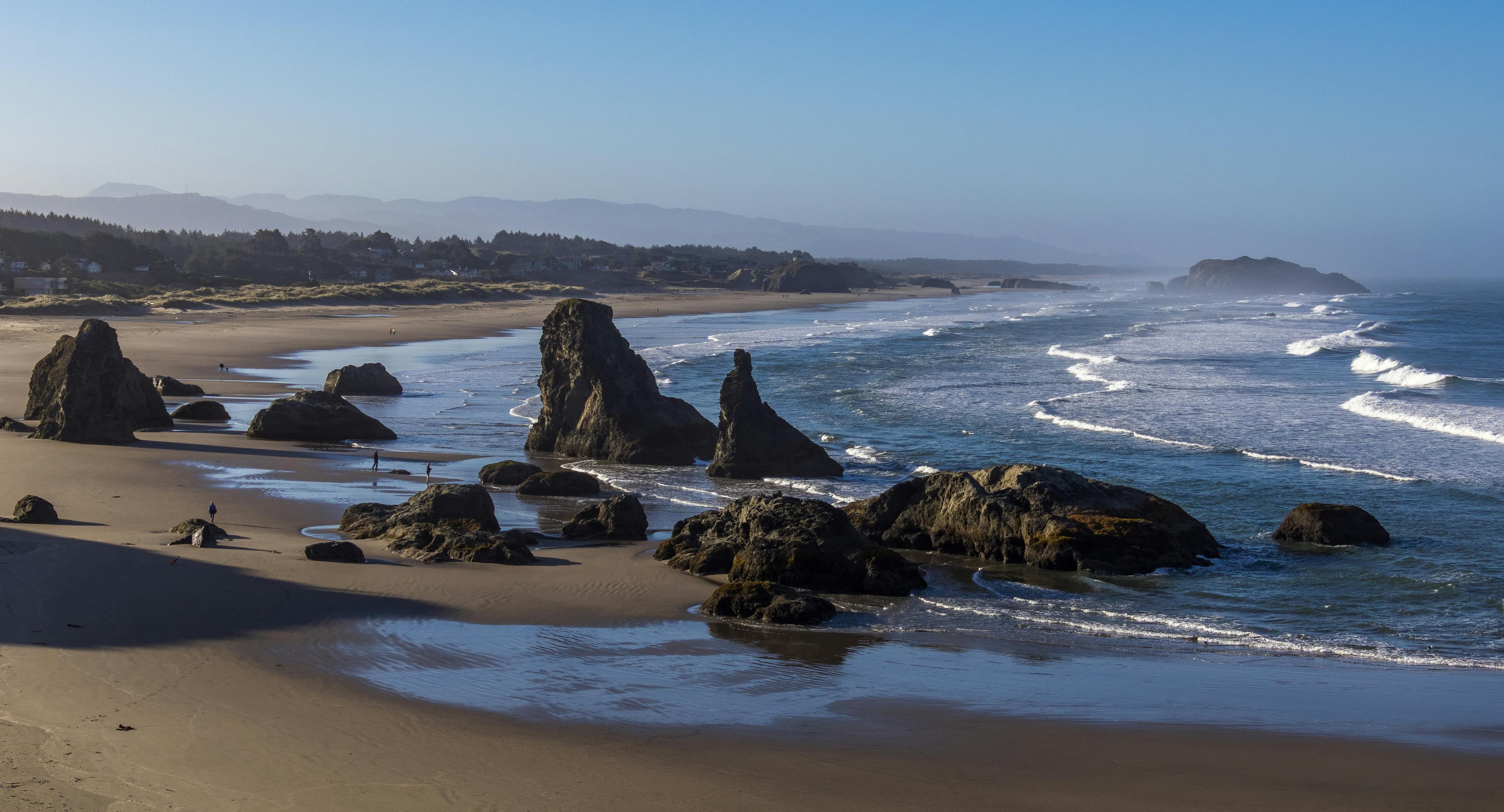
Bandon Dunes
The routing makes intelligent use of the property's elevation changes. Several holes run along the bluff edge with Lake Michigan directly in view, while others turn inland through corridors of tall fescue that block the water from sight and redirect the wind. The shifts between exposed and sheltered holes give the round a rhythm that prevents the setting from becoming monotonous. A clifftop par 3 followed by a sheltered inland par 4 resets the sensory register and demands a recalibration of strategy.
Henderson placed bunkers in the links tradition: deep, steep-faced, and positioned to catch the running approach rather than the aerial one. The design philosophy is coherent. Every element points toward ground-game golf, and the course rewards golfers who recognize that intent and adjust their approach accordingly.
The greens are firm and contoured, designed to reward shots that land short and release forward rather than those that descend from altitude and stop where they land.
How the Course Plays
The opening hole establishes the contract. A par 5 sweeping gently left, it presents a wide fairway and a green that accepts a running third shot from well below the putting surface. The wind is likely present from the first swing, and the fescue rough flanking both sides of the fairway penalizes shots that stray without being punitive. It is an invitation, not a warning.
The front nine builds gradually toward the lake. By the 5th hole, the water dominates the western horizon, and the wind patterns become more complex as the routing turns to face different exposures. The par-3 7th plays from an elevated tee toward a green perched near the bluff edge, with Lake Michigan stretching beyond in a way that affects depth perception. Judging distance on holes where the background is open water and open sky requires experience that most inland golfers do not possess on their first visit. The tendency is to over-club.
The 11th through 14th form a sequence along the bluffs where the views are constant and the wind exposure is at its peak. These holes are where scoring can come apart for golfers who insist on aerial approaches. The greens on the exposed holes are designed to be approached along the ground whenever conditions permit. A low, running 7-iron into a crosswind is a more reliable play than a high wedge that the wind will carry off line. The course does not penalize the high ball in calm conditions, but calm conditions on this stretch are the exception rather than the rule.
The back nine delivers the most concentrated stretch of lakeside golf.
The 15th, a par 3 of roughly 200 yards, is frequently cited as the signature hole. It plays over a ravine to a green backed by the lake, and the aesthetic impact is considerable. The hole is also genuinely difficult. The green is narrow relative to its depth, the wind is typically across, and the bunkers on both sides are not places from which par is easily recovered. It is a hole that earns its reputation through the quality of the design rather than merely through the scenery.
The closing stretch moves back inland, and the final two holes provide birdie opportunities for golfers who have managed their games through the exposed middle sections. The 18th green sits near the clubhouse with a view back across the property, a finish that frames the round's narrative neatly.
What the Green Fee Purchases
Tip
Caddies are available and worth the investment, particularly for first-time visitors. The course's caddie program is well-established, and a knowledgeable caddie provides not only yardage assistance but wind reads and green contour information that materially affect the score. Walking without a caddie is equally viable. The course is designed for it, and the distances between greens and tees are manageable.
The resort offers on-site lodging, and the accommodations, while not luxurious by destination-resort standards, are comfortable and well-maintained. The dining facilities take advantage of the lakeside setting. For golfers making the trip specifically for the Bluffs Course, staying on property eliminates the need to navigate rural roads between a hotel and the first tee.
The South Course
Since 2020, Arcadia Bluffs has operated a second 18-hole course. The South Course, designed by Dana Fry and Jason Straka, sits on lower ground away from the bluffs and plays in a different register. Where the Bluffs Course is exposed and links-inspired, The South Course incorporates more elevation change, tree lines, and a routing that feels more distinctly American. The two courses complement each other well. A two-day visit playing both provides sufficient variety and a clear sense of what the property offers across its full acreage.
Practical Considerations
Arcadia Bluffs is remote by the standards of premium public golf. The course sits roughly 4.5 hours north of Detroit and about an hour southwest of Traverse City, the nearest town with meaningful dining and lodging alternatives. Cherry Capital Airport in Traverse City receives seasonal service from several carriers, and driving from there is the most practical access route for visitors arriving by air. From Chicago, the drive is approximately five hours, with a Lake Michigan ferry crossing from Milwaukee to Muskegon available as a scenic alternative that reduces drive time slightly.
The season runs from early May through late October, with peak conditions typically arriving in June and lasting through September. July and August bring the warmest weather and the highest green fees. September and early October offer lower rates, thinner crowds, and fall color that adds a dimension to an already striking setting.
The verdict