Tiburon Golf Club Naples: Review and Playing Guide
Gold Course — Par: 72 | Yardage: 7,288 | Designer: Greg Norman (1998) | Type: Resort / Semi-Private | Green Fee: $175–350 | Walking: Permitted (cart recommended)
Black Course — Par: 72 | Yardage: 7,005 | Designer: Greg Norman (2001) | Type: Resort / Semi-Private | Green Fee: $175–350 | Walking: Permitted (cart recommended)
The LPGA's CME Group Tour Championship, the season finale that determines the tour's Player of the Year, plays the Gold Course each November. The PGA Tour's QBE Shootout, now known as the Grant Thornton Invitational, called the same layout home for decades. That double endorsement from professional golf's governing bodies tells you something specific about the quality of the turf and the caliber of the infrastructure. What it does not tell you is whether the golf itself justifies the green fee for a visiting resort golfer playing without a gallery, without a broadcast crew, and without a caddie forecasting the break on the 14th green.
Tiburon Golf Club sits at the center of the Ritz-Carlton Golf Resort in North Naples, the most tournament-tested golf facility in Southwest Florida.
The answer depends on what you are buying. At Tiburon, the purchase is conditioning, convenience, and a design that asks for strategic thought without ever threatening to ruin an afternoon. It is a particular kind of golf experience, and it delivers that experience reliably.
Where to stay in Naples
Planning the trip? Compare live prices across every nearby hotel and rental in one search.
Prices and availability from Booking.com, Expedia and others via Stay22. GolfTrailsHQ may earn a commission at no additional cost to you.
The Design Story
Greg Norman completed the Gold Course in 1998 and the Black three years later in 2001. Both layouts occupy the same stretch of flat coastal terrain that defines Collier County. There are no elevation changes worth mentioning. The land is level in the way that only Southwest Florida can be level, which means Norman's design challenge was not routing through natural topography but creating visual and strategic interest on a canvas that offered neither.
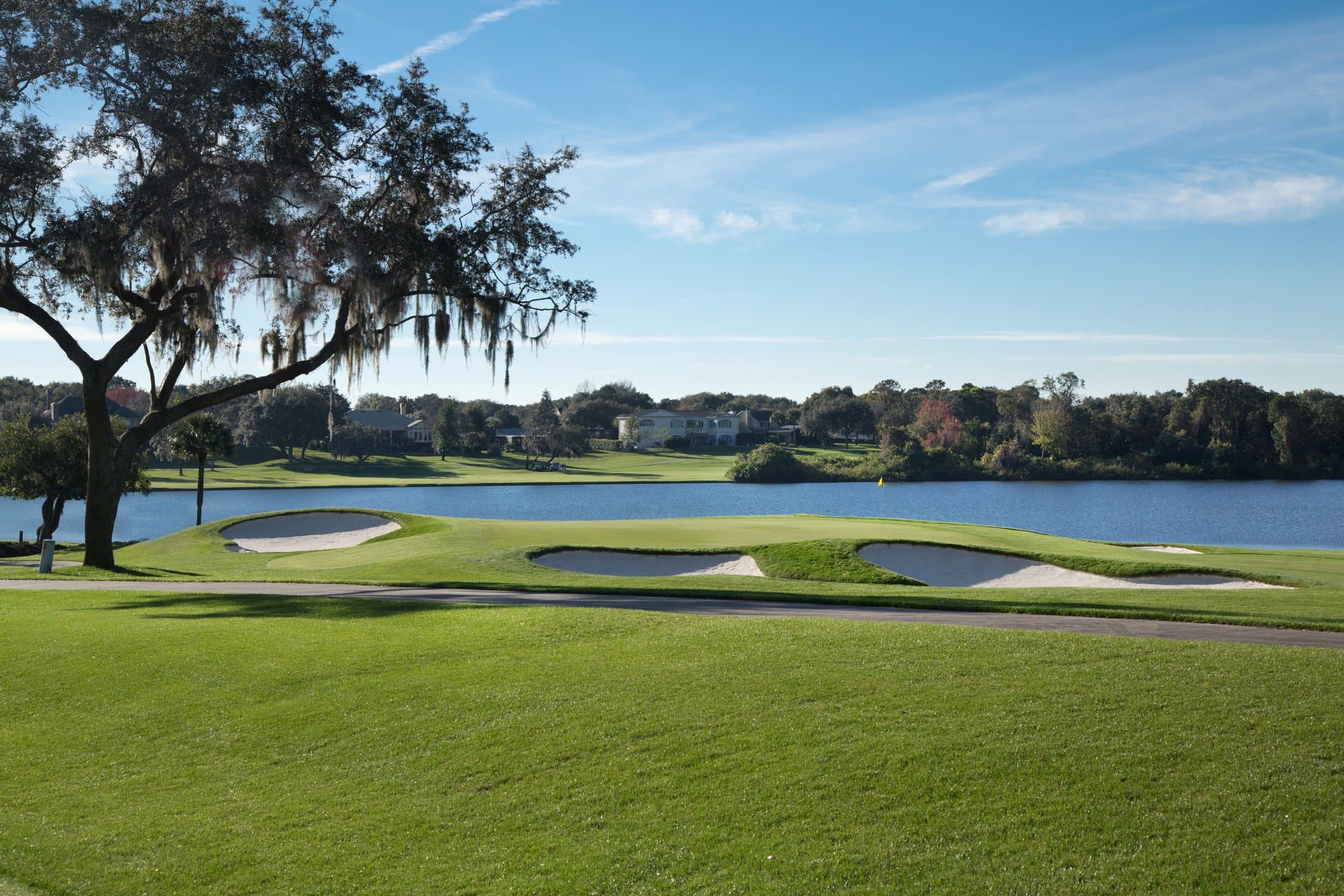
His solution on the Gold was sod-wall bunkers. The stacked turf faces give the course a visual signature that reads as links-adjacent, unusual for a region dominated by tropical landscaping and water features. The bunkers frame fairway landing zones with precision, and their depth creates a genuine penalty for golfers who find them. The sand is firm and heavy, closer in texture to a Scottish links than to the fluffy bunker fill common at Florida resort courses. Golfers who arrive expecting to splash out casually will adjust their expectations on the second or third visit to the sand.
On the Black, Norman shifted the design vocabulary entirely. Pine straw replaces manicured rough. Crushed coquina shell waste areas replace conventional bunkers in several locations. The effect is a layout that feels less like the Gold's polished sibling and more like something transported from the North Carolina Sandhills. The coquina areas function similarly to the sandy waste at Pinehurst: technically not hazards under the Rules of Golf, but practically challenging for anyone who finds them. The ball sits down, the footing is uneven, and the club selection changes with every lie.
How It Plays: The Gold Course
The Gold stretches to 7,288 yards from the back tees with a slope of 137, which is moderate for a championship layout. The fairways are wide enough that an errant drive usually has a recovery option, and the forced carries are minimal. The difficulty is positional rather than penal. Reaching greens in regulation is not the hard part. Reaching them from the correct angle, to pin positions made famous by LPGA broadcasts, is a different proposition.
Each demands precise distance control to greens that are guarded in front and on the flanks, with very little room for the bail-out shot. The par 5s offer legitimate risk-reward decisions for longer hitters, with water featuring prominently on the approach to at least two of them. The overall rhythm of the Gold is steady and deliberate. There are no moments of pure spectacle, no dramatic elevation shifts or ocean views. What there is, hole after hole, is a clear set of choices presented honestly.
The par 3s are the strongest holes on the routing.
How It Plays: The Black Course
The Black is 283 yards shorter than the Gold but carries a slope of 147, the highest of any publicly accessible course in the Naples destination guide area. That ten-point slope differential tells the real story. The greens are the primary defense. Norman built significant movement into the putting surfaces, and the contours create pin positions that range from accessible to genuinely difficult. Three-putts on the Black come not from poor stroke mechanics but from misread greens, which is a type of difficulty that accumulates quietly across eighteen holes.
The routing threads through native Florida pine flatwoods, and the canopy provides shade that the exposed Gold Course does not. The round has an insular, almost private-club quality. Water features are present but subordinate to the pine and coquina elements that define the playing experience. Golfers who value strategic complexity over presentation will prefer the Black. Golfers who want the tournament association and the polished aesthetic will prefer the Gold. The recommended sequence for visitors playing both is Gold first, Black second. The Gold establishes the standard. The Black raises the stakes.
What the Green Fee Purchases
Tip
What the fee includes, beyond the golf, is conditioning that reflects the facility's tournament obligations. Fairways are maintained to broadcast standards year-round. Greens roll at speeds that would be considered fast at most private clubs. The practice facility is extensive, with a full driving range, short-game area, and putting green that replicate on-course conditions. For golfers who build in forty-five minutes of warm-up time, the practice session becomes part of the experience.
Booking priority goes to resort guests at the Ritz-Carlton, and prime morning tee times during peak season fill quickly. Non-resort visitors can book through the facility, Troon, or GolfNow, but a seven-to-ten-day advance booking window is advisable between November and April.
Practical Considerations
Walking is technically permitted on both courses but not practical. The distances between greens and subsequent tees are substantial, a common feature of Norman's resort-era designs where residential real estate influenced the routing. A cart is the realistic choice for virtually every round.
The shared clubhouse serves both courses and reflects the Ritz-Carlton standard: clean, well-staffed, and equipped with dining options that exceed what most golf facilities offer. The halfway house is similarly above the resort-course baseline.
Southwest Florida's climate shapes the playing calendar in ways that matter for trip planning. November through April offers the best combination of weather and conditioning. Summer rounds are available at reduced rates, but afternoon thunderstorms are routine from June through September, and the humidity can be oppressive before noon. The Naples complete golf guide covers seasonal planning in greater detail.
The verdict