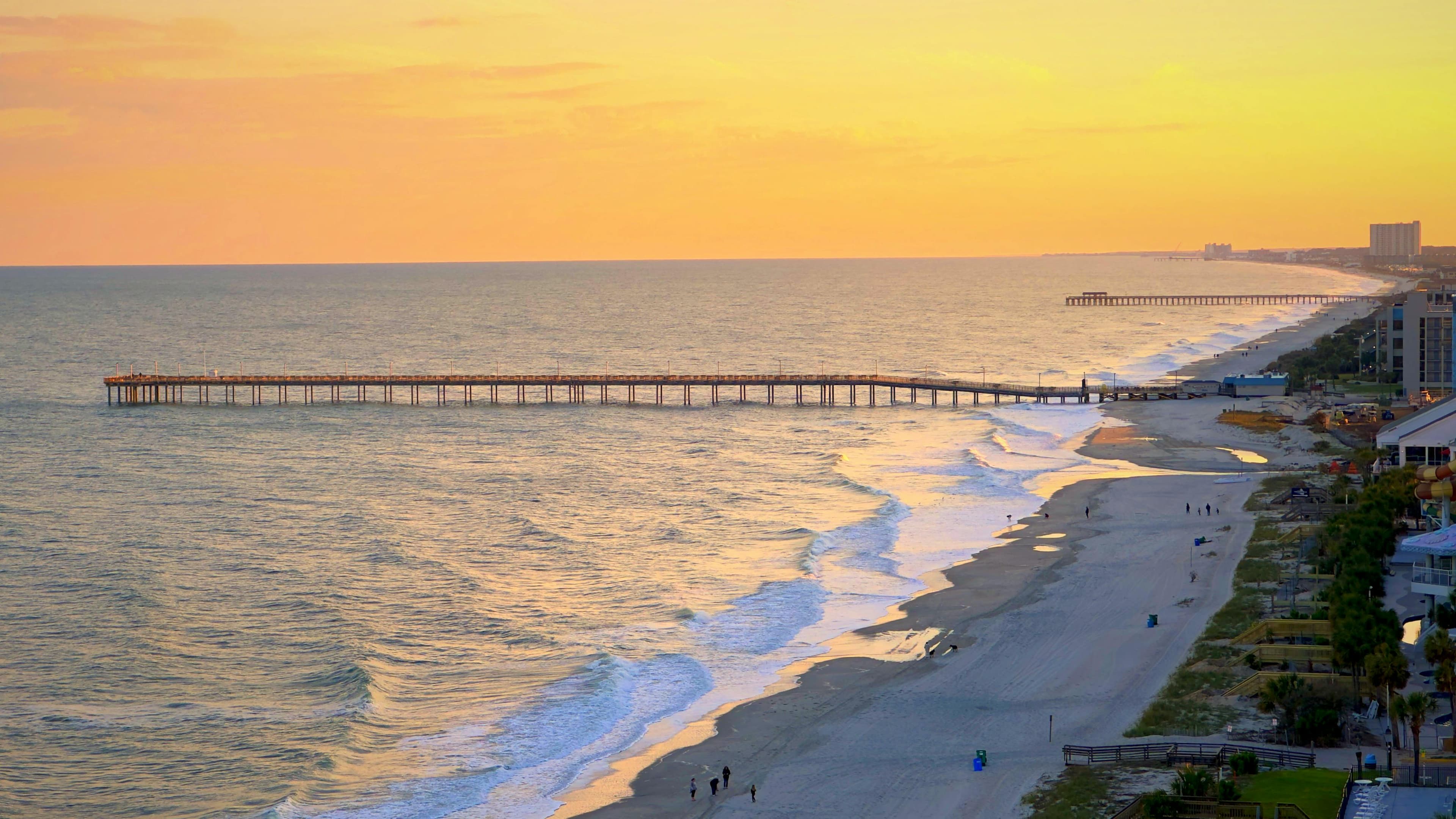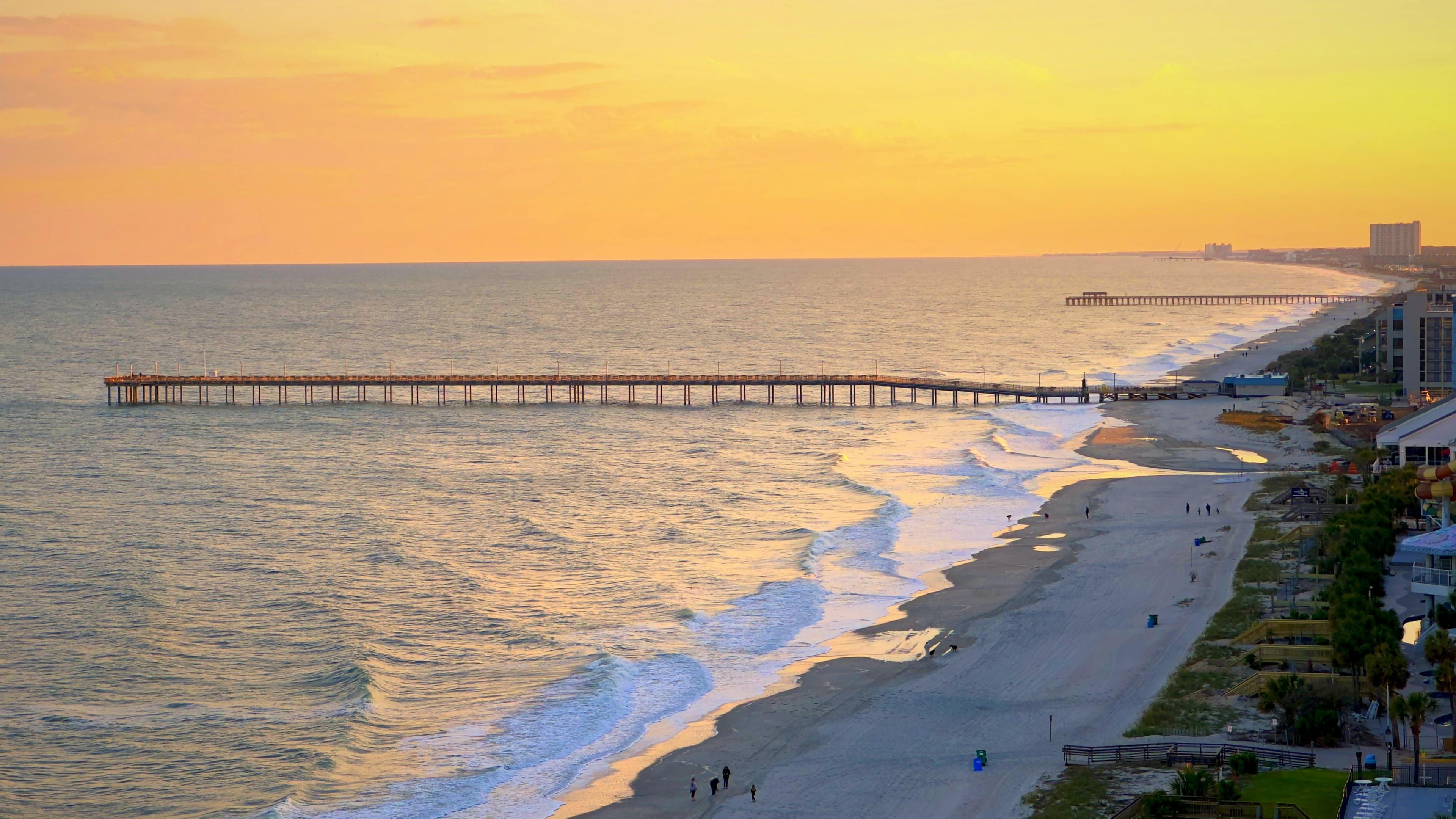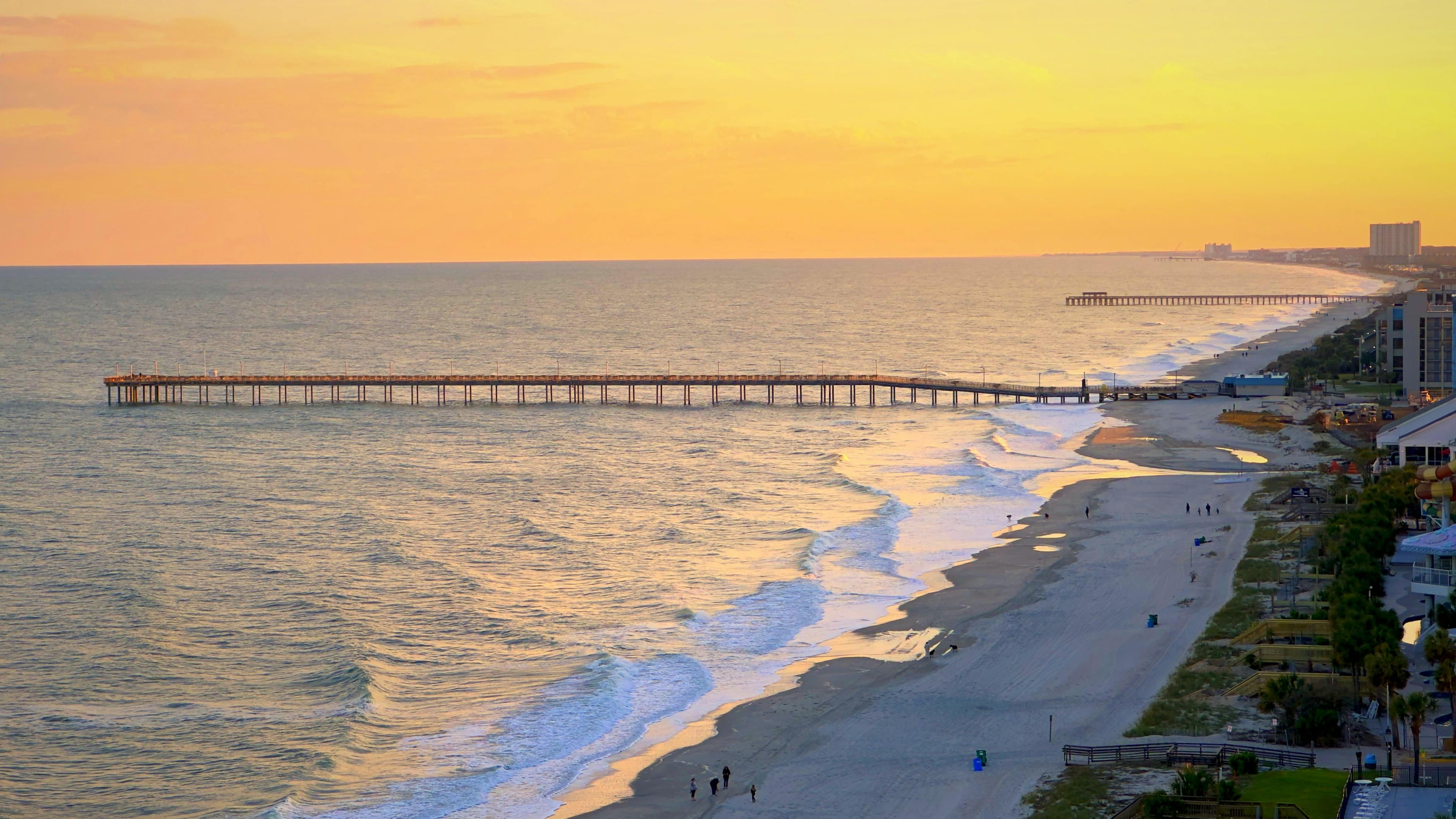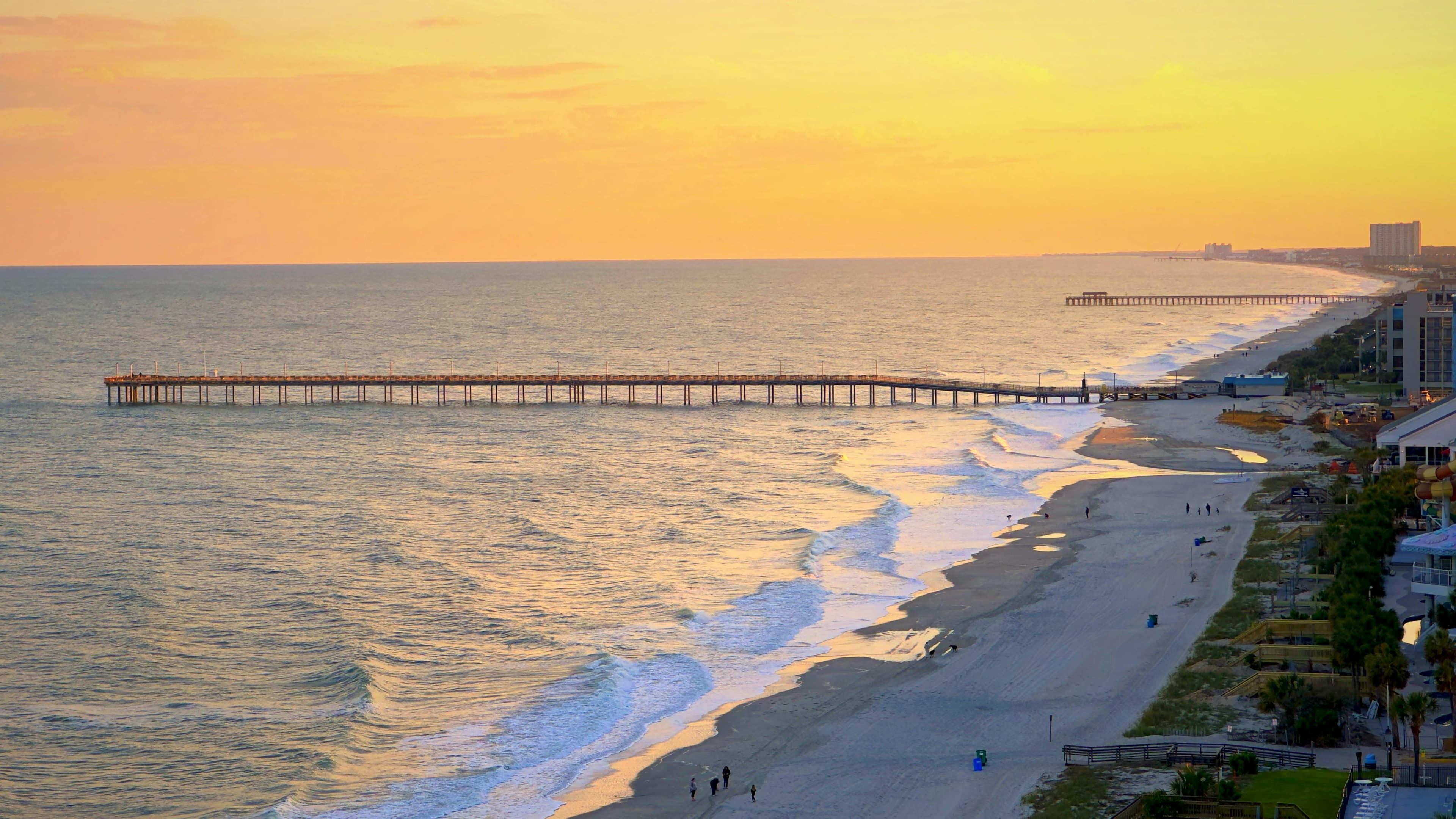
Myrtle Beach, South Carolina
The numbers tell the story before anything else does. Roughly 759,000 visiting golfers arrive each year. They play more than three million rounds across approximately 90 courses stretched along a 60-mile coastal arc called the Grand Strand, from Little River at the North Carolina border to Georgetown at the mouth of Winyah Bay. The annual golf economic impact reaches $1.6 billion. No other destination in America operates at this scale.
That scale is worth understanding because it shapes every aspect of the experience. Myrtle Beach is not a curated collection of trophy courses arranged around a single resort. It is an entire regional economy organized around the premise that golf travel should be available to anyone willing to make the drive or book the flight. The result is a destination where a foursome can play quality golf for under $50 a round or spend $350 for a tournament-caliber layout, sleep in a $60 hotel room or a $450 resort suite, and find the full spectrum filled in between. There is no other golf destination in the country where the gap between the cheapest round and the most expensive round is this wide, and both rounds are genuinely worth playing.
The Grand Strand
Geography matters here more than at most golf destinations. The Grand Strand is not a single town but a continuous stretch of coastal communities, each with its own cluster of courses and accommodations. North Myrtle Beach and Little River anchor the northern end, with Barefoot Resort's four courses and Tidewater's dramatic perch above the Intracoastal Waterway. The central strip around Myrtle Beach proper holds the densest concentration of hotels, restaurants, and entertainment. Murrells Inlet and Pawleys Island, roughly 20 to 30 minutes south, carry a quieter, more residential character and happen to contain some of the Strand's most celebrated designs.
Understanding this geography saves time and frustration. A golfer staying in North Myrtle Beach and playing Caledonia in Pawleys Island faces a 45-minute drive each way. Most experienced visitors either choose accommodations near their preferred courses or plan their rounds geographically, grouping northern and southern courses on separate days.
Course Diversity
The depth of the course inventory is the defining characteristic, and it operates across clearly distinct tiers.
At the top sit layouts that would anchor any destination in the country. Caledonia Golf and Fish Club, Mike Strantz's 1994 design routed through a former rice plantation in Pawleys Island, consistently ranks among the finest public-access courses in the Southeast. Green fees run $200 to $249 depending on season. TPC Myrtle Beach, host of various professional events over the years, commands $250 to $350 and delivers conditioning standards that reflect its Tour Players Club pedigree. The Dunes Golf and Beach Club, a Robert Trent Jones Sr. design from 1948 with green fees of $200 to $300, carries genuine historical weight. Its par-5 thirteenth, "Waterloo," remains one of the most photographed and discussed holes on the East Coast.
True Blue Golf Club, also in Pawleys Island and also a Strantz design, offers a different proposition. The course is bold, occasionally eccentric, with massive bunkers and greens that reward imagination over formula. At $150 to $196, it represents strong value relative to its design ambition. Tidewater Golf Club, perched on a bluff where the Intracoastal Waterway meets Cherry Grove inlet, pairs memorable elevated tee shots with green fees between $97 and $192. Grande Dunes Resort Course, a Roger Rulewich design near the center of the Strand, occupies the $150 to $200 range and routes through a stretch of Intracoastal Waterway frontage that gives several holes a sense of occasion.
Barefoot Resort consolidates four distinct courses on a single property in North Myrtle Beach: the Dye, Fazio, Love, and Norman courses, each designed by its namesake. Green fees across the four range from $90 to $168 per course, and the variety of design philosophies within a single resort makes it possible to play four genuinely different rounds without leaving the property.
The value tier is where the Strand's volume becomes its greatest practical asset. Courses like Beachwood, a Gene Hamm design dating to 1968, offer solid, well-maintained golf for $40 to $79. These are not afterthoughts. Many of the value-tier courses have been operating for decades, carry mature tree lines, and provide a legitimate golf experience that compares favorably with mid-range options at less saturated destinations. The sheer competition for tee times keeps conditions higher and prices lower than the market might otherwise support. A golfer who plays only the value tier at Myrtle Beach will have a better trip than a golfer who plays the mid-range tier at most other destinations. That is the practical effect of 90 courses competing for the same visitors.
Where to Stay
The accommodation landscape mirrors the course inventory in both range and density. At the upper end, Marina Inn at Grande Dunes operates as a full-service resort with nightly rates between $250 and $450, positioned along the Intracoastal Waterway with proximity to the Grande Dunes course. The property delivers the kind of coordinated resort experience, including dining, spa access, and marina facilities, that simplifies trip logistics for groups willing to pay the premium.
The middle of the market is where most visiting golfers land. Myrtle Beach's long history as a vacation destination means the hotel and condo inventory is enormous. Golf package operators have spent decades building relationships with properties across the Strand, and bundled course-and-lodging deals remain the most common way groups book trips. Nightly rates in the $100 to $200 range open up a wide selection of oceanfront hotels and golf-oriented properties.
Budget travelers find genuine options as well. National chains like La Quinta operate in the area with rates as low as $60 to $100 per night. The combination of budget lodging and value-tier green fees makes Myrtle Beach one of the few major golf destinations where a multi-day trip remains feasible for golfers on a constrained budget. Across the 16 primary accommodation options, the full range runs from $60 to $450 per night, with the majority of inventory concentrated between $90 and $200.
Beyond the Course
Myrtle Beach has never pretended to be exclusively a golf destination. The Grand Strand draws several million total visitors annually, and the non-golf infrastructure reflects that broader appeal. This matters for groups traveling with non-golfers or for rest days between rounds.
Brookgreen Gardens, a sculpture garden and wildlife preserve occupying a former rice plantation south of Murrells Inlet, is the most substantive cultural offering in the area. Its collection of American figurative sculpture, set within formal gardens and a lowcountry nature preserve, provides a half-day experience with genuine depth.
Charleston sits roughly 90 minutes to the south, and a day trip is a common inclusion for visitors staying a week or longer. The historic district, restaurant scene, and cultural institutions operate at a level that complements rather than competes with the beach-town character of the Strand.
Water-based activities fill the calendar: dolphin cruises along the coast, deep-sea fishing charters out of Little River and Murrells Inlet, and kayaking through the salt marshes and tidal creeks that line the Intracoastal Waterway. The MarshWalk in Murrells Inlet, a half-mile boardwalk lined with waterfront restaurants, serves as the default evening gathering spot for the southern end of the Strand. Broadway at the Beach, a large entertainment and shopping complex in central Myrtle Beach, anchors the family-oriented side of the visitor experience. The SkyWheel, a 187-foot observation wheel on the boardwalk, and the Carolina Opry, a long-running variety show, round out the entertainment options.
None of this is incidental. The non-golf amenities are what allow Myrtle Beach to function as a vacation destination for mixed groups, which in turn supports the golf economy by broadening the visitor base beyond dedicated golf travelers. A partner who spends a morning at Brookgreen Gardens and an evening at the MarshWalk is not having a lesser version of the trip. They may, in fact, be having the better one.
The Practical Case
Myrtle Beach International Airport (MYR) connects to more than 50 nonstop destinations and sits five minutes from the main hotel strip. That proximity, unusual for a resort-area airport, eliminates the long transfer that characterizes many golf trips. For the large share of visitors who drive, the Strand sits within a four-hour radius of Charlotte (3 hours 55 minutes), Raleigh (4 hours 7 minutes), and Columbia (2 hours 39 minutes), and just 1 hour 26 minutes from Wilmington. The regional driving catchment covers tens of millions of people, which explains both the visitor volume and the prevalence of long-weekend trips.
A rental car is necessary. The Grand Strand's 60-mile length and the distribution of courses across it make ride-sharing impractical for a golf trip. Rental rates run $36 to $80 per day depending on season and vehicle class.
Who It Serves
Myrtle Beach is the most accessible major golf destination in America. That accessibility operates on every axis: price, geography, logistics, and the sheer number of available tee times on any given day. It does not attempt to be exclusive, and it does not need to be. The concentration of courses creates a competitive environment that pushes quality up and prices down across every tier. A group that returns annually can play different courses each trip for years without repetition. A first-time visitor can build a four-round itinerary mixing design pedigree and value that would be difficult to replicate anywhere else in the country.
The golfers who dismiss Myrtle Beach tend to have never played the top of the card here, or they played it twenty years ago and assume nothing has changed. Both assumptions are wrong. Caledonia and True Blue would be the best public courses in most states. The Dunes Club has legitimate championship history. And the value courses, far from dragging the destination down, are the reason it works: they fill the tee sheets, support the infrastructure, and keep the entire ecosystem competitive. The volume is the feature.