Every US Open Venue You Can Play
The U.S. Open is held at the best courses in America. Most of them are private. But a surprising number are not. Across more than a century of championship history, the USGA has taken its national championship to courses that are open to the public, available to resort guests, or accessible through specific booking arrangements. These are courses where you can walk the same fairways, face the same greens, and understand, in a way that television cannot convey, why the scores were what they were.
Here is every U.S. Open venue you can play, organized by accessibility.
Fully Public or Resort Guest Access
Pebble Beach Golf Links, Pebble Beach, California U.S. Opens: 1972, 1982, 1992, 2000, 2010, 2019. Next: 2027.
Pinehurst No. 2
Six U.S. Opens and counting. Tom Watson's chip-in on the 71st hole in 1982 and Tiger Woods' fifteen-stroke victory in 2000 are part of the permanent record. Green fees are $695 for resort guests. Non-guests can book within 48 hours of play at the same rate. Advance reservations require a two-night minimum stay at a Pebble Beach Resorts property.
More than any other venue in the modern era.
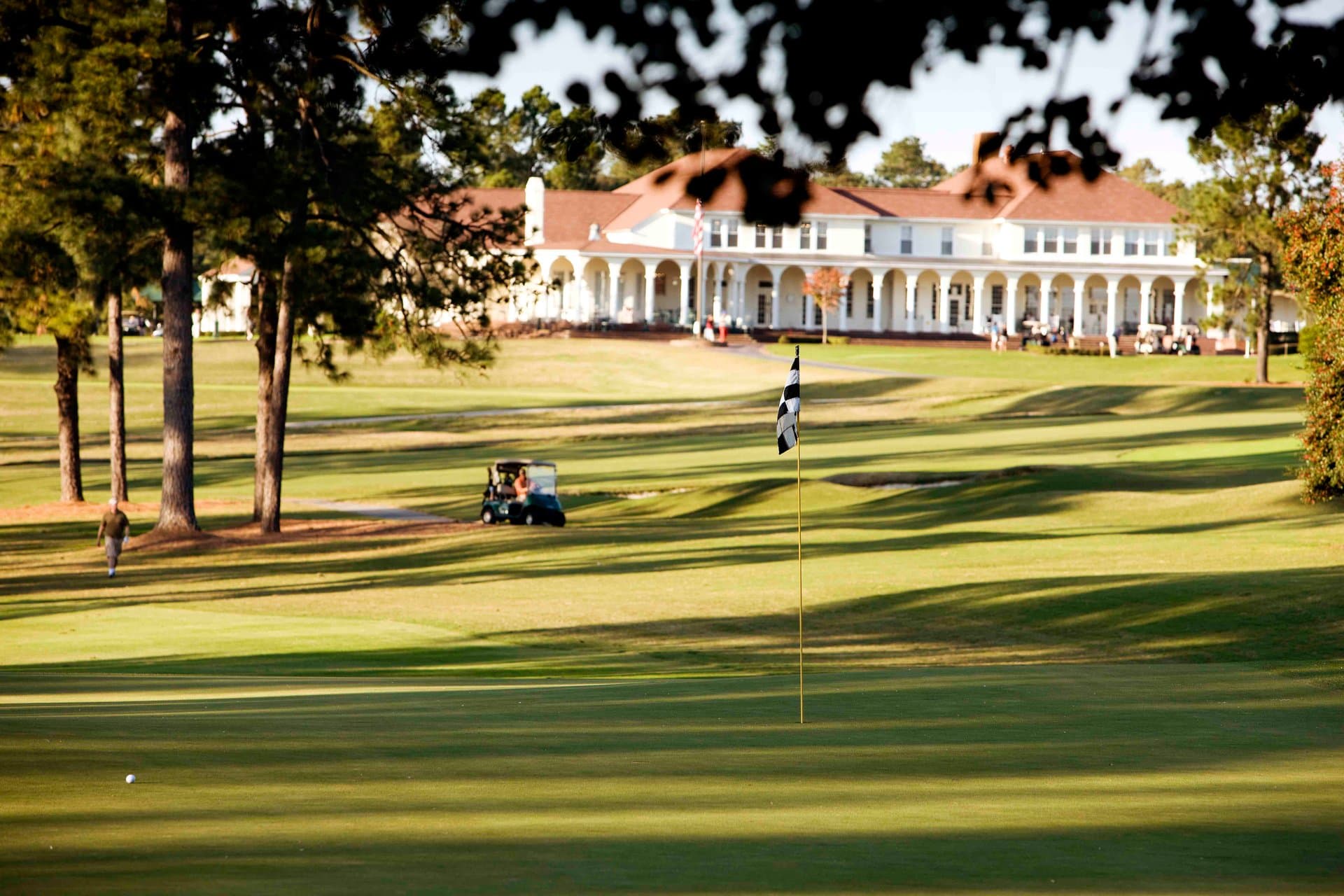
Pinehurst No. 2, Pinehurst, North Carolina U.S. Opens: 1999, 2005, 2014, 2024. Next: 2029, 2035, 2041, 2047.
Donald Ross refined No. 2 over four decades. Bill Coore and Ben Crenshaw restored it in 2011, stripping the rough and returning native wiregrass to the course's edges. The crowned, sloping greens are the course's primary defense. Access requires an overnight stay at Pinehurst Resort with a two-night minimum. The No. 2 surcharge on top of a standard golf package is $250; a second round costs $595 in peak season, $360 off-peak. The USGA has committed to returning here every five years through at least 2047, confirming No. 2's status as the permanent anchor of the U.S. Open rotation.
Erin Hills, Hartford, Wisconsin U.S. Open: 2017.
Michael Hurdzan, Dana Fry, and Ron Whitten designed Erin Hills on glacial terrain west of Milwaukee, and the 2017 championship played long at 7,731 yards. Brooks Koepka won at 16 under par in benign conditions. The course is fully public, with green fees reaching $495 in peak season. The fescue rough that frames the fairways can grow knee-high by late summer, and the open, windswept terrain creates a links-like test that is uncommon in the Midwest.
Torrey Pines South Course, La Jolla, California U.S. Opens: 2008, 2021.
A municipal course perched on cliffs above the Pacific in San Diego. Tiger Woods won the 2008 championship on a broken leg. Jon Rahm won in 2021. Green fees for non-residents are approximately $250 on weekends, which makes Torrey Pines the most affordable U.S. Open venue on this list. The South Course is long at 7,698 yards and the ocean views from the back nine are exceptional. Tee times for out-of-towners can be booked seven days in advance, and the booking system fills quickly.
Chambers Bay, University Place, Washington U.S. Open: 2015.
Tip
Bethpage Black, Farmingdale, New York U.S. Opens: 2002, 2009. Next: 2025.
A state-owned public course on Long Island with a famous sign at the first tee: "The Black Course is an extremely difficult course which we recommend only for highly skilled golfers." New York state residents pay $75; non-residents pay $150 on weekends. The catch is the booking system, which requires either camping out for walk-up tee times or navigating an online reservation system that is competitive. The course, designed by A.W. Tillinghast and restored by Rees Jones, is a genuine championship test at 7,468 yards with a slope of 155.
The Olympic Club Lake Course, San Francisco, California U.S. Opens: 1955, 1966, 1987, 1998, 2012.
Olympic is a private club, but non-member access is available through specific programs and member introduction. The Lake Course has hosted five U.S. It is listed here with a caveat: access requires planning and either a member connection or participation in approved events.
Opens, more than any other venue on the West Coast.
Resort Guest Access with Advance Planning
TPC Sawgrass Stadium Course, Ponte Vedra Beach, Florida Not a U.S. Open venue, but included for context as home of THE PLAYERS Championship.
Note: TPC Sawgrass has not hosted a U.S. Open but is frequently confused with championship venues. The Stadium Course, home of THE PLAYERS Championship and its iconic 17th island green, is accessible to guests of the Sawgrass Marriott. It is covered separately in our Sawgrass guide.
Whistling Straits, Kohler, Wisconsin Not a U.S. Open venue. Hosted three PGA Championships and the 2021 Ryder Cup.
Also included for reference as it is frequently mentioned alongside U.S. Open courses. Whistling Straits has hosted major championships but not the U.S. Open specifically. See our Kohler guide for full details.
The Courses You Cannot Play
The majority of U.S. Open venues are private clubs with no public access: Shinnecock Hills, Winged Foot, Oakmont, Merion, Oakland Hills, the Country Club at Brookline, Southern Hills, Congressional, Baltusrol, and others. These courses represent a significant portion of championship history, but they remain behind membership gates. Visiting them requires either a member's invitation or attendance at the championship itself.
Planning Your Championship Tour
Among the fully accessible courses, the strongest three-course U.S. Open itinerary is Pebble Beach, Pinehurst No. 2, and Bethpage Black. The three courses span the country and represent three distinct traditions of championship architecture: coastal California, Sandhills North Carolina, and New York state parkland. Playing all three requires approximately $1,500 in green fees alone (more at Pebble Beach if accommodation is included), but the experience covers the full range of what the USGA asks of its championship venues.
For a more affordable approach, Bethpage Black and Erin Hills can be played in a single Midwest/Northeast trip for under $650 in green fees combined. Add Chambers Bay on a Pacific Northwest leg for another $200, and three U.S. Open venues become accessible for under $1,000 in total green fees.
The courses on this list share a common characteristic: they are more difficult than they appear on television. Television flattens elevation changes, compresses distances, and cannot convey the wind or the firmness of the greens. Playing a U.S. Open venue in person recalibrates your understanding of what the professionals accomplish. The greens at Pinehurst No. 2 are more severely crowned than any camera angle suggests. The par-3 7th at Pebble Beach is more exposed than it looks. The rough at Bethpage Black is more penal than any broadcast describes.
The verdict