Desert Golf Architecture: How Courses Survive the Heat
A golf course in the Sonoran Desert consumes, on average, between 100 and 150 million gallons of water per year. That figure is both the central challenge of desert golf architecture and the reason why courses in Scottsdale, Palm Springs, and Las Vegas look and play the way they do. Every design decision in desert golf, from routing to turf selection to the ratio of irrigated to non-irrigated acreage, is a response to the fundamental problem of sustaining grass in a place that receives less than eight inches of rainfall annually.
The architects who work in the desert cannot ignore this constraint.
They must design around it, and the best desert courses are the ones where the water management strategy produces better golf rather than merely workable golf.
The Target Golf Era
The first generation of desert golf courses, built primarily in the 1970s and 1980s, adopted a straightforward approach to the water problem: irrigate only the playing surfaces and leave everything else as native desert. The result was "target golf," where bright green fairways and greens floated in a sea of brown desert, and every shot required a carry from one maintained surface to another.
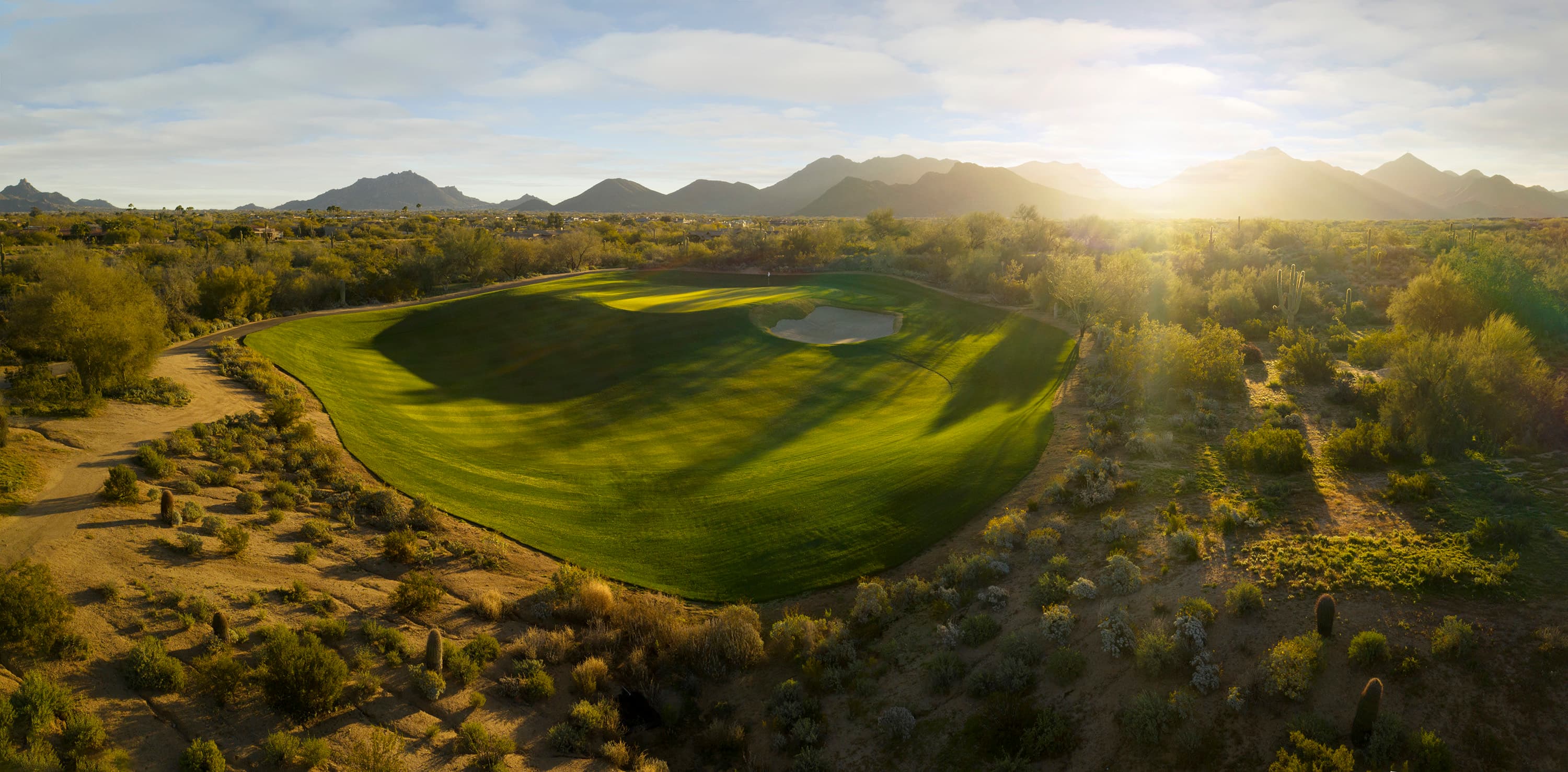
Quintero Golf Club
The forced carries over desert waste areas are the defining feature of the design, and the contrast between the irrigated playing surfaces and the surrounding landscape is stark and deliberate. Dye leaned into the visual drama, making the desert itself a hazard. The design works because Dye calibrated the carries to different skill levels through multiple tee positions, so that the desert is a genuine threat for every golfer, not just for those playing from the back tees.
Pete Dye's Stadium Course at PGA West is the most famous example of this approach.
The Paiute courses outside Las Vegas, also designed by Dye, apply the same philosophy to a flat desert floor with the Spring Mountains as a backdrop. The three courses on the Paiute reservation are entirely manufactured landscapes, with every contour, every water feature, and every piece of turf placed by the design team. The desert surrounding the maintained surfaces is untouched, and the boundary between golf and desert is sharp.
The Naturalist Response
The second generation of desert architects took a different approach. Rather than treating the desert as an obstacle to be carried over, they treated it as a partner. We-Ko-Pa's Saguaro Course, designed by Coore and Crenshaw on Fort McDowell Yavapai Nation land, routes through the desert with minimal disturbance to the native vegetation. The saguaro cactus, ironwood, and palo verde trees that surround each hole are not planted. They were there before the course, and the routing was designed to preserve them.
The Saguaro Course irrigates only the fairways and greens, leaving the rough as transitional areas of maintained Bermuda grass that gradually give way to native desert. The effect is a course that sits within its landscape rather than on top of it. The strategic implications are significant: the boundary between playable and unplayable is not a hard line but a gradient, and golfers must decide how much desert they are willing to challenge on each shot.
Troon North's Monument Course, designed by Tom Weiskopf and Jay Morrish, achieves a similar integration with more dramatic terrain. The course is routed through boulder-strewn hillsides at the base of Pinnacle Peak, and the natural rock formations serve as both visual landmarks and strategic elements. The boulders are not decoration. They redirect shots, block sight lines, and create the kind of visual reference points that help golfers orient themselves in a landscape that can otherwise feel featureless.
Turf Science and Water Management
The turf grasses used on desert courses have evolved substantially over the past three decades. Early desert courses used ryegrass, which requires heavy irrigation and struggles in extreme heat. Modern desert courses use varieties of Bermuda grass during the summer months, which tolerate heat and require less water, then overseed with ryegrass in October for the winter playing season when temperatures moderate and the summer grass goes dormant.
This transition, known as overseeding, is a significant operational event. Courses typically close for two to three weeks in October while the ryegrass establishes. The transition back to Bermuda in late spring is less dramatic but equally important for maintaining playing surfaces through the summer. The result is that desert courses look and play differently in different seasons: lush and green during the winter playing season, brown and firm during the summer months when the Bermuda grass is dormant or the ryegrass has burned out.
Water reclamation is now standard practice. Most Scottsdale and Palm Springs courses irrigate entirely with reclaimed water, using treated effluent from municipal water systems. This addresses the ethical dimension of watering golf courses in the desert without reducing the volume of water consumed. The next frontier, already being explored at several courses, is the use of saltwater-tolerant grasses and the reduction of irrigated acreage to the absolute minimum needed for playable golf.
Elevation and Microclimate
Desert golf architecture is not limited to flat terrain. The foothills around Scottsdale, the canyons of the Texas Hill Country, and the mountain bases outside Las Vegas provide elevation changes that create microclimates within a single round. Quintero Golf Club, a Rees Jones design northwest of Phoenix, routes through a canyon system where temperature differences between exposed ridgetop holes and sheltered canyon holes can be ten degrees or more.
These elevation changes also affect the golf. Balls fly further in the thin, dry desert air than at sea level, and the effect is amplified at elevation. A drive that carries 250 yards in humid coastal conditions might carry 270 in Scottsdale. Club selection must account for this, and visiting golfers from sea-level locations often find themselves between clubs on approach shots until they recalibrate.
The morning tee time is the desert golfer's most important booking. Courses in Scottsdale and Palm Springs open at dawn during the summer months, and the difference between a 6:30 AM round and an 11:00 AM round is not just comfort but quality of play. The morning light in the desert is low and directional, casting shadows that reveal the contours of greens and fairways. By midday, the overhead sun flattens everything, and the heat distorts the landscape visually as well as physically.
The Future of Desert Golf
Water scarcity will increasingly shape desert golf architecture. Several municipalities in Arizona and Southern California have imposed restrictions on new course construction, and existing courses face pressure to reduce their water consumption. The architectural response is already visible: newer desert courses have smaller irrigated footprints, use more drought-tolerant grasses, and incorporate larger areas of native desert into their designs.
This constraint is producing better golf. Courses with smaller irrigated areas tend toward the firm, fast playing conditions that reward creative shot-making. The reduced footprint forces tighter routings, which improves walkability. The visual contrast between maintained turf and native desert creates a clarity of design that more heavily irrigated courses lack.
The verdict