The Collector's Golf Trip: Playing Every Course at a Multi-Course Resort
There is a particular satisfaction in completionism. Playing one course at a multi-course resort is a visit. Playing all of them is an experience. Each course reveals something about the property, the designers, and the land that a single round cannot convey. The first course tells you what the resort is. The last course tells you what the resort means.
This is a guide to six resorts where playing every course is not merely possible but recommended, where the variety between courses is substantial enough that each round feels distinct, and where the total experience justifies the time and expense of the full collection.
Bandon Dunes, Oregon — 5 courses, 5 nights
The gold standard. Five 18-hole courses by four different architects, all walking only, all on the same stretch of Oregon coastline. Pacific Dunes (Tom Doak) is the one most visitors rank first: eleven ocean-view holes on the cliff edge. Bandon Dunes (David McLay Kidd) is the original, a Scottish-style links that launched the resort in 1999. Old Macdonald (Doak and Jim Urbina) pays tribute to C.B. Macdonald's template-hole philosophy with massive greens and deep bunkering. Sheep Ranch (Coore and Crenshaw) is the newest 18, a bunkerless design on an exposed coastal headland.
Bandon Trails (Coore and Crenshaw) is the outlier, routed through coastal forest and meadows rather than along the ocean.
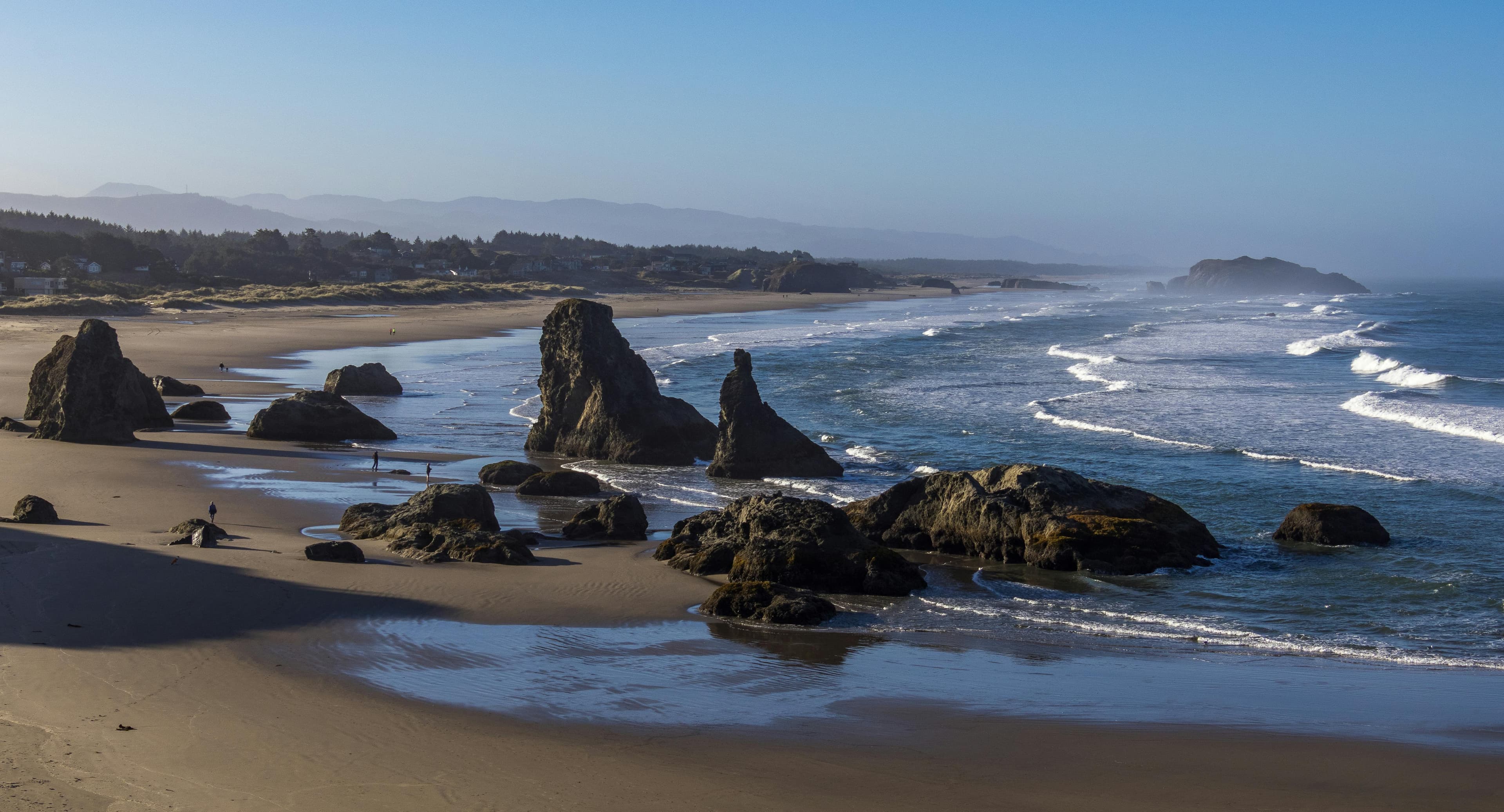
Bandon Trails
Five rounds in five days, walking every step, is physically demanding but entirely achievable for a golfer in reasonable condition. The replay rate (50% off the same-day green fee) creates an incentive to return to your favorite in the evening for a second loop. Add the Bandon Preserve par-3 course and Shorty's 19-hole short course for late-afternoon rounds that use different muscles.
Total green fees (5 rounds, peak, resort guest): approximately $1,650 What the collection reveals: The range of links golf that is possible on a single stretch of coastline, from the clifftop drama of Pacific Dunes to the inland restraint of Bandon Trails.
Explore our Bandon Dunes guide
Sand Valley, Wisconsin — 4 full courses + short courses, 3-4 nights
Sand Valley has grown rapidly since its 2017 opening. The current collection includes the original Sand Valley course (Coore and Crenshaw), Mammoth Dunes (David McLay Kidd), The Lido (Tom Doak, a recreation of C.B. Macdonald's lost masterpiece), and Sedge Valley (Tom Doak, a compact par-68). The Sandbox, a 17-hole par-3 short course, fills the gaps between full rounds.
Four rounds in three to four days is comfortable. The courses share a walking-only philosophy and sandy terrain, but the design approaches differ meaningfully. Mammoth Dunes is wide and welcoming, with fairways that encourage aggressive lines. The Lido is historically precise, recreating holes designed in 1917. Sedge Valley is compact and strategic, packing challenge into sub-6,000 yards.
Total green fees (4 rounds, peak): approximately $1,180 What the collection reveals: How different architects interpret the same sandy landscape, from Kidd's expansiveness to Doak's precision.
Destination Kohler, Wisconsin — 4 Pete Dye courses, 3-4 nights
Every course at Destination Kohler is designed by Pete Dye, which makes the collection a masterclass in a single architect's range. Whistling Straits' Straits Course is lakeside links with over 1,000 bunkers. The Irish Course is its gentler companion on the same property. Blackwolf Run's River Course is parkland golf through the Sheboygan River valley. Blackwolf Run's Meadow Valleys winds through more open terrain.
Four rounds by one designer might sound repetitive. It is the opposite. Dye's ability to produce fundamentally different courses on different terrain is the revelation. The Straits Course plays like a links. The River Course plays like nothing else Dye has designed, with dense forest and river crossings creating a claustrophobic intensity that the lakeside courses never approach.
Total green fees (4 rounds, peak): approximately $1,915 What the collection reveals: The full spectrum of Pete Dye's design philosophy, from exposed lakeside links to dense riverbank parkland.
Big Cedar Lodge, Missouri — 5 courses, 3-4 nights
Big Cedar's collection spans five courses by five different architects: Payne's Valley (Tiger Woods), Ozarks National (Coore and Crenshaw), Buffalo Ridge Springs (Tom Fazio), Top of the Rock (Jack Nicklaus, a par-3), and Mountain Top (Gary Player, a par-3). The variety of designers and formats is the largest on this list.
Three to four days covers the full set comfortably. Start with Payne's Valley, the flagship, then alternate between the full courses and the short courses. Ozarks National, with its exposed ridgeline routing and 400-foot wooden bridge on the 13th, is the architectural highlight.
Top of the Rock, a par-3 course overlooking Table Rock Lake, is the most relaxing round on the property.
Total green fees (5 rounds, resort guest): approximately $1,065 What the collection reveals: How five different architects respond to the same Ozarks terrain, from Tiger's polished championship layout to Coore and Crenshaw's naturalistic approach.
Barefoot Resort, Myrtle Beach — 4 courses, 2-3 nights
Tip
The courses share a North Myrtle Beach setting but differ meaningfully in design philosophy. The Fazio course uses tree cover and lakes. The Love course emphasizes playability and natural wetlands. The Norman course favors bump-and-run approaches. The Dye course is the longest and most difficult, with railroad ties and native grasses in the Dye tradition. Two to three days with a round each morning covers the full set.
Total green fees (4 rounds, peak): approximately $500 What the collection reveals: Four distinct design philosophies at a price point that makes comparison a pleasure rather than an investment.
Reunion Resort, Orlando — 3 courses, 2 nights
Three courses by three legends: Tom Watson, Arnold Palmer, and Jack Nicklaus. The Nicklaus, Palmer, and Watson labels are not honorary. Each course reflects its designer's competitive philosophy. The Watson course rewards accuracy and shot-shaping. The Palmer course is aggressive, encouraging the player to take chances. The Nicklaus course is strategically complex with multiple risk-reward decisions on every hole.
Two nights and three rounds over three days is a compact schedule that covers the complete set. Green fees are competitive for Orlando resort golf, and the villas at Reunion provide comfortable accommodation without the nightly rates of the major resort chains.
Total green fees (3 rounds): approximately $550 What the collection reveals: How three of the greatest players in golf history think about course design, and how their competitive instincts translate into architecture.
The Collector's Mindset
Playing every course at a multi-course resort is not about checking boxes. It is about understanding a place fully. Each course at these resorts was designed to complement the others, to offer something the neighboring courses do not. A single round gives you a snapshot. The complete set gives you the full picture.
The ideal collector's trip includes a rest day or a short-course day between the flagship rounds. Walking 90 holes in five days at Bandon is possible but unnecessary. Walking 72 holes at Kohler with a rest afternoon between the Straits Course and the River Course is more pleasant and produces better golf.
The financial commitment varies enormously. Barefoot Resort's four courses can be played for $500 in total green fees. Kohler's four Pete Dye courses cost nearly $2,000. Both experiences are worth the price. The question is not which resort to choose but which collection appeals to your taste: coastal links, Midwest sand, lakeside Dye, Ozarks wilderness, Grand Strand variety, or Orlando design philosophy.
The verdict