The destination
Branson is known for live entertainment, Silver Dollar City, and the 43,000-acre lake that wraps around the southern edge of the Missouri Ozarks, and golf is rarely the first thing visitors associate with it. That works in your favor. Four courses operating in and around Branson play through terrain that is genuinely distinctive: steep elevation changes carved through limestone ridgelines, dense hardwood forests, and water features fed by Ozark springs. Green fees top out around $165 and start in the mid-thirties. For golfers passing through the region or looking for a trip that combines affordable golf with a substantial off-course program, Branson delivers more than its reputation suggests.
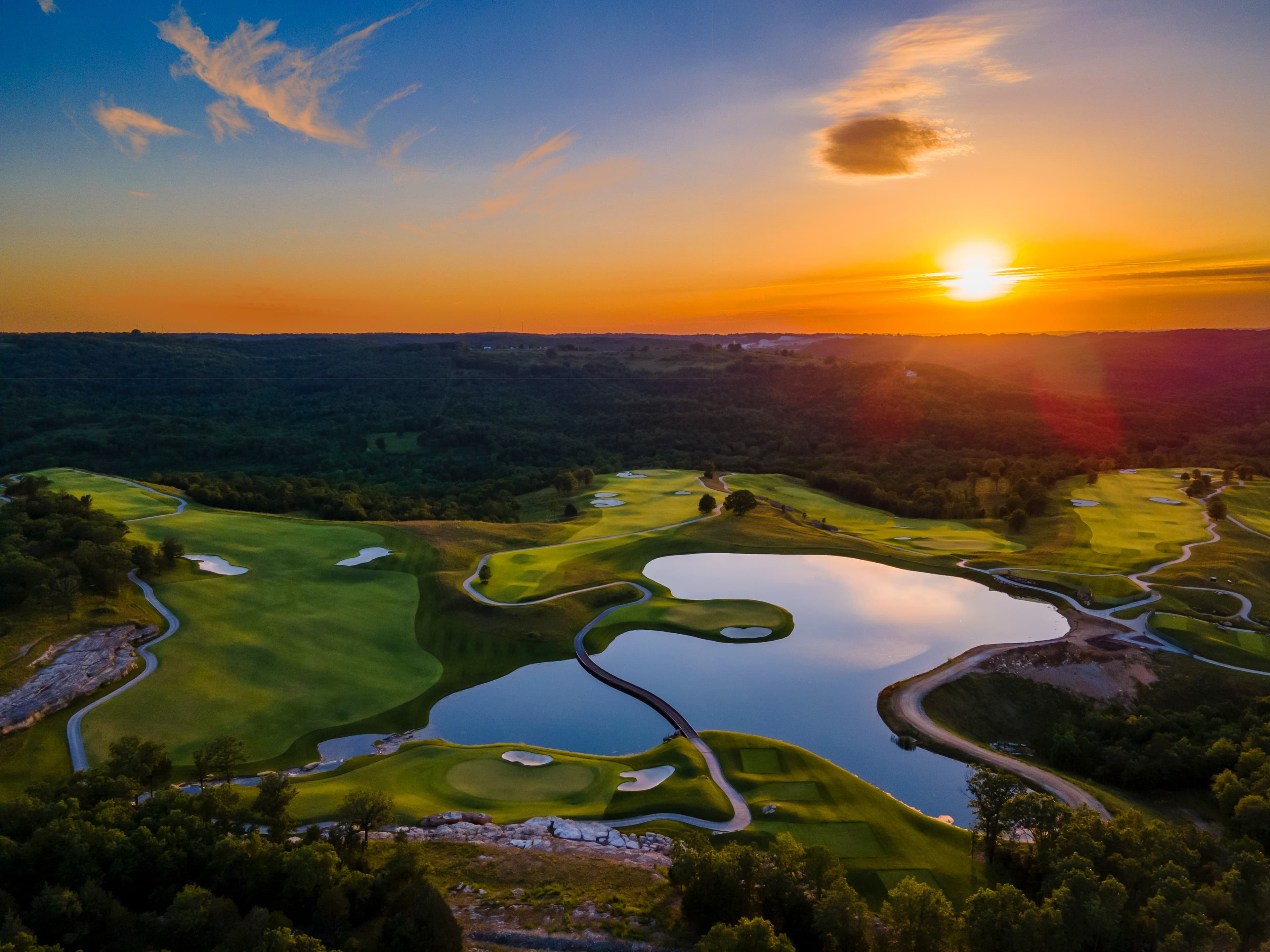
The Ozarks provide the architecture. The hills here are older and more weathered than the Rockies, covered in oak, hickory, and cedar rather than exposed rock, and the courses use the natural topography rather than manufacturing it. Elevation changes of 100 feet or more within a single hole are common. This is hill golf through hardwood forest, and it rewards the player who adjusts to what the land presents.
Where to stay in Branson & the Ozarks, Missouri
Live prices from Booking.com, Expedia and more — every nearby hotel and rental in one search.
Prices and availability from Booking.com, Expedia and others via Stay22. GolfTrailsHQ may earn a commission at no additional cost to you.
The courses
Ledgestone Country Club is the area's premium layout. Tom Clark designed the course in 1994 along the wooded ridgelines near Branson West, with zoysia fairways and bentgrass greens that hold up through the Ozark summer. Six sets of tees accommodate 3,793 to 6,881 yards. At $100 to $160, Ledgestone earns the ceiling of the local market through conditioning and design quality rather than name recognition.
Branson Hills Golf Club is the longest and most physically demanding course in the area. Chuck Smith designed it with Bobby Clampett consulting, opening in 2009 at 7,324 yards from the tips with a slope of 135. The routing runs through rock outcroppings, over creeks, and past waterfalls. This is the course that most surprises first-time visitors to Branson, and at $80 to $165 it competes with courses charging considerably more.
Pointe Royale Golf Course is Branson's original championship layout, an Ault-Clark & Associates design from 1986 with water in play on 12 holes. At $35 to $90, it is the area's strongest value proposition. Thousand Hills Golf Resort, a Robert E. Cupp par-64 executive layout from 1995, anchors the golf-and-stay market through its on-site condo and cabin lodging. The compact routing produces a round that takes less time than a standard 18 but still tests short-game precision on bentgrass greens, and the resort guest discount is roughly 50 percent off published rates.
When to go
April and October deliver the best balance of weather and value: temperatures in the 60s and 70s, fall foliage in October, and the lowest demand of the playable months. Peak runs May through September, with July and August highs in the upper 80s. Most courses close or run reduced hours November through March.
Getting there
Springfield-Branson National Airport (SGF) is the closest commercial airport, roughly 50 miles north of Branson. The drive in is straightforward. For golfers in the Midwest or upper South, Branson is a viable road trip from St. Louis (3.5 hours), Tulsa (3 hours), or Kansas City (3.5 hours). A rental car is required. The four courses are spread across the Branson area, and ride-sharing is impractical for a multi-round trip.
Beyond the course
The entertainment infrastructure that draws millions of visitors annually is the destination's most underrated asset for golf trip planning. Silver Dollar City absorbs a full day with its 1880s-themed park, roller coasters, craftspeople demonstrations, and seasonal festivals. Table Rock Lake supports dinner cruises on the Showboat Branson Belle as well as fishing and water sports. Dolly Parton's Stampede combines a four-course dinner with a 32-horse arena show. The Branson Scenic Railway covers 40 miles of Ozark terrain through tunnels and over trestles inaccessible by road. For groups traveling with non-golfers, this depth of programming matters: the companion who spends a morning at Silver Dollar City and an evening at a dinner show is having a genuine Ozarks experience, not filling time between tee times. Three to four nights is the right window for a full trip.