10 Best Walking-Only Golf Courses in America
The golf cart changed American golf more than any single design innovation of the past century, and not entirely for the better. It accelerated pace of play and made courses accessible to players with mobility limitations, both genuine benefits. But it also disconnected golfers from the land they were playing, turned the walk between green and tee into a windshield experience, and enabled course routing that prioritised real estate over playability. The courses on this list reject that trade-off. They require walking, and in doing so they preserve something essential about the game.
Walking-only policies are not nostalgia. They are design statements. A course built for walkers can use green-to-tee transitions that would be absurd in a cart, route through terrain that carts would damage, and maintain turf conditions that tire tracks would compromise. The result is a playing experience that feels closer to the game's origins while losing nothing that matters. These ten courses prove the point.
Pacific Dunes, Bandon, Oregon
Tom Doak's masterpiece at Bandon is the standard against which all American walking courses are measured. Pacific Dunes plays firm and fast, the way links golf was designed to play, and the absence of cart paths preserves sight lines and ground conditions that would suffer under rubber. Caddies are available and encouraged. The walk itself, roughly five miles through dunes and native grasses with the Pacific as constant companion, is one of the great experiences in American golf.
The routing flows naturally along the Oregon coastline, with thirteen holes offering ocean views and green-to-tee walks that feel like coastal hikes rather than forced marches.
Sheep Ranch, Bandon, Oregon
Sheep Ranch's walking-only policy is not a concession to philosophy; it is a practical requirement. The terrain is too wild, too exposed, and too beautiful for carts. The walk between holes often routes along the cliff edge, and the absence of any man-made intrusion beyond the golf holes themselves creates an experience that feels genuinely wild. The course plays fast, the turf is firm, and the walking is invigorating in every weather condition, including the sideways rain that Bandon delivers without apology.
The most exposed course at Bandon, with 13 holes directly along the Pacific and no protection from the coastal wind.
Old Macdonald, Bandon, Oregon
Tom Doak and Jim Urbina's tribute to C.B. Macdonald's template holes provides the most walkable routing at Bandon, with wide fairways, enormous greens averaging over 10,000 square feet, and gentle terrain that makes the five-mile walk feel effortless. Old Macdonald is the course at Bandon that non-golfers could enjoy as a spectator walk, and the strategic width means that the walking golfer is constantly choosing angles rather than simply hitting to a target. The Redan, the Biarritz, the Cape: these template holes were designed a century ago for walking golfers, and experiencing them on foot connects the modern player to the game's architectural traditions in a way that arriving by cart simply cannot. Old Macdonald proves that walking-only golf does not require coastal drama. It requires intelligent design and respect for the pedestrian experience.
Sand Valley, Nekoosa, Wisconsin
The original course at Sand Valley, designed by Ben Crenshaw and Bill Coore, plays through sandy glacial terrain in central Wisconsin that provides the firm, fast conditions that make walking pleasurable. The routing takes advantage of natural ridges and valleys, and the sand underfoot provides drainage that keeps the course playable even after rain. The walk is quiet, the terrain is rolling without being exhausting, and the sandy soil means the turf conditions reward the ground game that walking golfers tend to favour.
Mammoth Dunes, Sand Valley, Wisconsin
David McLay Kidd's design at Sand Valley is the widest course in America, with fairways that average 80 yards across. The width makes Mammoth Dunes one of the most enjoyable walking courses for players of all abilities, because the generous landing areas eliminate the punishing rough that turns walking rounds into search parties. The sandy terrain is gentle on the legs, the views across the Wisconsin sand barrens are expansive, and the course's scale creates a sense of space that cart golf cannot replicate. Walking Mammoth Dunes takes roughly four hours, which is faster than most cart rounds at other courses.
The Lido, Sand Valley, Wisconsin
Tip
Streamsong Red, Streamsong, Florida
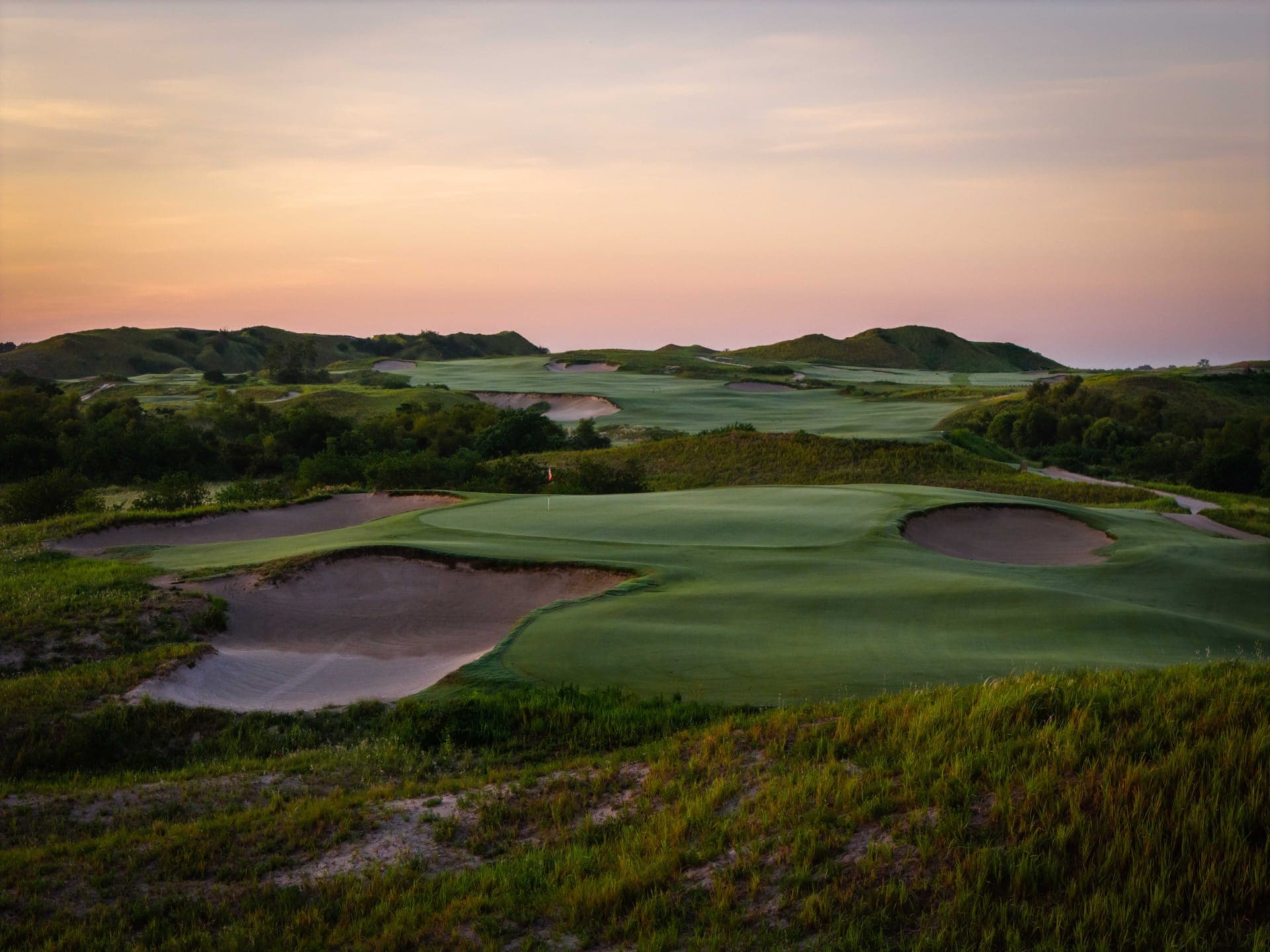
Tom Doak's first Streamsong design is not technically walking-only (carts are available), but it was designed for walkers and plays best on foot. The routing through former phosphate mining land produces elevation changes that are rare in Florida, and the sandy terrain provides the firm turf that makes walking comfortable. Streamsong Red encourages walking through its caddie programme and course design, and golfers who walk it discover undulations and ground-game options that are invisible from a cart. The resort's culture tilts firmly toward walking, even if it does not mandate it.
Streamsong Blue, Streamsong, Florida
Tom Doak's second Streamsong course is slightly more aggressive in its topography than Red, with deeper bunkers and more pronounced ridgelines. Like Red, Blue was designed with walkers in mind, and the caddie programme supports the walking experience. The walk between the 9th green and the 10th tee, through native grassland with no cart path in sight, captures the essence of what walking-only golf provides: a transition that belongs to the landscape rather than the infrastructure.
Bandon Trails, Bandon, Oregon
The inland course at Bandon, designed by Ben Crenshaw and Bill Coore, routes through dune forest and meadowland rather than along the coast. The walking experience is different from Pacific Dunes or Sheep Ranch: quieter, more enclosed, with the sound of wind in the trees replacing the sound of surf. Bandon Trails demonstrates that walking-only golf does not require ocean views to justify itself. The intimacy of the forest routing, where each hole feels private and self-contained, is something that cart access would fundamentally alter.
Kingsley Club, Kingsley, Michigan
A private club that accepts limited outside play through reciprocal arrangements, Kingsley Club occupies rolling terrain in the Northern Michigan interior and maintains a strict walking-only policy. Mike DeVries designed the course to flow with the natural topography, routing through hardwood forest and across sandy ridges that would be scarred by cart traffic. The walk reveals contours and strategic options that are invisible from any distance, and the absence of cart paths means every sightline is uninterrupted. Kingsley Club is quiet, understated, and deeply committed to the idea that golf is best experienced at three miles per hour. The course has no bag drop, no halfway house, and no concessions to golfers who view walking as an inconvenience. It is not for everyone, and it does not pretend otherwise.
Why Walking Matters
The case for walking-only golf is not sentimental. It is architectural. Courses designed for walkers use the walk between holes as part of the experience, route through terrain that rewards ground-level observation, and maintain turf conditions that benefit from the absence of cart traffic. The golfer who walks processes the course differently: they read slopes with their feet, judge distances with their eyes rather than a GPS screen, and arrive at each shot having physically earned the right to play it.
Streamsong Red
The verdict