The Best Golf Courses for High Handicappers
The myth that great courses require great ball-striking to enjoy is exactly that. Several of the finest courses in America are designed with enough width, enough forgiveness, and enough strategic variety that the 18-handicapper has as rich an experience as the scratch player. The difference is philosophical: the courses on this list reward smart play over powerful play, provide multiple routes to the green, and penalise mistakes proportionally rather than catastrophically. A ball 20 yards offline should find trouble, not oblivion.
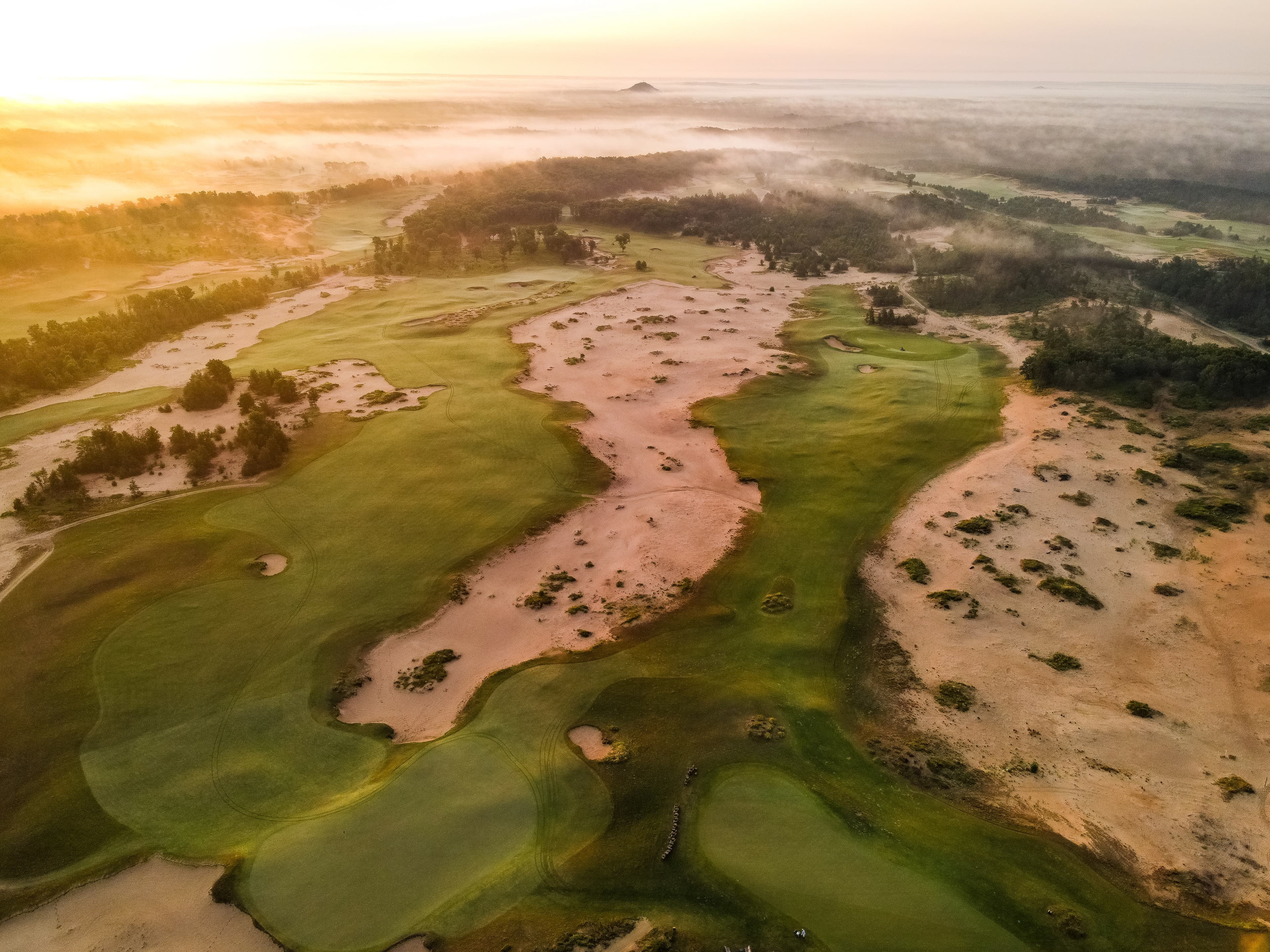
1. Mammoth Dunes, Sand Valley, Wisconsin
Fairways averaging over 60 yards wide. David McLay Kidd designed the width deliberately: it creates strategic options for the low handicapper while eliminating the "lost ball every other hole" experience for everyone else. The green complexes are the equaliser, demanding precision from all skill levels, but getting to the green is genuinely accessible.
That single statistic explains why Mammoth Dunes is the best course in America for the high handicapper who wants to play a nationally ranked layout.
2. Old Macdonald, Bandon, Oregon
The widest course at Bandon Dunes, with fairways and greens scaled to C.B. Macdonald's original template designs. Greens average over 10,000 square feet, which means the approach shot has an enormous target. The strategic depth comes from pin position and the contours within the green, not from the difficulty of reaching it. Old Macdonald is the Bandon course that the high handicapper should play first, and the one they will likely enjoy most.
3. Talking Stick (North Course), Scottsdale, Arizona
Coore and Crenshaw designed the North Course with minimal rough and wide fairways on flat desert terrain. Green fees are among the lowest in the Scottsdale market for a course of this design pedigree.
The high handicapper will find their ball on nearly every tee shot, and the strategic interest comes from the angle of approach to the green rather than the penalty for missing the fairway.
4. Caledonia Golf and Fish Club, Pawleys Island, South Carolina
At roughly 6,500 yards from the tips and significantly less from the forward tees, Caledonia does not overwhelm with length. Mike Strantz's bunkering is dramatic but the fairways are generous, and the overall experience, from the live oak entrance to the Lowcountry finish, is so beautiful that the scorecard becomes secondary. This is the course that makes high handicappers fall in love with golf architecture.
5. Papago Golf Course, Phoenix, Arizona
A municipal course at a municipal price, with the buttes of Papago Park as a backdrop. The William F. Bell design is honest and accessible: wide fairways, reasonable green complexes, and a pace of play that reflects its local-golfer orientation. Papago proves that quality and accessibility are not competing values. The high handicapper will enjoy this course as much as the PGA Tour professionals who use it for qualifying rounds.
6. Ross Bridge, Birmingham, Alabama
The RTJ Trail's flagship plays long from the back tees (over 8,100 yards), but the forward tees reduce the course to a manageable length without compromising the strategic interest. The wide fairways and the lake views are available at every tee-box option, and the green fee under $80 means the high handicapper can afford to come back and play it again.
7. Kapalua (Bay Course), Maui, Hawaii
Arnold Palmer designed the Bay Course as the more accessible of Kapalua's two layouts, with wider fairways and gentler contours than the Plantation Course above it. The ocean views are equally stunning, and the trade winds are less severe at the lower elevation. The Bay Course is the Maui round for the high handicapper who wants the Hawaiian golf experience without the Hawaiian golf humiliation.
8. Barefoot Resort (Love Course), North Myrtle Beach, South Carolina
Davis Love III designed the Love Course at Barefoot Resort with playability in mind. The marsh-side routing provides visual interest, and the fairways are generous by Myrtle Beach standards. The course is well-maintained, the pace of play is manageable, and the overall experience rewards the golfer who enjoys the setting as much as the challenge.
9. Orange County National (Panther Lake), Orlando, Florida
Two 18-hole courses, both designed to accommodate a broad range of abilities. Panther Lake routes through wetlands and native terrain with fairways wide enough to keep the high handicapper in play. The conditioning is strong, the green fees are reasonable, and the proximity to Orlando's accommodation market makes it an easy add-on to any central Florida trip.
10. Shanty Creek (The Legend), Bellaire, Michigan
Arnold Palmer designed The Legend at Shanty Creek with the resort golfer in mind: forgiving off the tee, scenic throughout, and enjoyable regardless of skill level. The northern Michigan setting provides the kind of summer golf experience that makes the scorecard irrelevant: cool breezes, long days, and mountain views that improve with every hole.
The Width Principle
The verdict
Mammoth Dunes